Pillar II — Geometric: arrangement fixes length
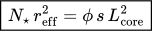
The rotational core capacity identity N_★ r_eff²=φ s L_core² fixes the effective core length exactly once the arrangement is specified. The published cross-regime audit reproduces to 3×10⁻¹², the identity itself to 10⁻¹⁵. [DERIVE]
The rotational core capacity identity N_★ r_eff²=φ s L_core² fixes the effective core length exactly once the arrangement is specified. The published cross-regime audit reproduces to 3×10⁻¹², the identity itself to 10⁻¹⁵.
Pillar I gives the equations. Pillar II makes the first sharp statement about form: once the arrangement of a rotational core is specified, its effective length is fixed by an accounting identity. We then audit, across four flow regimes, exactly when a single length is an adequate summary of the arrangement and when it is not—turning the question "does this flow have a core radius?" into a measurable, reproducible diagnostic.
The rotational core capacity identity (RCCI)
Let an Okubo–Weiss–type criterion define a core mask  of area
  .
Let
.
Let  be the strong-rotation blobs inside , with areas
 and equivalent radii
 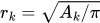 . Define the RMS-equivalent radius,
the filling fraction, and the shape factor by
. Define the RMS-equivalent radius,
the filling fraction, and the shape factor by

RCCI — arrangement fixes the effective length
[LOCK]/[DERIVE]. By construction  , hence
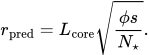
The same identity in any dimension
Written in terms of volumes rather than areas, (eq.) is dimension-free:
 , where
  is the effective
cell volume and
is the effective
cell volume and  the core volume in
  dimensions. This is the form
that recurs across the document—it is the capacity identity verified in
dimensions. This is the form
that recurs across the document—it is the capacity identity verified in
 in Section §10 (U2), and it is literally the
genome-condensate identity
in Section §10 (U2), and it is literally the
genome-condensate identity  of
Section §11 (E1). The geometric pillar is therefore not a
two-dimensional accident; it is a single packing law, instantiated here in two
dimensions. The fill fraction
of
Section §11 (E1). The geometric pillar is therefore not a
two-dimensional accident; it is a single packing law, instantiated here in two
dimensions. The fill fraction  that enters the identity is, moreover,
the same control knob whose marginal value the companion bundle
measures for the substrate (
that enters the identity is, moreover,
the same control knob whose marginal value the companion bundle
measures for the substrate ( –
– at
at
 ; see E1 of Section §11 and the numeric-adjacency
non-claim of Section §14).
; see E1 of Section §11 and the numeric-adjacency
non-claim of Section §14).
Why this is the geometric face of the thesis. The four numbers
 are a complete coarse description of the
arrangement of strong rotation inside the core: a length, how full the
core is, how non-circular it is, and how many sub-cores pack into it. The
identity says that the radius an independent observer would measure is not free:
it is fixed by the arrangement. The single number
are a complete coarse description of the
arrangement of strong rotation inside the core: a length, how full the
core is, how non-circular it is, and how many sub-cores pack into it. The
identity says that the radius an independent observer would measure is not free:
it is fixed by the arrangement. The single number  is the
arrangement, compressed. When a real measurement
is the
arrangement, compressed. When a real measurement  departs from
 , the departure is a quantitative statement that the flow
resists compression to one length—i.e. that its arrangement is
multiscale.
, the departure is a quantitative statement that the flow
resists compression to one length—i.e. that its arrangement is
multiscale.
The cross-regime audit and what it reveals
Embedding (eq.) in four regimes turns the identity into a test of when
"one core length" is a faithful summary. The arrangement is supplied by an
Okubo–Weiss pipeline (the "A-pipeline"), while is measured by
three independent segmenters (swirling strength  , a
local-circulation
, a
local-circulation  proxy, and a persistence-based method). The
normalized residual
proxy, and a persistence-based method). The
normalized residual

The qualitative picture (respecting the phenomena).
In coherent single-core regimes (tropical cyclone, ocean eddy) the prediction
tracks the measurement to a few percent and the residuals stay small: a
one-length description is adequate, so the arrangement is well summarized by a
single scale. In dense two-dimensional turbulence the errors become order unity,
the rank correlation between and turns
negative, and the residuals develop heavy tails: no single core length is
adequate, because the arrangement is genuinely multiscale (filaments and merging
events). The multi-vortex surrogate sits in between, with a  penalty that is visible and method-dependent. This ordering—coherent
  multi-core filamented—is exactly the ordering a configurational view
predicts: the more the arrangement refuses to collapse to one cell, the more the
one-length summary fails.
multi-core filamented—is exactly the ordering a configurational view
predicts: the more the arrangement refuses to collapse to one cell, the more the
one-length summary fails.
| Regime |  |  | rel. med. |  | Spearman  |
|---|---|---|---|---|---|
| Tropical cyclone |  |  |  |  |  |
| Ocean eddy |  | |  |  |  |
| TC multi-vortex |  |  |  |  |  |
| 2D turbulence |  | |  |  |  |
 , and the
 –
– ,
,
 )
)  ) is the
audit's robust conclusion. All reproduced by
) is the
audit's robust conclusion. All reproduced by The single most telling entry is the negative rank correlation in two-dimensional turbulence. It is not noise: it concentrates in frames with elongated, strain-dominated filaments and vortex mergers, where the Okubo–Weiss mask fuses several interacting vortices. In other words, the geometric breakdown of the one-radius description is the spatial signature of the enstrophy cascade—the same fragmentation of coherent cores into filaments that, in Pillar §9, carries the forward enstrophy flux onto thin vorticity-gradient events. The geometric pillar and the dissipative pillar are thus reading one physical process from two angles: when the arrangement stops being a single cell (Pillar II's residual blows up), it is precisely because it is cascading enstrophy to small scales through filamentary events (Pillar §9's flux concentration). That two independent diagnostics locate the same transition is a coherence check on "form follows arrangement."
Pillar II — the geometric identity and its audit (verify_rotcore.py)
Recomputation from the sample-level table (4800 samples; 12 case method
groups of 400) against the published audit tables.
method
groups of 400) against the published audit tables.
- Identity check.
 holds to a maximum relative error of
  across all 4800 samples.
PASS (Equation (eq.) is satisfied to floating-point.)
across all 4800 samples.
PASS (Equation (eq.) is satisfied to floating-point.) - Robust metrics. Median relative error, MAPE, MAE, NRMSE and
Spearman for every group reproduce the published table to a worst-case
relative mismatch of
 . PASS
 - Identity residuals. Median/mean of (eq.) per group
reproduce the published residual table (e.g. 2D turbulence: median
 –
– , mean
  –
– ; coherent cores: single to low tens of
percent). PASS
; coherent cores: single to low tens of
percent). PASS
python verify_rotcore.py <data_dir> on the frozen sample table.Reading the residuals as a configuration diagnostic.
The gap between the median and the mean residual is a measure of how heavy the
tail is—i.e. how often the arrangement produces a frame in which a single
length is badly wrong. Small gap (coherent cores) means the arrangement is
reliably single-cell; large gap (2D turbulence under the shear-sensitive
proxy) means rare but extreme multiscale events. This is the sense in
which the residual is not a "model error" so much as a quantitative
complexity parameter of the arrangement.
What Pillar II does not claim
The RCCI is a kinematic sum rule, not a dynamical law: it does not predict how a core evolves, and it introduces no constitutive relation. Its content is exactly that the effective length is fixed by the arrangement, and that departures are measurable. The audit's conclusions are stated as a regime/method ordering, which we expect to be robust to reasonable changes of error metric, rather than as absolute percentages.
Pillar II, in one line. Once the rotational arrangement
is fixed, the effective core length is fixed by an
exact identity ([DERIVE]), reproduced to  ; the cross-regime audit
(reproduced to
; the cross-regime audit
(reproduced to  ) measures exactly when one length is enough and when the
arrangement is irreducibly multiscale.
) measures exactly when one length is enough and when the
arrangement is irreducibly multiscale.