Demonstration I: radiocarbon
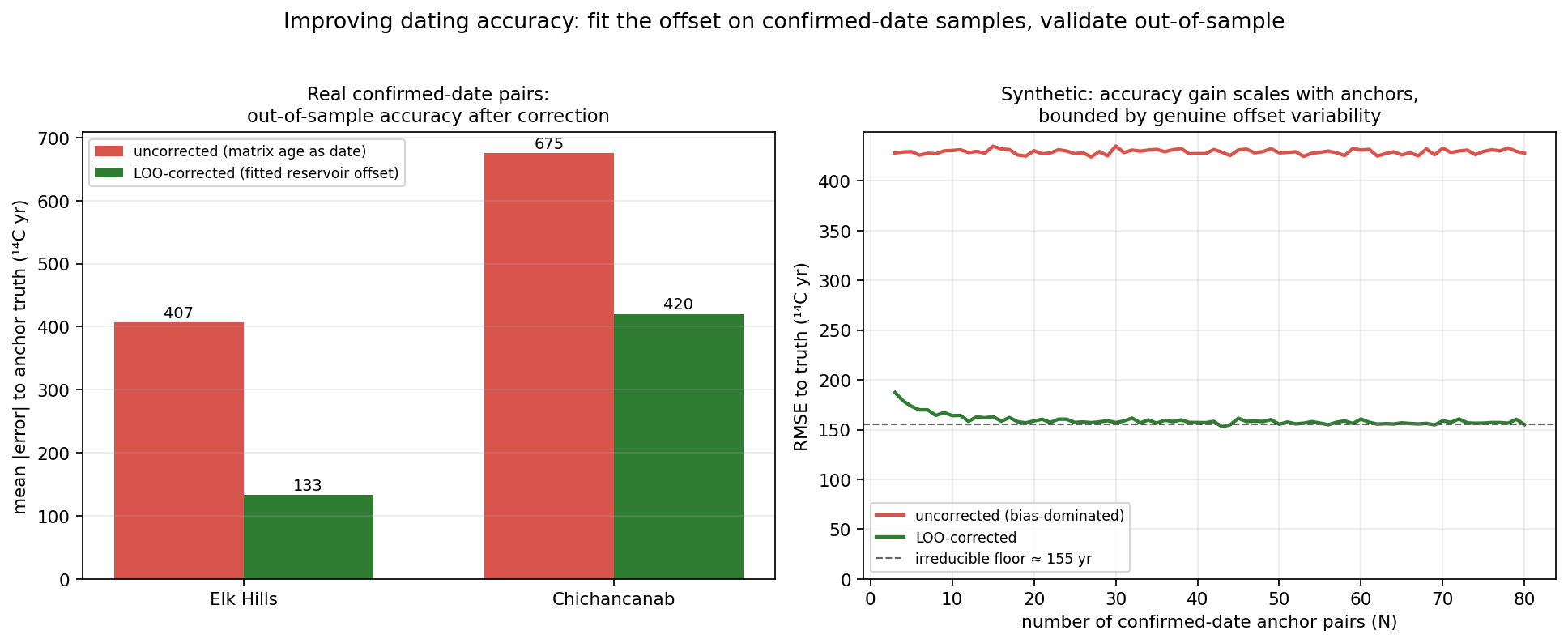
Leave-one-out cross-validation tests the reservoir correction out-of-sample on independently constrained radiocarbon pairs. On Elk Hills shell–charcoal it cut RMSE 418 → 141 yr (66%); on Lake Chichancanab leaf-wax / macrofossil pairs, 739 → 453 yr (39%). The smaller gain is the point: it flags the locality-dependent transferability that the protocol is designed to report.
Leave-one-out cross-validation tests the reservoir correction out-of-sample on independently constrained radiocarbon pairs. On Elk Hills shell–charcoal it cut RMSE 418 → 141 yr (66%); on Lake Chichancanab leaf-wax/macrofossil pairs, 739 → 453 yr (39%). The smaller gain is the point: it flags the locality-dependent transferability of a reservoir offset, the caveat the protocol requires reporting.
The companion paper’s reservoir correction was tested by leave-one-out (LOO) cross-validation on published, independently constrained radiocarbon pairs. [F] On the Elk Hills shell–charcoal series the correction reduced the root-mean-square error 418 → 141 yr (a 66% reduction); on the Lake Chichancanab leaf-wax/macrofossil pairs it reduced RMSE 739 → 453 yr (39%). The smaller Chichancanab gain is itself informative: it signals limited transferability of a locally estimated reservoir offset, exactly the caveat the protocol requires reporting. [I]