Demonstration II: Lava Creek zircon
Applied to the Lava Creek Tuff zircon dataset, the protocol splits grains by crystal position: faces give 626.5 ± 2.9 ka, cores 668.8 ± 3.2 ka. Faces reproduce the published rim age exactly and agree with two independent anchors (~631 ka eruption; MIS tephra ~630 ka) at the ~1% level; pooling biases the eruption age ~42 ka old.
Applying the protocol to the published 183-grain Lava Creek Tuff zircon dataset, grains are split by crystal position (age-independent): faces (autocryst) give 626.5 ± 2.9 ka, cores (antecryst) 668.8 ± 3.2 ka. The face age reproduces the published rim age exactly and agrees with two independent anchors (~631 ka eruption; MIS 16–15 tephra ~630 ka) at the ~1% level. Pooling faces and cores would bias the eruption age ~42 ka old.
We applied the protocol to the published grain-level zircon U–Pb dataset for the Lava Creek Tuff (LCT) supereruption[3], comprising 183 SHRIMP-RG analyses with ²³⁰Th-corrected ²⁰⁶Pb/²³⁸U dates, common-Pb fractions, crystal-position labels (crystal faces vs. interiors/cores) and stratigraphy. [F]
Classifying strictly by crystal position—faces are the last-grown material and therefore closest to eruption; cores grew earlier—yields the populations in Table 2.
| Population (by position) | n | Weighted mean | Interpretation |
|---|---|---|---|
| crystal faces (autocryst) | 70 | 626.5 ± 2.9 ka | eruption estimate |
| cores (antecryst) | 62 | 668.8 ± 3.2 ka | older — pre-eruptive, excluded |
| inter-zone | 25 | 649.8 ka | intermediate growth |
| EBT (separate unit) | 26 | 769.3 ka | not LCT — excluded |
The face population reproduces the published rim age of 626.5 ± 5.8 ka exactly, confirming both the analysis and the integrity of the source data. [F] Two independent anchors agree at the ~1% level: the published eruption age of ~631 ka, and the occurrence of distal LCT tephra at the Marine Isotope Stage 16–15 transition (~630 ka)—a stratigraphic constraint entirely independent of U–Pb[3]. [I]
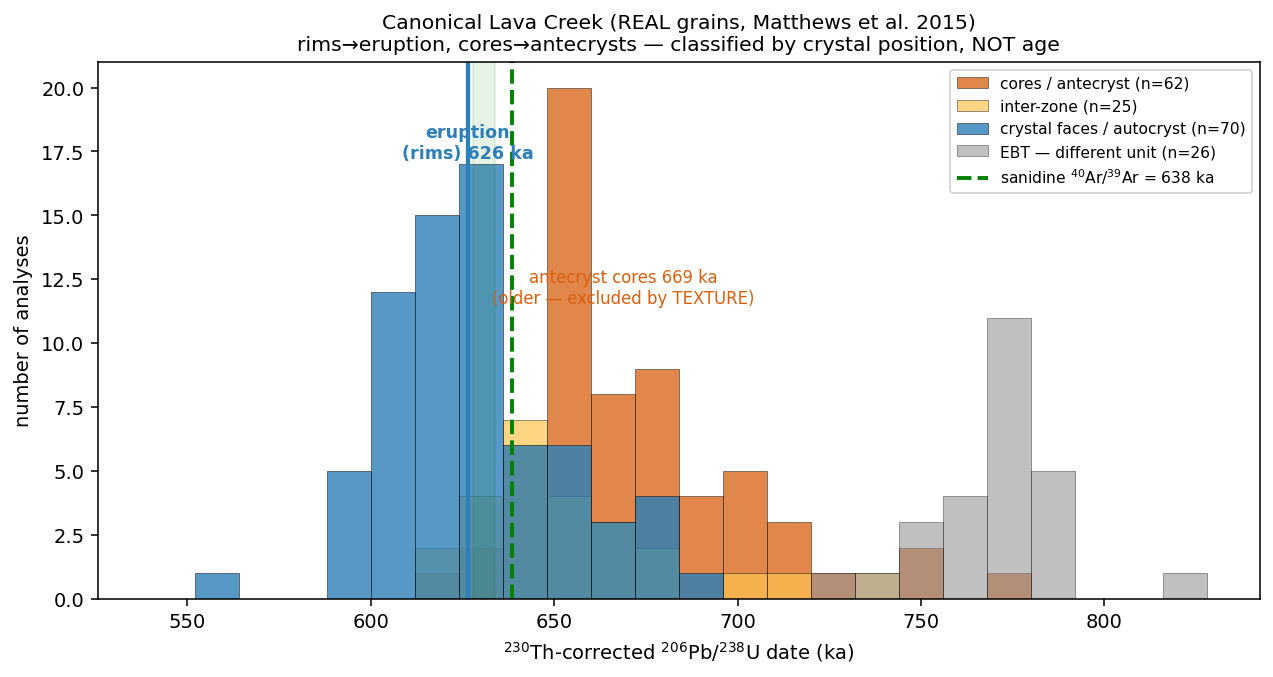
Honest caveats. (i) The sanidine ⁴⁰Ar/³⁹Ar value used here as a quick cross-check (≈638 ka, all-fusion weighted mean of dataset S2) was not reduced with proper step-heating/plateau and outlier criteria; the published curated sanidine eruption age is ~625–631 ka. The robust anchors are the faces (626.5 ka), the published eruption age (631 ka) and the MIS tie (~630 ka). [A] (ii) Classifying faces vs. cores is reliable only when CL texture and chemistry are unambiguous; where they are not, the assignment can fall back on age, which is the genuine residual vulnerability discussed in §11—see the independent near-rim dataset that places LCT crystallisation at 658.8 ± 6.6 ka[4].