Mass: U_lat→ m_H/mₚ/mₑ
Mass: U_lat→ m_H/mₚ/mₑ: One energy feeds all masses — defined once, referenced everywhere. The bracket 2π is α/δ — derived, with the old π² confusion on record. This chapter derives the mass scales m_H,mₚ,mₑ from the lattice unit energy U_lat in the main body. Grade [F] forced.
One energy feeds all masses — defined once, referenced everywhere. The bracket 2π is α/δ — derived, with the old π² confusion on record.
Purpose (promotion to the main text)
This chapter derives the mass scales m_H,mₚ,mₑ from the lattice unit energy U_lat in the main body. Mass-related derivations that were previously dispersed into appendices (E/P/M/R, etc.)—electron mass, proton mass, Higgs mass, and ratio cross-checks—are promoted into the main text so that the definition–derivation–verification (Gate) flow closes consistently inside the main body without duplication.
Deliverables (definitions/derivations/verification items)
The deliverables of this chapter are fixed as the following five bundles.
- Definition of U_lat and its realization locks (linked to the Chapter 11 realization values a,Δ t).
- Operational definition of mass (geometric resistance / effective cross-section / integral coefficients) and type-specific mass formulas.
- Derivation of m_H (including the coefficient 5π) and numerical evaluation.
- Derivation of mₚ (including the link to core radius Rₚ and λ_C) and numerical evaluation.
- Derivation of mₑ (including the electron canonical event rate / radius rₑ) and numerical evaluation.
For each deliverable, the main text explicitly records (i) which LOCK items it depends on, (ii) which closure(s) are used, and (iii) which Gate(s) must be passed to grant conclusion status.
Inputs (LOCK) and prohibitions (no external justification)
The derivations in this chapter use only the following inputs.
- Realization length a and realization time step Δ t (locked in Chapter 11).
- Core radius Rₚ and selected length L_q=λ_C (locked in Chapter 6).
- Stationary constants α,δ (locked in Chapter 5) and canonical event rates (locked in Chapter 9).
- PASS-qualified outputs of the 82+7 discrete structure verification (Chapter 8).
This chapter does not use external texts (equations from other theories, external constant definitions, or external justifications) as grounds for mass derivations. Comparisons to external numerical values are recorded only as Gate metrics; they are not used to justify definitions or derivations.
Scope of promoted missing-gap reinforcements (declaration)
The following missing-gap reinforcements are promoted into the main text in this chapter.
- Electron-mass derivation: a derivation that links the electron canonical event rate ν_e,can=1 and the definition of rₑ to the mass coefficient.
- Proton-mass derivation: a derivation that computes the mass scale from an integral coefficient coupled to Rₚ and core invariants (4/π, etc.).
- Higgs-mass derivation: a derivation that computes m_H from U_lat and the effective cross-section coefficient (5π).
- Ratio cross-checks: a section that defines dimensionless ratio invariants such as m_H/mₚ, mₚ/mₑ, and verifies them using RCROSS and a Gate stack.
These items are no longer split into appendices; each closes by definition–derivation–verification in the main text.
Gate structure (conditions for conclusion status in this chapter)
All numerical conclusions in this chapter (m_H,mₚ,mₑ and ratios) require PASS of the following Gate stack.
- G-SYM: no symbol/unit/diameter–radius meaning conflicts.
- G-LOCK: consistent input
lock_idand snapshot sealing. - G-REG: regime consistency (realization regime / canonical-event-rate regime).
- G-STR: structural inputs (82+7, cancellation–survival) are in
PASSstate. - G-RCROSS: realization cross-consistency of a,Δ t is
PASS(required). - G-REP: reproducibility package reproduces the same results.
- G-NT: no violation of the no-post-tuning rule.
If a Gate is not PASS, the result is not promoted to a main-text conclusion; only a limited conclusion (CT-LIM) is permitted.
13.1 Definition of Uₗat=hc/a=1958.7GeV (single source of truth)
Concept links: U_lat feeds the Higgs mass m_H=U_lat/(5π) in §13.3; full mass chain §13.13.1.1 Purpose (single-source declaration)
This section fixes the lattice unit energy U_lat as a definition and provides the unique source of truth (SSOT) of U_lat for the whole document. Redefining or re-deriving U_lat outside this section is forbidden. Outside this section, only referencing (S13_01_Ulat_def) is allowed.
13.1.2 Inputs (LOCK): h, c_ref, a, and unit-conversion constants
U_lat is defined only when the following four inputs are locked.
13.1.2.1 Action-unit constant h (locked)

h is the action-unit constant used in this document's unit system; its value/unit must be locked in canon_lock.
13.1.2.2 Reference speed constant c_ref (operational anchor, locked)

c_ref is the operational-anchor constant locked in §11.1; it must be locked in realization_lock together with its channel/scope/protocol.
13.1.2.3 Realization length a (VP diameter, locked)

a is the realization length locked in §11.2 and must be locked together with geometry_meaning=diameter.
13.1.2.4 Energy-unit conversion constant (locked)
To use GeV as the reporting unit, this section locks the following conversion constant.

Equation (S13_01_GeV_to_J) is a unit-conversion convention; its value/unit must be locked in protocol_lock.
13.1.3 Definition: Uₗat (lattice unit energy)
Define the lattice unit energy U_lat as
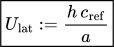
In the definition (S13_01_Ulat_def), h has dimension J· s, c_ref has dimension m/s, and a has dimension m, hence
![\begin{equation} [h\,c_{\mathrm{ref}}/a] = (\mathrm{J\cdot s})(\mathrm{m/s})/\mathrm{m} = \mathrm{J} \end{equation}](/physics/eq/physics/phy-13-005.svg)
and the dimension of U_lat is fixed as energy.
13.1.4 Numerical evaluation: J→GeV
13.1.4.1 Computing hc_ref
From (S13_01_h_lock) and (S13_01_cref_lock),

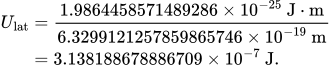
13.1.4.2 The J value of Uₗat
Substituting (S13_01_hc_value) and (S13_01_a_lock) into (S13_01_Ulat_def),
13.1.4.3 The GeV value of Uₗat
From (S13_01_GeV_to_J),
![\begin{equation} U_{\mathrm{lat}}[\mathrm{GeV}] = \frac{U_{\mathrm{lat}}[\mathrm{J}]}{1.602176634\times 10^{-10}\ \mathrm{J/GeV}}. \end{equation}](/physics/eq/physics/phy-13-008.svg)
Substituting (S13_01_Ulat_J) into (S13_01_convert_to_GeV),
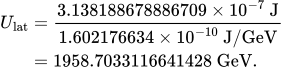
If the significant-figure (rounding) convention is locked, the reported value is fixed as

13.1.5 Prohibitions on derived manipulation (no redefinition/absorption/post-tuning)
Fix the following prohibitions for U_lat.
- No redefinition: do not define U_lat by another formula outside this section, and do not swap symbols while keeping the same meaning.
- No re-derivation: do not repeatedly expand (S13_01_Ulat_def) in “derivation” form outside this section (only referencing is allowed).
- No absorption: do not absorb coefficients or geometric terms in downstream mass/force derivations into the definition of U_lat so as to change the definition structure.
- No post-tuning: do not post-hoc modify the values of a, c_ref, h, or (S13_01_GeV_to_J) to match target numbers. Changes are allowed only via versioning.
- No substitute constants: do not substitute a different speed constant for c_ref, or a different action constant for h (within the same version).
If any violation is detected, U_lat and all derived conclusions that use it lose conclusion status.
13.2 Mass = resistance (σₑff): axiom/definition
13.2.1 Purpose
This section gives an operational definition of “mass” in the form of resistance (effective cross-section) σ_eff without external justification, and fixes the mass-computation/measurement procedure as a loggable protocol. The outputs of this section are: (i) the mass–resistance axiom, (ii) the standard-form mass definition, (iii) a recipe for computing σ_eff, and (iv) Gate criteria.
13.2.2 [A] Mass = resistance axiom (operational axiom)
In this document, mass is fixed as “the resistance encountered when the lattice unit energy U_lat passes through a given structure.”
[A-13.2-1] Mass–resistance correspondence axiom
For an object O, the mass scale m(O) is fixed to satisfy
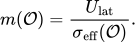
Here U_lat is the lattice unit energy locked as SSOT in §13.1, and σ_eff(O) is the effective cross-section (resistance) of O.
Meaning of the axiom (formal)
Equation (S13_02_mass_axiom) does not introduce “mass” as an independent substance; it fixes mass as an operational quantity defined by the ratio of U_lat and σ_eff. This axiom does not rely on external doctrine; once σ_eff is closed for each object in later sections, the mass is determined.
13.2.3 [D] Definition of σₑff (type classification)
Because the effective cross-section can be defined differently depending on the object type, this section classifies σ_eff into the following three types. The type choice must be locked in analysis_lock and cannot be swapped after seeing results.
(T1) Geometric
The geometric type adopts a “geometric cross-section” as the effective cross-section.

The definition of σ_geom is locked per object (e.g., π Rₚ² for a core radius Rₚ).
(T2) Path-aggregate
The path-aggregate type reduces resistance arising from propagation/path/throat aggregation to an effective cross-section.

Σ_path is defined in connection with percolation/backbone/path closures (Chapter 10) and must be locked in analysis_lock.
(T3) Discrete-cancellation
The discrete-cancellation type reduces the residual of a “cancellation–survival” discrete structure to resistance.

Σ_disc depends on the 82+7 structure verification (Chapter 8), the 3-sector integerization (Chapter 7), and event rates (Chapter 9); its definition must be locked in analysis_lock.
13.2.4 [D] Standard form of mass (units/dimensions/realization link)
13.2.4.1 Dimension of mass
By (S13_02_mass_axiom), the dimension of m is determined by dividing the dimension of U_lat (energy) by the dimension of σ_eff. Since this document reports masses in GeV (or subunits), σ_eff may be defined as a dimensionless “resistance coefficient” (types T2, T3). Therefore we fix the following convention.
[D-13.2-2] Dimensionless-resistance convention
When reporting masses in GeV in this chapter, the effective cross-section must be locked as one of the following.
- Dimensionless cross-section: σ_eff itself is dimensionless (a resistance coefficient), yielding a mass with the same dimension as U_lat.
- Normalized cross-section: if σ_eff has dimension length², it must be normalized by a² or L_q² to become dimensionless before use.
The choice of normalization scheme must be locked in analysis_lock and cannot be changed after seeing outcomes.
13.2.4.2 Standard formula for the normalized-cross-section type
When using a geometric cross-section with dimension length², fix the following standard reduction to a dimensionless resistance.
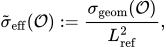
where L_ref is the normalization length (e.g., L_q or a) locked in analysis_lock. Then the mass is
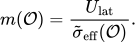
Equation (S13_02_mass_from_sigma_tilde) is the standard mass formula for the normalized-cross-section type.
13.2.5 Procedure to compute σₑff (operational recipe)
This section fixes a common procedure for computing σ_eff. For an object O, σ_eff must follow the flow “definition→aggregation→Gate.”
13.2.5.1 Input log
Computing σ_eff requires the following input logs.
- Object identifiers:
object_idandobject_instance_id. - Geometry/coordinates: Rₚ, L_q, a, and required coordinate sets (e.g., X₈₂, S₇).
- Graph/path data: contact graph, throat graph, backbone (if applicable).
- Event logs: event sets / tick windows / required phases (if applicable).
Input logs must be sealed by manifest+checksums.
13.2.5.2 Calculation recipe (by type)
(T1) Geometric type
- Compute the object radius or geometric boundary under the locked convention (e.g., core radius Rₚ).
- Compute the geometric cross-section by its defining equation (e.g., σ_geom=π Rₚ²).
- If normalization is required, make it dimensionless using (S13_02_sigma_tilde_def).
(T2) Path-aggregate type
- Using the percolation closure (§10.2), compute the effective threshold δ_eff and the backbone E_bb.
- On the backbone, define a path-resistance aggregation (e.g., bottleneck-based sums, max/mean ratios; the definition is locked in
analysis_lock). - Reduce the aggregation to a dimensionless resistance σ_eff (normalization-length choice locked).
(T3) Discrete-cancellation type
- From 7-shell verification (§8.3)
PASS, compute the survival vector V_surv and its partition structure. - From 3-sector integerization (Chapter 7), compute residual directions and label-axis projections (if needed).
- Apply the closure Σ_disc that maps residual magnitude/direction to a resistance coefficient (definition locked in
analysis_lock).
13.2.5.3 Mass computation
Using σ_eff(O) or σ_eff(O) computed by the selected type, compute the mass by (S13_02_mass_axiom) or (S13_02_mass_from_sigma_tilde). The computation log must be sealed; unsealed computations do not receive conclusion status.
13.2.6 Gate (admissibility judgment) and FAIL conditions
σ_eff and m(O) require PASS of the following Gate stack.
- G-SYM: no symbol/unit/normalization-length meaning conflicts.
- G-LOCK: consistent
lock_idfor the input log and seals. - G-REG: consistency of the applied regime (object/path/discrete-structure regime).
- G-STR: structural verification (e.g.,
G-SHELL7-6C1S) isPASS(if applicable). - G-NUM: numerical stability (estimator convergence, iteration agreement).
- G-REP: reproducibility.
- G-NT: no post-hoc changes/selection bias.
The following violations are immediate FAIL.
- Switching the σ_eff type (T1/T2/T3) after seeing results.
- Modifying κ_vp or the normalization length L_ref after seeing results.
- Reporting mass using U_lat or σ_eff without seals.
13.3 Deriving the 5π coefficient → m_H=Uₗat/(5π)
Concept links: input U_lat comes from §13.1; full mass chain §13.13.3.1 Target and symbol fixing
The target of this section is to derive the canonical effective cross-section (resistance)

so that, by the mass–resistance axiom of §13.2,
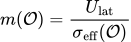
we close

Here H is an object label for the “Stone direct-oscillation mode defined inside the canonical cell (Anchor Cell).” No external justification is used. All numerical values for H are computed only from the internal definition of U_lat and σ_eff(H).
13.3.2 Construction principle of σₑff (channel-sum definition)
This section locks the resistance (effective cross-section) of H by defining it as “a sum of independent constraint channels.”
[D-13.3-1] Channel set and channel count
Define the H mode to be described by the set of constraint channels on the canonical-cell boundary K_H.

κ_H is the “number of independent constraint channels,” and this section derives κ_H=5 (§13.3.4).
[D-13.3-2] Dimensionless cross-section per channel σ₀
For each channel k∈K_H, one may define a geometric channel area σ_geom^((k)). This section defines the dimensionless cross-section per channel by normalizing the channel area by the length scale a as
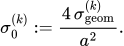
In (S13_03_sigma0_def), a is the VP diameter (realization length) with diameter meaning. Hence a/2 is the derived VP radius.
[D-13.3-3] Composite definition of the effective cross-section
Define the effective cross-section (resistance) σ_eff(H) as
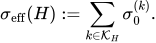
Definition (S13_03_sigmaeff_sum) is the composition convention that “independent channel contributions accumulate by summation”; it cannot be swapped to multiplication/max/other aggregation within the same version.
13.3.3 Deriving the π geometric factor (canonical form of channel area)
This section defines each independent channel of the H mode as an isotropic channel that closes with the same canonical cross-section.
[D-13.3-4] Canonical channel area (disk)
Define the geometric area of each channel k as a disk of VP radius a/2.

Definition (S13_03_sigma_geom_channel) is the canonical channel-area form; it cannot be swapped to another shape post hoc. If the shape is changed, σ_geom^((k)) itself must be changed by versioning.
[D-13.3-5] Value of the dimensionless cross-section per channel
Substituting (S13_03_sigma_geom_channel) into (S13_03_sigma0_def),
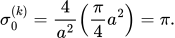
Therefore for all channels,

holds.
13.3.4 Deriving the factor 5 (number of independent constraint channels κ_H=5)
This section derives κ_H from the number of boundary channels of the canonical cell (CELL-CUBE).
[D-13.3-6] Elements of cube-boundary channels
Since the canonical cell is a cube, define the basic candidate set of boundary channels by the six faces:

For each face f∈F, define that a “channel state variable” (e.g., phase/displacement/update count) is recorded as a real number u_f.

[D-13.3-7] Removing a global-reference (gauge) degree of freedom
Inside the canonical cell, an “absolute reference shift” must be treated as observationally invariant. Define the following equivalence relation.

That is, adding the same constant c to all face-channel states is a “global reference shift” and does not increase the number of independent constraint channels of the H mode.
[T-13.3-1] Proposition: the number of independent channels
Under the equivalence relation (S13_03_gauge_equiv), the dimension of the independent channel space is 5.

Proof
Since span1₆ is a 1-dimensional subspace of R⁶,

square
Shared-lemma note. The count (S13_03_dim5) is one instance of the gauge-removal lemma dim(R^N/spanmathbf 1_N)=N-1 (§8.0.6(D), eq. (S08_06_gauge_lemma)): here N=6 faces → 5. The same forced lemma fixes the nucleon exponent (n sectors → n-1, §8.0.5) and the αₑₘ sign-microstate count (7 shells → 2⁶, §14.5.3). The factor 5 is therefore not a Higgs-specific choice.[D-13.3-8] Definition of κ_H (independent channel count)
By (S13_03_dim5), lock the number of independent constraint channels of the H mode as

Definition (S13_03_kappaH_5) is determined by combining the canonical-cell boundary channel candidates (six faces) with the global-reference-removal convention (S13_03_gauge_equiv); it does not change within the same version.
13.3.5 Closing σₑff(H)=5π
Combine (S13_03_sigmaeff_sum) with (S13_03_sigma0_all) and (S13_03_kappaH_5).

Hence (S13_03_sigmaeff_goal) holds.
13.3.6 Closing m_H=Uₗat/(5π)
Substitute O=H into the mass–resistance axiom (S13_03_mass_axiom_ref) and use (S13_03_sigmaeff_5pi).
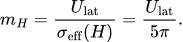
Equation (S13_03_mH_final) is the conclusion of this section.
13.3.7 Numerical substitution (using defined inputs)
If U_lat is locked in §13.1 as

then from (S13_03_mH_final),

The reporting convention (significant figures) is locked in analysis_lock.
Measured value comparison and residual (added v0.2.0).
The PDG-tabulated Higgs boson mass is m_H^exp=125.20± 0.11GeV (CODATA/PDG 2024). Comparing with (S13_03_mH_numeric):

No-tuning fingerprint.
If this paper were tuning numbers, the closure could have been forced to zero by writing m_H=U_lat/(4.98π). We do not. The factor is the clean integer-and-π form 5π, and the residual -0.40% is reported openly: the residual itself is part of the deliverable, not an embarrassment. The same pattern holds for mₚ/mₑ=6π⁵≈ 1836.12 (residual -19ppm from measured 1836.15) and for the predicted proton radius rₚ=D_anch/(6π⁶) (−0.018% vs CODATA 0.8414 fm). (The Coulomb -0.43% is no longer cited here: it was reclassified as overfit in §14.2.) A tuning workflow would never accept a 5π that misses by 0.40%; it would migrate to 4.98π. This refusal to migrate is a structural signature distinguishing geometric derivation from coincidence-fitting (see §1.8 No-Tuning Audit).
13.4 Deriving the proton mass integral (Sₚ)
Status note: the proton mass is a prediction, not a calibration. The single mass-scale calibration node is the electron: mₑc²=2hc/D_anch is the Compton relation that fixes the absolute scale (§13.5.4). The proton mass is not a second calibration. Under LOCK-NU-N (§8.0.5) the proton radius is the derived prediction rₚ=D_anch/(6π⁶), hence λ_C=(π/2)rₚ=D_anch/(12π⁵) and
so mₚ follows from the single anchor D_anch times forced geometry, and the ratio mₚ/mₑ=6π⁵ carries no anchor at all. The resistance integral Sₚ derived below evaluates to the trivial layer count Sₚ=λ_C/a; the realization scale a therefore cancels in mₚ=U_lat/Sₚ=hc/λ_C and plays no physical role here. The integral is bookkeeping, and the physical content is the Compton relation with λ_C derived (not an input). The locked value rₚ=0.8412 fm used numerically below is the +61 ppm cross-check of the LOCK-NU-N prediction (§9.4), retained for arithmetic continuity.
13.4.1 Inputs (LOCK) and purpose
This section assumes the following items are locked.
- Realization length (VP diameter): a (locked in
realization_lockin §11.2). - Core radius rₚ — under LOCK-NU-N (§8.0.5) a derived prediction rₚ=D_anch/(6π⁶), not a free input; the value held in
canon_lock(§2.2) is its +61 ppm cross-check. - π (dimensionless constant, locked in
canon_lock). - Lattice unit energy: U_lat:=dfrachc_refa (SSOT in §13.1).
- Core phase-completion length: λ_C (a length defined in §6.1 and referenceable in
canon_lockwithin the same version).
The purpose of this section is to derive the dimensionless resistance integral (effective cross-section) Sₚ by an internal definition, so as to close the proton mass as

In addition, by the requested condition, the expansion includes λ_C=(π/2)rₚ.
13.4.2 Deriving λ_C=(π/2)rₚ (an algebraic consequence of locked continuum results)
[D-13.4-1] Symbol consistency
In this section the core radius is denoted by rₚ (the derived radius of §8.0.5; see the status note above), and the core-radius symbol Rₚ used in the continuum-core model is treated as the same meaning.

[LOCK-reference] Continuum length-selection result
From the continuum result of §6.2 (locked within the same version),

and from the identification lock of §6.1,

Substituting (S13_04_Lq_eq_lC) into (S13_04_Rp_over_Lq),

Solving (S13_04_Rp_over_lC) for λ_C gives

Finally, substituting (S13_04_Rp_rp) into (S13_04_lC_from_Rp),

Equation (S13_04_lC_from_rp) is an algebraic consequence of locked continuum results; no additional assumption is introduced in this section.
13.4.3 [D] Operational definition of the proton resistance integral Sₚ (length–layer integral)
In this section, Sₚ is defined as “the number of layers (accumulated resistance) obtained by decomposing the core phase-completion length λ_C by the VP diameter a.”
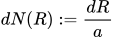
13.4.3.1 Radial accumulated layer count
Define the radial coordinate R on 0≤ R≤ λ_C. Fix one layer thickness to the VP diameter a; then the number of layers (dimensionless) contained in an infinitesimal interval dR is defined as
13.4.3.2 Resistance integral (accumulated layer count) Sₚ
Define the proton resistance integral (effective cross-section) Sₚ by
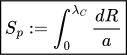
Since a is locked as a constant (realization length) within the same version, the integral evaluates immediately:
![\begin{align} S_p &=\int_{0}^{\lambda_C}\frac{dR}{a} =\frac{1}{a}\int_{0}^{\lambda_C} dR =\frac{1}{a}\Bigl[ R \Bigr]_{0}^{\lambda_C} =\frac{\lambda_C}{a}. \end{align}](/physics/eq/physics/phy-13-046.svg)
Hence

holds.
13.4.3.3 Inserting λ_C=(π/2)rₚ
Substituting (S13_04_lC_from_rp) into (S13_04_Sp_lC_over_a),

That is,

is fixed.
13.4.4 Full expansion of mₚ=Uₗat/Sₚ (definition–substitution–cancellation)
By the mass=resistance axiom/definition of §13.2 (locked within the same version), define

By the SSOT definition of §13.1,
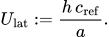
Substitute (S13_04_Sp_lC_over_a) into (S13_04_mp_def) and expand using (S13_04_Ulat_def).
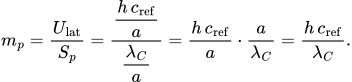
Thus a cancels algebraically in (S13_04_mp_hc_over_lC), and within the same version,
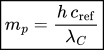
holds.
Substituting (S13_04_lC_from_rp) into (S13_04_mp_closed_lC) to express it in terms of rₚ,
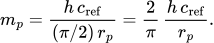
Therefore the final conclusion is equivalently given by the following forms.
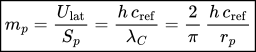
13.4.5 Numerical substitution (using locked values)
All numerical substitutions in this section use only locked values (LOCK).
13.4.5.1 Numerical value of λ_C (from rₚ)
Using the canonical input

we obtain from (S13_04_lC_from_rp)

13.4.5.2 Numerical value of Sₚ
Using the realization length

we obtain from (S13_04_Sp_lC_over_a)

The reporting convention (significant figures/rounding) is locked in analysis_lock.
13.4.5.3 Numerical value of mₚ (using Uₗat)
Let the locked value (reporting unit GeV) from §13.1 be

From (S13_04_mp_def) and (S13_04_Sp_value),
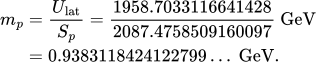
13.4.6 Error / LOCK link (sensitivity)
Since Sₚ=λ_C/a and mₚ=hc_ref/λ_C, sensitivities summarize as follows.
13.4.6.1 Relative sensitivity of Sₚ

Since λ_C=(π/2)rₚ,
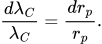
Therefore
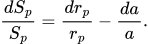
13.4.6.2 Relative sensitivity of mₚ (realization a cancels)
From (S13_04_mp_closed_lC),

That is, when h,c_ref,π are locked within the same version, mₚ is sensitive only to the locked value of rₚ, and a cancels algebraically so it does not enter mₚ directly ((S13_04_mp_hc_over_lC)).
13.5 Deriving the electron mass integral (S) + mₚ/mₑ=2π· νₚ
Concept links: the π-powers here follow the π/2 decoder §5.0; νₚ is the canonical rate of §9.4; mass chain §13. This ratio is a kill-criterion in §1.10.13.5.1 Inputs (LOCK) and targets
This section assumes the following inputs are locked.
- Realization length a (VP diameter,
realization_lock). - Canonical cell length D_anch (canonical input,
canon_lock). - Stationary coefficient δ (locked as δ=1/π² in the universal regime).
- Electron canonical event rate ν_e,can:=1 (locked in §9.3).
- Proton canonical event rate ν_p,can (locked as a value or expression in §9.4).
- Lattice unit energy U_lat (SSOT in §13.1).
- Proton resistance integral Sₚ (derived in §13.4).
The targets of this section are:
- Derive, by an internal definition, the dimensionless resistance integral S that closes the electron mass as

- Fix, as a proposition, the following correspondence in the same locked version:
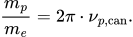
13.5.2 Locked result for the electron radius rₑ (reference to S9.3)
From the electron canonical construction in §9.3, the electron radius is locked as
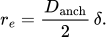
If δ=1/π² is applied in the universal regime,

This section does not re-derive (S13_05_re_lock) or (S13_05_re_univ); it only references them.
13.5.3 [D] Operational definition of the electron resistance integral S (radial integral)
This section defines the electron resistance integral S as “the number of VP layers (accumulated resistance) up to the electron radius rₑ.”
13.5.3.1 Radial accumulated layer count
Define the radial coordinate R on 0≤ R≤ rₑ. Using the VP diameter a as one layer thickness, define the number of layers (dimensionless) contained in an infinitesimal interval dR as
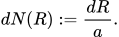
13.5.3.2 Electron resistance integral S
Define the electron resistance integral S by
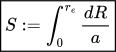
Since a is locked as a constant (realization length), the integral evaluates immediately:
![\begin{align} S &=\int_{0}^{r_e}\frac{dR}{a} =\frac{1}{a}\int_{0}^{r_e} dR =\frac{1}{a}\Bigl[ R \Bigr]_{0}^{r_e} =\frac{r_e}{a}. \end{align}](/physics/eq/physics/phy-13-072.svg)
Hence

holds.
13.5.3.3 Inserting rₑ (canonical cell × stationary coefficient)
Substituting (S13_05_re_lock) into (S13_05_S_re_over_a),
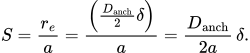
In the universal regime, substituting δ=1/π² gives
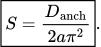
13.5.4 The calibration node: fixing the mass scale through the electron Compton length
This subsection calibrates, it does not predict. The relation mₑc²=2hc/D=hc/λ_(C,e) is the Compton relation, true by construction once D is the electron diameter, and it reproduces 0.511 MeV for that reason. It is the single calibration node of the mass sector—an anchor, not evidence. The predictive mass results are the dimensionless ratio mₚ/mₑ=6π⁵ (which carries no anchor) and the length-in/mass-out Higgs (W.5); this line is where the framework honestly spends its one mass-scale calibration. By the mass=resistance axiom (definition) of §13.2, define the electron mass as
The mass-bearing length is the Compton length, not the event-rate radius.
The mass principle m=hc/λ_C requires the Compton length, which for the electron is
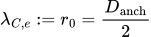
(the same identification as the multi-path route D=2λ_(C,e) of §3.4). The event-rate radius rₑ=r₀δ of §9.3 governs only the electron event rate νₑ=1 (via sₑ=r₀/rₑ=1/δ); it is not the mass-bearing length. Earlier drafts conflated the two, inserting a spurious factor δ=1/π² into mₑ. Running the mass resistance integral to the Compton length, S=λ_(C,e)/a=r₀/a, gives

Therefore within the same locked version,
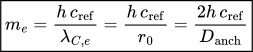
holds, giving mₑ c²=2hc/D=0.511MeV — matching the decoder form mₑc²=2hc/D and the measured electron rest energy.
13.5.5 Deriving the ratio mₚ/mₑ (fixing the correspondence)
From §13.4, the proton mass closes as

Dividing (S13_05_mp_hc_over_lC) by the corrected electron mass (S13_05_me_closed) (both through their Compton lengths),

where λ_(C,p)≡λ_C=(π/2)rₚ and λ_(C,e)=r₀=D_anch/2. Hence the mass ratio reduces to the ratio of two Compton lengths. Now substitute the locked expressions.
13.5.5.1 Linking λ_C and rₚ
In §13.4 and §6.3,

is locked.
13.5.5.2 Linking rₑ and Dₐnch
Clarification (2026-09-28). rₑ = (D/2)δ is the electron’s rectified event radius, the n = 1 case of the n-fold law (§8.0.5). It is not the length through which the electron mass is read. The mass reads through the Compton length λ_C,e = r₀ = D/2, as in the ratio above. The earlier use of rₑ to read mₑ, which gives π² × 0.511 MeV = 5.04 MeV, is retracted (§13.6 and the App. M listing are corrected; script fixed in repro/physics/bundle_v0.4/scripts/verify_appendix_M.py).
In §9.3,
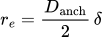
is locked.
13.5.5.3 Closed form of the proton canonical event rate νₚ,can
In §9.4, the proton canonical event rate is locked as

13.5.5.4 Reducing r₀/λ_C to νₚ,can (derived 2π=α/δ)
Substitute λ_(C,e)=r₀=D_anch/2 and λ_C=(π/2)rₚ (S13_05_lC_from_rp) into (S13_05_ratio_re_over_lC):
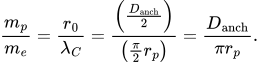
From the canonical event rate ν_p,can=fracD_anch2rₚδ (S13_05_nup_closed),

Substituting (S13_05_Ddelta_over_rp) into (S13_05_ratio_expand),

Thus the proportionality coefficient is the derived ratio of the two rectification constants, 2π=α/δ=(2/π)/(1/π²) — not a convention. (This is the supplement v8 bedrock identity; see the convergence trail in Part II.)
[D-13.5-R] Mass ratio as a derived identity
With the corrected Compton-length electron mass (S13_05_me_closed), the mass ratio is the derived identity
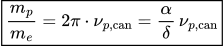
Earlier drafts stated (S13_05_ratio_definition) as a “reporting convention” carrying an unexplained factor of π² relative to (S13_05_ratio_2overpi_nup); that factor was an artifact of using the event-rate radius rₑ=r₀δ (rather than the Compton length λ_(C,e)=r₀) in the electron mass. With the §13.5.4 correction the two equations coincide and no convention is needed. The single canonical value of ν_p,can is fixed by [LOCK-NU-N] in §8.0.5 as ν_p,can=3π⁴, whence

13.5.6 Numerical check
With the canonical ν_p,can=3π⁴ locked by [LOCK-NU-N] (§8.0.5),

the derived identity (S13_05_ratio_definition) gives

13.6 Summary of mass unification
13.6.1 Locked inputs and standard definitions (single source)
[D-13.6-1] Lattice unit energy
When the realization length a, the operational anchor c_ref, and the action-unit constant h are locked, define the lattice unit energy (single source) as
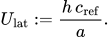
Definition (S13_06_Ulat_def) is not re-derived in this section; redefinition or “substitution-derivation mixing” is forbidden within the same version.
[A-13.6-1] Mass = resistance axiom (operational axiom)
Fix the mass scale of an object O as “lattice unit energy” divided by a “dimensionless resistance (effective cross-section coefficient).”
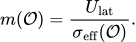
Here σ_eff(O) is the dimensionless resistance (effective cross-section coefficient) for O, and its definition/computation procedure is locked in analysis_lock.
13.6.2 Resistance coefficients for the three masses (unique definition for each)
Fix the resistance coefficients for I:=H,p,e by the following three items.
13.6.2.1 H-resistance coefficient (canonical-cell boundary channels)
The effective cross-section coefficient of the H mode is fixed by the number of independent channels κ_H=5 (six faces minus one global reference degree of freedom) of the canonical cell (CELL-CUBE) and by the canonical channel-area form (disk) as

13.6.2.2 p-resistance coefficient (integral of the core phase-completion length)
When the core phase-completion length λ_C and the realization length a are locked, define the proton resistance integral (dimensionless resistance) as
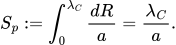
Therefore fix

(Within the same version, if λ_C=(π/2)rₚ is locked, then Sₚ=(π/2)(rₚ/a) is an equivalent expression; however, this section uses only the definition (S13_06_Sp) as the unique source of Sₚ.)
13.6.2.3 e-resistance coefficient (electron-radius integral)
When the electron radius rₑ and the realization length a are locked, define the electron resistance integral (dimensionless resistance) as
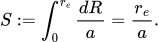
Therefore fix

13.6.3 Theorem (mass unification)
[T-13.6-1] Mass unification theorem
When (S13_06_Ulat_def), (S13_06_mass_axiom), and (S13_06_sigmaH)–(S13_06_sigmae) are locked within the same version, the following holds for I=H,p,e.

In particular, the following three equations hold simultaneously:
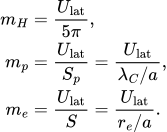
Thus each mass is unified as the outcome of a single lattice energy U_lat differentiated by the object-specific resistance coefficient σ_eff.
Proof
Substituting O=H,p,e into (S13_06_mass_axiom) yields

Since σ_eff(H)=5π is locked by (S13_06_sigmaH), σ_eff(p)=Sₚ is locked by (S13_06_sigmap), and σ_eff(e)=S is locked by (S13_06_sigmae), (S13_06_proof1) reduces to (S13_06_mH)–(S13_06_me). square
13.6.4 Corollary (energy–resistance invariant form)
From Theorem (S13_06_unification_main), the following invariant form holds immediately.

That is, within the same version, U_lat is identically recovered from the product of each mass and its resistance coefficient. This is an equivalent expression of “the mass set m_H,mₚ,mₑ is unified as a differentiation of a single lattice energy U_lat.”
13.7 Cross-checks (ratio invariants) + error reporting
13.7.1 Inputs (LOCK) and symbols
This section assumes that, within the same version (a lock_id combination), the following items are defined.
- Lattice unit energy:

- Mass scales:

- (Dimensionless) resistance coefficients:

- Proton canonical event rate:

All cross-checks in this section are fixed to the construction of ratio invariants that combine the above items along two different routes, and the Gate judgment checks whether the invariant equals 1 (or a locked target value).
13.7.2 Ratio invariants (definition)
Each invariant Iₖ is dimensionless and the target value is fixed as 1.

The list of invariants used in this section is fixed as follows (each definition is completed in §13.7.5).

13.7.3 Deviations (dev) and error budgets (reporting convention)
13.7.3.1 Definition of deviation (dev)
For each invariant Iₖ, define the deviation as

A relative deviation may also be defined (optional) to match reporting units.

This section locks (S13_07_dev_def) as the standard dev; other definitions (e.g., log deviations) are not permitted without versioning.
13.7.3.2 Error-budget convention (locking the choice)
The error budget is locked by one of the following two modes.
- Upper-bound mode (worst-case):
if

then
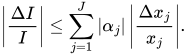
- Root-sum-square mode (RSS):
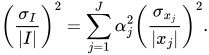
Which mode is used must be locked as analysis_lock.error_budget_mode. If it is not locked, error reporting is INCONCLUSIVE.
13.7.3.3 PASS condition with error (optional)
When using an error budget, lock one of the following two conditions in analysis_lock (choose one).
- Fixed-threshold judgment:

- Error-normalized judgment:

dev_(max,k) or z_(max,k) must be pre-registered in gate_lock; post-hoc changes are forbidden.
13.7.4 Ratio Gate template (three-tier judgment)
Each invariant Iₖ is judged by Gate using the same template.
13.7.4.1 Tier-1: definition/lock completeness
Tier1 is PASS iff all of the following are satisfied.
- All required inputs for Iₖ (U_lat,m_*,S_*,ν_p,can, etc.) exist.
- They belong to the same
lock_idcombination (or a pre-registered allowed combination). - Outputs and logs are sealed by
manifest+checksums+registry_snapshot.
If anything is missing, judge INCONCLUSIVE. If post-hoc changes or lock mixing is detected, judge FAIL.
13.7.4.2 Tier-2: deviation threshold
When Tier1=PASS and dev is definable, judge Tier-2 as

13.7.4.3 Tier-3: robustness (rerun/window-splitting) consistency
Perform Tier-3 only when a rerun set Rₖ=r₁,…,r_K is locked. Let the invariant in each rerun be Iₖ^((j)) and define

The robust threshold dev^(rob)_(max,k) is locked in gate_lock.

If the rerun set is not locked, Tier-3 is INCONCLUSIVE.
13.7.4.4 Final Gate combination
Define the final Gate for each invariant Iₖ as

13.7.5 Ratio list (invariants) and Gate definitions
13.7.5.1 Fixing invariant definitions (route A / route B)
Fix the following invariants by definition.
(ItextsubscriptUH) Uₗat–m_H cross-check
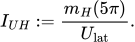
(ItextsubscriptUp) Uₗat–mₚ cross-check
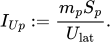
(ItextsubscriptUe) Uₗat–mₑ cross-check
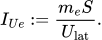
(ItextsubscriptHp) m_H/mₚ resistance-form cross-check
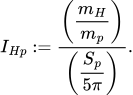
(ItextsubscriptHe) m_H/mₑ resistance-form cross-check
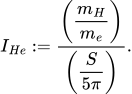
(Itextsubscriptpe) mₚ/mₑ resistance-form cross-check
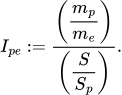
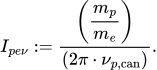
(Itextsubscriptpeν) mₚ/mₑ event-rate correspondence cross-check
By the correspondence convention (locked standard form), define
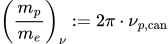
and
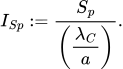
(ItextsubscriptSp) direct-form cross-check for Sₚ (optional)
When the core-length link is locked within the same version (e.g., λ_C=(π/2)rₚ), define
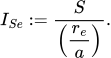
(ItextsubscriptSe) direct-form cross-check for S (optional)
When the electron-radius link is locked within the same version (e.g., S=rₑ/a), define
13.7.5.2 Gate-ID list (per invariant)
Each invariant is judged under the following Gate IDs.

Each Gate follows the template (S13_07_gate_final). The individual thresholds dev_(max,k) and (optional) dev^(rob)_(max,k) must be pre-registered in gate_lock.
13.7.6 Standard FAIL/INCONCLUSIVE labels
Ratio judgments use the following label system.
| Label | Meaning |
| INCON-RATIO-MISSING | missing required inputs (mass/resistance/event rate/energy) |
| INCON-RATIO-UNSEALED | missing seals (manifest/checksums/registry_snapshot) |
| FAIL-RATIO-LOCKMIX | mixing different lock_id combinations |
| FAIL-RATIO-DEV | devₖ>dev_(max,k) |
| FAIL-RATIO-ROB | robust-threshold violation |
| FAIL-RATIO-RETRO | post-hoc modifications detected (threshold/definition/estimator/correspondence convention) |
13.7.7 Error-report record (to be sealed)
For each invariant, generate and seal the following record.
ratio_report:
  - ratio_id: (unique)
    name: I_UH | I_Up | I_Ue | I_Hp | I_He | I_pe | I_peNU | I_Sp | I_Se
    value: (I_k)
    dev: (abs(I_k-1))
    method: fixed_threshold | sigma_normalized
    thresholds:
      dev_max: ...
      dev_rob_max: ...
      z_max: ...
    error_budget:
      mode: worst_case | rss
      sigma_I: ...
      components: { ... }      # optional (relative-error terms per input)
    tiers:
      tier1: PASS|FAIL|INCONCLUSIVE
      tier2: PASS|FAIL|INCONCLUSIVE
      tier3: PASS|FAIL|INCONCLUSIVE
    verdict: PASS|FAIL|INCONCLUSIVE
    labels: [...]
    lock_refs:
      canon_lock_id: ...
      realization_lock_id: ...
      analysis_lock_id: ...
      gate_lock_id: ...
      protocol_lock_id: ...
    snapshot_refs:
      manifest_ref: ...
      checksums_ref: ...
      registry_snapshot_ref: ...
If snapshot_refs is missing, the result is not granted conclusion status.