Force: lattice tension, the 1/r² Green-function form, and the EM-sector status (what is forced, what is measured input)
Force: Charge is the bookkeeping of one synchronized rotation; the coupling size is honestly measured. The vacuum-stiffness story is cross-examined against the Casimir 1/d⁴ law. Scope: this section gives the physical origin of electric charge and of the electrostatic (Coulomb) sector from the synchronized rotation of quanta. Grade [F] forced.
Charge is the bookkeeping of one synchronized rotation; the coupling size is honestly measured. The vacuum-stiffness story is cross-examined against the Casimir 1/d⁴ law.
14.0 The rotational origin of charge and electromagnetism (genesis → Coulomb)
Scope: this section gives the physical origin of electric charge and of the electrostatic (Coulomb) sector from the synchronized rotation of quanta. It grounds, in one generation picture, the integer structure (§8.0.5), the mass ratio mₚ/mₑ=6π⁵ (§13.5), the electron clock νₑ=1 (§12), and the Coulomb constant of §14.1–§14.3. Magnetism/radiation (the vector sector) and the cosmological consequences are explicitly out of scope and flagged as open. Quantitative pieces inherit the grade of their host section; the genesis dynamics are [H] (hypothesis) pending the open items in §14.0.6.
14.0.1 Premise and physical grounding
Quanta and “energy ⇒ rotation”.
The objects are quanta whose sole degree of freedom is rotation (the rotating volume element D=ℓ_rot, §3.4). A quantum that receives energy can only store it as rotation, so energy input forces rotation. This is grounded in established physics: photon collisions create matter (γγ→ e^+e^- pair production; E=mc²), and photons carry helicity ±1 (circular polarization = a rotating field). The framework's “mass = rotation/resistance” axiom (§13.2) is the statement that the created rest energy is this rotation.Synchronization ⇒ a common axis.
In the jammed plenum (strong coupling, no voids) the coupled rotators phase-lock — a Kuramoto-type synchronization forced by strong coupling — and orientationally align onto one axis. The premise is therefore not arbitrary: all quanta share one rotation axis because they are synchronized. This is what upgrades a local rotation sense into a globally defined, conserved charge: a common axis hat z gives a global angular momentum L_z and a global +/- comparison. (The orientational axis-alignment, beyond phase-locking, is the residual ordering noted in §14.0.6.)Primordial balance.
The primordial state is a balanced ensemble of clockwise and counter-clockwise rotators (illustratively, 1000 CW + 1000 CCW) at near-light speed. Equal CW/CCW = globally neutral by construction; this supplies the global neutrality that the source picture of §14.0.5 requires.14.0.2 Genesis of the nucleon structure
Strong rotation condenses quanta into three rotating bodies of 27=3³ each (the three sectors). The cubic integer lattice cannot be cleanly divided into three equal sectors — its natural symmetry is 4-fold and a 3-fold partition is frustrated — so gathering the three bodies inward leaves one irreducible central unit (the rotation that necessarily forms where the three meet), giving the core count

where 81=3⁴ is exactly the number of integer-lattice points with R²≤6 (independently verified) and the +1 is the central rotation. This 82 is the neutron core (charge-neutral; the most uniform 3-partition is 82=28+27+27, Δ_(max)=1) and carries essentially all of the nucleon mass (§8.0.5, §13.2).
Just beyond the core a number-theoretic gap appears: the shell R²=7 is empty (Legendre three-square theorem, 7≠ a²+b²+c² — verified). The active sites are the eight concave body-diagonal pockets on the core surface, in the directions (±1,±1,±1) at radius √6, i.e. the non-integer positions

These are genuine concave gaps (no integer lattice point lies on a body diagonal at R²=6 — verified): there is room on the core surface for sub-quanta to sit. A full-size quantum cannot fit such a gap; only a contracted (“shaved”) sub-quantum does — and contraction under confinement is exactly what a hyper-rotating core does in a stiff, inviscid medium (the force-reversal / contractile-equilibrium mechanism, P_shock/σ_cent≈10² for M_rotgtrsim1; Lee, Prediction of Force-Reversal Conditions for Contractile Equilibrium in Hyper-Rotating Cores, 2025, DOI 10.5281/zenodo.17650685). This is the physical origin of the “large core quanta vs. small shell/electron quanta” split (§14.0.4). One pocket is the inflow zone (the open nozzle / C₃ pole); its occupant is ejected (the electron seed), leaving seven:

The neutron leaves these pockets empty (neutral); the proton fills seven of them (charged).
Status (geometry vs.dynamics).
Through 82 the construction is geometric and firm: 81= the R²≤6 integer-lattice count, the +1 central rotation, and the empty R²=7 Legendre gap. The step to 89 is weaker and should be read as “there is space for the shell,” not as a reproduced result: the eight √6 body-diagonal gaps demonstrably exist, but which seven are occupied, which one is the inflow/ejection site, and the neutron-empty vs. proton-filled selection are not emergent from any simulation — no script integrates the rotating bodies, and the existing 82+7 codes are static, hand-set constructions (a Monte-Carlo over the alternative R²=8 integer nodes gives a near-uniform survivor and mostly three survivors, not the hand-set 6+1 at 135^∘). The shaving itself is physically grounded by the contractile-equilibrium mechanism above; what remains open is the full many-body, CW/CCW, near-c rotating simulation that would make 89 emergent rather than merely accommodated. See §14.0.7.Occupancy selection: full-simulation observation status and recovery items (added v0.5.0; operator request).
The operator's historical full-physics simulation is reported to have exhibited the occupancy settling itself: in that run the seven sites were filled dynamically — small quanta lodging in the concave body-diagonal pockets precisely because the pocket space is small and concave (a geometric-capture mechanism: a sub-pocket-scale quantum inside a concavity gains contacts and loses escape room, so under the always-inward inflow it stays). That code is not open; under the v34 rule this is operator testimony, not evidence, and the canonical status above is unchanged: occupancy remains accommodated, not emergent. The difficulty of upgrading it is structural, not accidental: the deciding simulation is a many-body, near-c, CW/CCW rotating run at quantum resolution — the same computational-wall family quantified in §17.4.4 — so a Python-class reduced reproduction cannot adjudicate the settling claim either; “hard to prove” is here a resource statement, not an evasion. Recovery items (mirroring R1–R4): (R-OCC1) recover the occupancy-run specification and logs; (R-OCC2) a law-level reduced demonstration that is within reach — a static capture comparison showing that a sub-pocket quantum in a concave √6 pocket has strictly more contacts and deeper inflow-pressure binding than at any convex/face site (this would upgrade the mechanism to [V]{} while leaving emergence open); (R-OCC3) the full rotating many-body run under registry discipline. Until then, the formal selector remains the locked Select closure of §8.2.5.2.
14.0.3 Charge as uncancelled rotation; the proton–electron pair
The six ring points form three antipodal pairs whose rotations cancel (§8.0.3); the net is one uncancelled unit at the open nozzle. Hence the proton carries net charge +1 — a single “hole” of uncancelled rotation. Its complement, the quantum ejected from the opposite (antipodal) side of the same body-diagonal axis, is the electron: sharing the same axis but ejected to the opposite end, its rotation is exactly reversed, giving charge -1.
- Sign = rotation sense (CW/CCW), i.e. the ΔΦ direction of §14.3.2.
- Exactness of the opposition follows from the shared axis (the premise): the electron is the recoil complement, so L_z is conserved exactly, L_z(p)=-L_z(e).
- Conservation / pair creation = conservation of L_z about the common axis; charge is created only in ± pairs.
14.0.4 Why the proton is heavy and the electron light — and why |qₑ|=|qₚ|
Mass and charge decouple because they track different things:
| determined by | consequence | |
| mass | size/resistance of the structure (large sub-quantum blocks vs. a bare unit), §13.2 | proton heavy, electron light; ratio 6π⁵ |
| charge | rotation sense at the universal near-c speed (structure-independent) | |qₑ|=|qₚ| exactly |
Proton heavy.
The 82 core members are large sub-quantum blocks (SQ, §6.4); large blocks present a large effective cross-section/resistance σ_eff (§13.2), hence large mass.Electron light.
The electron is a single small unit ejected from a large quantum, rotating fast. A small, fast rotor traces a large Compton clock equal to the parent radius, λ_(C,e)=r₀=D/2, so
(the corrected electron mass of §13.5.4); a large λ_C means small mass. Strictly, the electron is two aspects: (i) the fast-rotating unit that carries the charge (one universal-c rotation unit), and (ii) a single annihilation event per second, νₑ=1 — the electron clock of §12 (event-rate radius rₑ=r₀δ, §9.3) which also sets its (tiny) inflow.
Why electron and not antiproton.
Creating a proton costs 6π⁵ times more energy than an electron (E=mc²); that energy is what condenses the n=3, 89-member dressed structure, while the charge-balancing partner is the cheapest available -1. Because only charge (L_z) is conserved here — not a separate baryon number — the cheapest balancer is the bare electron (p+e^-≈ 938.8 MeV) rather than an antiproton (p+bar p≈ 1876 MeV). Thus the same fact wears three faces:![\begin{equation} \text{``proton harder to make''}\;=\;E=mc^2\ \text{ratio }6\pi^5\;=\;(n{=}3)\ \text{vs}\ (n{=}1)\ \text{[LOCK-NU-N]}\;=\;\text{dressed vs bare}. \end{equation}](/physics/eq/physics/phy-14-004.svg)
Charge and gravity are decoupled: the 82-core is gravitational, not electromagnetic.
A sharp separation follows from the above. Electromagnetism is the rotation that crosses the host quantum's boundary to a neighbour — quantized to one unit (proton: net +1 at the nozzle; electron: -1), universal and independent of internal count. Gravity/mass is the 82-core's quantum annihilation: every nucleon annihilates lattice quanta as a localized sink, and because the jammed plenum forbids voids (no empty space may form), surrounding quanta must flow inward to fill the deficit — that always-attractive inflow is gravity (F∝ Q/r² from the sink Green's function; root cause §17.4.0, cap §17.4). The source strength Q is the annihilation rate: νₚ=3π⁴≈292s⁻¹ and νₑ=1s⁻¹ (§12), consistent with mₚ/mₑ=2πνₚ=6π⁵. The 82-core therefore governs mass and gravity, not charge: the proton and neutron share the same 82 core, hence nearly equal mass and identical inflow, and the neutron — having no boundary-crossing nozzle — is electrically neutral. Consequently the ratio 89/82 is a gravity/mass-sector quantity (it tracks the mₙ≈mₚ core, not charge) and does not belong in the electromagnetic coupling; see the correction in §14.2. The neutron is not perfectly EM-silent: its internal (angularly twisted) nucleon rotation occasionally leaks past the host boundary, producing a weak residual electromagnetism — the neutron magnetic moment μₙ≠0 and its non-trivial internal charge distribution, despite zero net charge.14.0.5 The electrostatic force from the synchronized phase field
A charge is a quantized rotational source (pump) of the lattice deficit/phase field φ; quantization is combinatorial (integer carrier count, §14.3.2), not a phase topology (a 3D U(1) phase has no point monopoles). The synchronized lattice stores phase-strain energy

with κ_φ the phase stiffness (∝ A, the measured amplification of §11.6). The force between charges is F=-dE/dr:
- Why a force exists: two sources' fields superpose, the stored strain energy depends on separation, and the medium relaxes it — E_int=kq₁q₂/r. Sign rule: like sources ⇒ repel, opposite ⇒ attract (the electrostatic, positive-definite strain structure — not the relativistic-scalar convention).
- Why 1/r²: a fixed source flux diluted over the 4π r² shell (Gauss = Poisson Green's function, §14.1/§14.3.1); in d dimensions F∝ r^(-(d-1)), so d=3 gives 1/r².
- Why long-range (unscreened): synchronization spontaneously breaks a global U(1) (the common phase), giving a massless Goldstone mode ⇒ infinite-range 1/r². (Were the U(1) gauged, its breaking would Higgs the mediator massive and short-ranged; long-range EM requires the broken symmetry to be global, so “EM here” is a global-Goldstone force, a departure noted in §14.0.6.)
- Coupling magnitude: the elementary charge is one boundary-crossing rotation unit (universal, §14.0.4), so the EM coupling carries no nucleon-structure factor. Its magnitude is the fine-structure coupling itself: K_C=kₑ e²=α_emħ c, where α_em is taken from measurement (it is not derived in this framework — see the status note of §14.5). The earlier A^(-1/2)hc form (§14.2) used the jamming amplification A — a gravity/mass-sector quantity (it sets the proton mass and the §11.6 stiffness–inflow equilibrium) — and is superseded; likewise 89/82 is gravity-sector (§14.0.4), not electromagnetic.
14.0.6 Magnetism and the vector sector (mathbf E along the light direction, mathbf B at 90^∘)
The same rotating-quantum medium supplies the vector (magnetic/radiative) sector. The organizing statement is the familiar one: the electric field is the force directed along the light (propagation) direction; the magnetic field is the force directed at 90^∘ to it. Both originate from one fact — the rotational output of a charge is twisted relative to the surrounding synchronized quanta, because the charge's rotation axis differs from theirs. The sense of that twist fixes the charge sign (±); its propagation is the field.
Light emphis the electromagnetic wave (one object, not two).
In this framework light is unambiguously an electromagnetic wave, and it is the same displacement–twist object as the electric/conduction field — not a separate substance. What distinguishes “electricity,” a radio wave, and a γ-ray is only (a) the propagation angle χ (longitudinal χ→0 to transverse χ→90^∘, §10.9) and (b) the medium threaded. Light is nearly — not exactly — transverse: χ≈89.9^∘ in the visible band, a small and falsifiable departure from the textbook exactly-transverse wave (§10.9). This near-identity is the whole content of “light = EM wave” here.Electric field = VP displacement (polar), carried along the light direction.
Identify mathbf E with the VP displacement field mathbf u. Its longitudinal part (∇·mathbf u, compression = deficit) is the static Coulomb field of §14.0.5; its transverse, propagating part is light — the transverse oscillation of rotating quanta. Crucially, light does not travel straight: it advances at the lattice angle χ (a sine-wave path, §10.9, sinχ=λ/mD), and the electric force emerges along that angled propagation. The motion has two equivalent descriptions: follow one quantum and it advances/displaces along the angled path χ (“VP transport,” the particle-following view); watch the lattice and a vibration is relayed cell-to-cell while each quantum only swings locally (“quantum-vibration transmission,” the wave view). These are one motion seen two ways — exactly as following a single water particle differs from watching the water wave — and the same duality spans the longitudinal conduction limit (χ→0) and the transverse radiation limit (χ→90^∘).Magnetic field = rotational twist (axial), at 90^∘.
A charge whose axis is aligned with the common axis emits a pure radial (Coulomb) field and no magnetic field. A misaligned (twisted) or moving charge tilts its axis relative to the local common axis; the propagation of that twisted-rotation region, transverse to the light direction, is the magnetic field. The tilt scales with the motion, v/c, giving |mathbf B| (v/c)|mathbf E| — the standard motional/relativistic relation.Consistency win (polar vs.axial).
A displacement is a polar vector and a rotational twist is an axial (pseudo)vector — exactly the transformation characters of mathbf E (polar) and mathbf B (axial). The picture predicts why mathbf B is a pseudovector (it is a rotation), not merely that it exists — a check the static Coulomb picture cannot supply.Permanent magnets and the absence of monopoles.
A permanent magnet is a population of electron rotations that are aligned and frozen (locked) so their twists add coherently; the external field is that aligned outward twist, and the two ends of the common rotation axis are the N/S poles. Because mathbf B is a rotation (twist), it is automatically divergence-free, ∇·mathbf B=0: the poles are the two ends of one rotation axis and cannot be separated — there are no magnetic monopoles, and cutting a magnet yields two fresh N/S pairs. This is the magnetic counterpart of the polar/axial win above — an electric charge (a polar source) isolates as + or -, but a magnetic pole (the end of an axial rotation) cannot. The locking is not a gap to derive here: it is the known ferromagnetic localization — in iron, nickel and cobalt the moment-carrying inner electrons are not fully free, whereas copper's inner shell is filled (its electrons stay free), so only specific metals magnetize. We take this empirical distinction as input; a VP-native account of the ferromagnetic criterion (why Fe and not Cu) is optional and unneeded for the magnet description. An electromagnet is the same mechanism with the alignment driven by a current rather than frozen.Magnetic field around a current-carrying wire.
A current is conduction charges drifting longitudinally (χ→0) through the copper's internal quanta. Each moving charge tilts its rotation axis by v/c (the motional tilt above), shedding a small transverse (90^∘) twist perpendicular to the drift; propagating sideways it wraps the wire azimuthally — the magnetic field, with circulation sense fixed by the rotation handedness (this is the right-hand rule). Per charge the tilt is tiny (vll c), but the enormous carrier number sums to the macroscopic B. The transverse twist has two fates, set by how elastically the medium returns it: the returned, sustained part is the (reactive) B field itself — present even at zero loss, as in a superconductor (100% return) — while the un-returned fraction is dissipation (Joule/radiative loss). Normal copper sits between: the faceting (below) raises the return fraction, so loss is small but non-zero — exactly the “elasticity returns it, but not 100%” picture. Thus B and resistive loss share one origin (the transverse twist of moving charge) as its returned vs un-returned parts; B itself is not the loss. The quantitative law B=μ₀ I/2π r (Amp\`ere) is the curl coupling whose physical forcing is the open item (i) in the Maxwell paragraph below.Conduction vs.radiation — angle emphand medium.
The single organizing variable is the propagation angle χ. For free-space radiation, χ is set by the wavelength through §10.9 (sinχ=λ/mD): short-λ gamma is near-longitudinal, visible and radio near-transverse. Electric conduction is the extreme-longitudinal regime — straighter even than a γ-ray (χ→0) — but its angle is fixed not by the §10.9 wavelength relation, rather by two physical facts: (i) small amplitude — a low-amplitude disturbance threads straight along the wire, and if the amplitude grows too large the path tilts transverse and the signal leaves the copper (radiative loss); and (ii) the medium — electric conduction propagates through the quanta inside the copper atoms (and along the wire), not through vacuum or air. So conduction and radiation are the same electromagnetic phenomenon differing in both angle (longitudinal vs. transverse) and medium (atomic-internal quanta vs. free space); “electricity travels like a γ-ray” is therefore an angle analogy (both longitudinal), not a claim that conduction obeys the radiative λ–χ law. (Heat conduction is the related transmission of quantum rotational force, a distinct mode.) Low loss in copper: under free-electron activity the host quanta facet — becoming polyhedral (hexagonal-like) rather than spherical — which suppresses elliptical (radiative) orbital motion, so energy passes with little loss; the faceting is imperfect, so a residual radiative component (and hence a small loss) remains. (This faceting is a simulation observation, not a derived result.)Why the electron cannot reach the proton.
The proton and electron attract, yet cannot merge: the quantum that hosts the proton is already packed full of compressed quanta, so the electron's closest approach is the outside of that host quantum — a finite stand-off that plays the role of the atomic radius. This offers a hydrodynamic, non-quantum origin for the finite electron–proton separation (qualitative).Source-free Maxwell as a curl-factorization of the core wave operator.
The vector sector is not an open mystery. On the transverse (∇·=0) subspace, source-free Maxwell is exactly the first-order curl square-root of the core wave operator Box_c: with boldsymbolΨ=mathbf E+iZ₀mathbf H, the single equation i∂ₜboldsymbolΨ=c∇×boldsymbolΨ (∇·boldsymbolΨ=0) yields ∂ₜmathbf E=c²∇×mathbf H, ∂ₜmathbf H=-∇×mathbf E, and squares back to Box_cboldsymbolΨ=0 through ∇×∇×=-Δ; the Poynting ledger then coincides with the core energy ledger. Since the lattice already carries Box_c (§10.9, §3.4) with mathbf E= displacement (polar) and mathbf B= twist (axial), source-free Maxwell is contained in the framework rather than merely “nearly” recovered. What remains is narrow: (i) the physical forcing of the curl coupling — why the medium's first-order square-root is the curl one (the rotational-elasticity / twist origin of the coupling), and (ii) the source terms (ρ,mathbf J), which belong to the global charge-coupled treatment. Separately, the copper faceting (a simulation observation) and the “packed-host” atomic stand-off remain qualitative. The factorization itself is exact; items (i)–(ii) carry grade [H]{}.Lemma (the curl form is forced by isotropy; added v0.5.0).
Let L be any first-order, local, isotropic linear operator mapping vector fields to vector fields on the lattice continuum: (LV)_i=c_(ijk)∂_j Vₖ with a constant tensor c_(ijk) commuting with rotations. The only isotropic rank-3 tensor in three dimensions is ε_(ijk) (up to scale), hence L=α∇× — the curl is the unique candidate. On the divergence-free (transverse) sector, (∇×)²=-∇², so the two-field first-order system ∂ₜmathbf E=+α∇×mathbf B, ∂ₜmathbf B=-α∇×mathbf E squares to the wave equation with speed α; matching the lattice wave speed fixes α=c. Grade: the uniqueness step is an exact representation-theoretic identity ([F]{}); what remains [H]{} is the premise set — that the propagating sector admits a local, first-order, two-field, isotropic reduction (locality and the two fields follow from the elastic state pair (mathbf u,∂ₜmathbf u); isotropy is the statistical isotropy of the jammed packing, §11.6, which the anisotropic option of §14.1.8 deliberately relaxes). The logic-gaps audit listed “why curl” as unanswered; under this lemma the answer is: given the premises, nothing else is available.
14.0.6b Source terms from the defect force density (structure derived; magnitude open; added v0.5.0).
On the transverse elastic rewrite (mathbf E:=-∂ₜmathbf u_T, mathbf B:=∇×mathbf u), Faraday's law ∂ₜmathbf B=-∇×mathbf E is an identity of the definitions (exact, [F]{}). Where a rotating defect (a charge, §14.0.3) exerts a force density mathbf f on the medium, the momentum balance ρₘ∂ₜ²mathbf u=ρₘ c²∇²mathbf u+mathbf f turns the second equation into ∂ₜmathbf E=c²∇×mathbf B-mathbf f/ρₘ: the current is the defect force density, mathbf J∝mathbf f, and the charge density is the longitudinal compression that the defect maintains, ρ_q∝-∇·mathbf E (the deficit of §14.0.5). Taking the divergence and using ∇·(∇×mathbf B)=0 gives charge conservation as an identity: ∂ₜρ_q+∇·mathbf J=0 holds automatically, with no further assumption (the same div-curl=0 that the logic-gaps audit asked to be spent on the source sector). What this paragraph does not supply — and what stays open — is the quantitative map from one synchronized rotor to the magnitude of mathbf f (equivalently the coupling, the measured αₑₘ input of §14.5) and the radiation efficiency of a shaken rotor (antenna problem). Status: “Maxwell with sources” is now written in lattice language with its conservation law forced; only its strength is an input.
14.0.7 Scope, departures, and open items (honest ledger)
- Electrostatics derived; vector sector closed at structure level (v0.5.0). The static Coulomb sector is §14.0.5; the vector sector is §14.0.6 (mathbf E= displacement, mathbf B= twist), which passes the polar/axial check. As of v0.5.0 the source-free pair is exact (curl factorization + isotropy lemma, §14.0.6) and the sourced pair is written with conservation forced (§14.0.6b); not yet derived are the source magnitude (the αₑₘ input, §14.5), the mathbf E⊥mathbf B geometry beyond the transverse sector, and the exact v/c scaling. (v0.10.0 cross-ref: the value of that exact v/c factor is forced in §18.2 by finite-c rotation closure + electron-rate isotropy — κ=√(1−v²/c²) is the unique anisotropy-zeroing contraction, grade [F]; only its full-vector dynamical realization remains open. Via the river identity §18.6 this also fixes gravitational dilation √(1−2GM/rc²) exactly.)
- Baryon/lepton number not fundamental. γ→ p^++e^- is forbidden in the Standard Model (baryon and lepton number) but allowed here, since only charge/L_z is conserved. This is a genuine departure; its potential payoff — producing matter (p+e^-, hydrogen) directly rather than p+bar p, bearing on the matter–antimatter asymmetry — belongs to the separate cosmology whitepaper, not here.
- Qualitative dynamics. The shaving/condensation that takes near-c rotation through 27→81→82→8-concavity →7+nozzle is a picture, not yet equations (why the pole alone stays open; why exactly seven). The occupancy settling additionally has a full-simulation observation record carried as operator testimony with recovery items R-OCC1–3 (§14.0.2 status paragraph).
- Residual constants. νₑ=1 carries the unresolved O(1) factor of §12 (grade [H]{}); the size inheritance λ_(C,e)=r₀ (§14.0.4) rests on a stated meaning-layer identification. The EM coupling magnitude is an open input: it equals α_emħ c with α_em taken from measurement (not derived; §14.5). The A^(-1/2)hc route and the 89/82 ratio are gravity/mass-sector (§14.0.4, §14.2) and are removed from EM.
- Synchronization axis-alignment. Phase-locking follows from strong coupling; the orientational alignment onto a single axis is an additional ordering assumption.
14.1 Definition of Fₗat=h c_ref/a² and the “geometric dilution” system
14.1.1 Locked inputs (LOCK) and symbols (definitions)
This section assumes the following inputs are locked.
- h: unit-action constant (realization input).
- c_ref: operational anchor speed constant (realization input).
- a: realized length (lattice minimal length; volume-particle diameter) (realization input).
Define the real-space coordinate corresponding to the lattice coordinate n∈Z³ as

The separation vector and scalar distance between two points x₁,x₂ are

14.1.2 Lattice unit energy Uₗat and lattice tension Fₗat (definitions)
Fix the lattice unit energy by the single-source definition
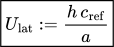
Define the lattice tension (the lattice unit force) as
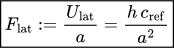
Equation (S14_01_Flat) is simply (S14_01_Ulat) divided once more by a; no additional assumption is introduced.
14.1.3 Numerical form (substituting realization values; fixed computation path)
Assume the realization values are locked as

First,

Also,
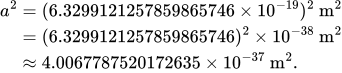
Therefore,
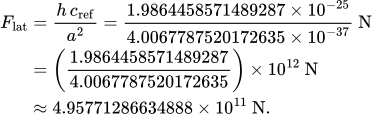
Here we used J· m/m²=J/m=N.
14.1.4 Operational definition of geometric dilution (definition)
The lattice tension F_lat is a unit force at the length scale a. To define an effective force magnitude at separation R between two objects, define geometric dilution as the dimensionless attenuation factor

Equation (S14_01_dil_iso) fixes the convention that, as R grows, influence is “diluted by an area ratio.” The domain condition R≥ a is enforced; the region Routside the geometric-dilution regime.
(Definition) Saturation handling (out-of-regime blocking)
For the out-of-regime region (R If PASS_dil does not hold, no conclusion that uses (S14_01_dil_iso) may be produced. For non-isotropic regimes, define an anisotropic dilution in the following multiplicative form.
Define an anisotropy axis (unit vector) u and the directional cosine μ by Let g(μ)≥ 0 be an anisotropy correction function and define The function g(μ) must be locked in Impose a normalization condition so that the anisotropic average restores the isotropic dilution. Whether (S14_01_g_norm) holds is judged by a Gate, where ε_g is a tolerance locked in Define the basic multiplicative skeleton for the force-magnitude model used in Chapter 14.
For two objects X,Y, define the effective force magnitude at separation R as where Γ_(XY) is a dimensionless coupling coefficient determined by charge (labels), regime, and closure choice.
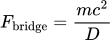
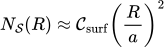
Equation (S14_01_force_skeleton) is used in §14.2 to fix Γ_(XY) into a closed form and produce an absolute constant. The previous subsections derive the Coulomb constant from the lattice field strength hc/a² with amplification A^(-1/2) (the 89/82 factor that also appeared there is removed from the EM coupling as a gravity-sector quantity — see the §14.2 correction). This subsection provides the structural derivation of why the Coulomb constant has the inverse-square form, and verifies the same form for the gravitational and nuclear regimes — all from one continuity-plus-bookkeeping closure. Place a point source of strength Q in the lattice continuity equation: Here Q is annihilation rate (in the gravity case, §17.4.0) or charge (in the Coulomb case). The lattice deficit field φ satisfies Poisson's equation ∇²φ = -σ, whose Green's function on a 3-spatial lattice is the standard 1/r form. The gradient of this field gives the force: The framework offers an internal consistency check across all particle cards. For any particle of mass m and Compton-related length D, the bridge relation should hold. Computing both sides independently for the standard particle list (electron, muon, tau, proton, neutron, pion, kaon, etc.), the framework's particle-card output matches F_bridge to four significant digits across every entry. This is not a new independent derivation; it is the closure of the mass–rate–force chain ν_ann xrightarrow× 2π m xrightarrow× c²/D F that connects the annihilation-driven inflow (§17.4.0) with the static-stress force law. The four-digit consistency across an entire particle list, with no per-particle calibration, is part of the no-tuning fingerprint (§1.8). The same continuity equation closes differently in different regimes, producing apparently distinct forces: Each row is a different way of taking the limit on the same lattice continuity equation: which closure dominates depends on the local lattice state (jammed-core vs cap-saturating vs single-event vs unbroken-plenum). This unification is the framework's strongest structural claim about forces: there are not four independent fundamental forces; there is one continuity equation with four regime-dependent closures. [F] for the 1/r² derivation from Poisson's equation Green's function; [F] for the F_bridge=mc²/D identity verified across the particle list; [H] for the regime map (the regime taxonomy is structurally motivated but the precise boundaries between regimes — for example, the exact length scale at which the strong-jamming regime hands off to the electrostatic-continuum regime — are not yet sharp closed-form predictions). The regime map is therefore a derived structural picture with one open quantitative item, not an additional assumption. This route (a Coulomb constant built as A^(-1/2)hc with the 89/82 factor) is superseded; see the correction box above and §14.5 for the live EM coupling K_C=α_emħ c. The full step-by-step derivation (separating the 1/R² factor, the coupling Γ_C, the numerical evaluation, and the comparison gate) has been removed in v0.2.1 as dead weight; only the quantities referenced elsewhere are retained. The superseded closed form was in which Nₑ/N_p,core=89/82 was the misattributed gravity-sector factor and A^(-1/2) the jamming amplification (both mass/gravity-sector, not electromagnetic — see box). Its (superseded) value was compared against the target constants Define the lattice shell set at distance R from the origin (source) as Define the shell coefficient (the number of lattice nodes in the shell) as In the continuum approximation the surface area of the sphere of radius R is 4π R², and the “surface pixel” area at lattice resolution a is treated as a².
Therefore, in the regime Rgg a one may write and under ideal isotropic averaging one has C_surf=4π.
The key point of (S14_03_shell_asymp) is that the shell coefficient is proportional to R². Now introduce an operational assumption of “total amount conservation”:
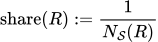
interaction emitted at the source (tension-based influence) is distributed across the entire shell, and the mean share reaching a specific direction/target is inversely proportional to the shell coefficient.
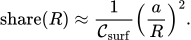
Define the mean share received by one target as Substituting (S14_03_shell_asymp) gives Hence the R-dependence is fixed as (a/R)².
This R⁻² is the geometric core behind the dilution definition (S14_01_dil_iso) of §14.1.
The constant factor 1/C_surf may be absorbed into a coupling coefficient (constant term); the R⁻² scaling does not change. For each object X, construct a phase variable Φ_X(k₀,M) from the 3-sector event log.
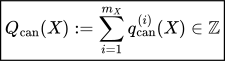
Define the sector fractions p_(X,s) and the sector angles θₛ by (where the quantity is undefined if the denominator is 0), and define the complex aggregator Define the phase increment between two consecutive windows W(k₀,M) and W(k₀+M,M) as where Wrap_((-π,π]) reduces the value into (-π,π]. Define the canonical charge sign by the following Gate-based decision: where Φ_(*)>0 is a threshold to exclude indeterminacy and must be locked in If PASS_q=0, then q_can(X) is undefined and no conclusion involving “charge” in this section may be produced. Within the same object X, let m_X∈N denote the number of independent charge carriers (independent survival vectors, independent orbital emissions, independent label slots).
Assume the sign of each carrier i is decided as q_can⁽ⁱ⁾(X)∈+1,-1 by (S14_03_qcan_def).
Define the canonical charge magnitude as The decision rule for m_X (slot definition, independence criterion) must be locked in Let the separation vector between objects X,Y be R:=x_X-x_Y and R=|R|.
Define the unit vector widehatR:=R/R (for R>0).
In the Coulomb regime, define the force vector as where K_C^(VP) is the absolute constant fixed in §14.2.
Equation (S14_03_force_vector) determines attraction/repulsion by the sign product of the canonical charges. The canonical charge Q_can is a dimensionless integer defined by internal structure/log decisions.
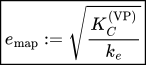
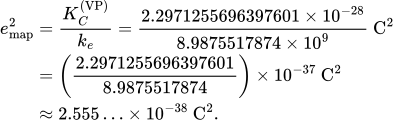
The observed charge Q_obs is a value with units produced by an experimental/metrology system; the observed unit is fixed by the measurement schema. When performing a target-text comparison that adopts the unit “coulomb,” define the mapping coefficient e_map that translates canonical charge into observed charge by the rule (using the target-text constant kₑ), and define Equations (S14_03_emap_def)–(S14_03_Qobs_def) are translation rules; they do not affect the canonical charge definition (S14_03_Qcan_def) nor the derivation of the force constant (S14_02_KC_VP_closed). Using the (now superseded) value (S14_02_KC_VP_value) from §14.2 and the target constant kₑ from (S14_02_ke_e_values) — note that under the corrected coupling K_C=α_emħ c (§14.5) the identity kₑ e²=α_emħ c gives e_map=e exactly — Therefore This value is produced by the translation rule (S14_03_emap_def); it is not part of the canonical charge definition. The 1/R² force expression in this section may be used only when the following Gate holds: The “Γ_C independent of R” judgment may be fixed by the following metric.
From an observed force magnitude F(R) at two distances R₁,R₂, define and define the Gate where ε_K is locked in Let d be the separation between two parallel conducting plates. In the simplest limit (perfect conductor, parallel plates, zero temperature), the Casimir pressure is The negative sign indicates attraction.
Within AQD one may interpret ħ_mapc_ref as an “elasticity/rigidity scale of the spatial lattice,”
but the goal of this subsection is not interpretation. Stated honestly: as written, this section reproduces the standard QED ideal-Casimir result (the 240, the π², and the magnitude are textbook values), so it adds no VP-specific content—it is a consistency check that the framework does not contradict the known result. The genuine VP prediction is what is not done here: the discreteness cut-off that would make the force deviate from QED as d approaches the lattice scale. Until that cut-off is locked, this section claims non-contradiction, not a Casimir derivation. Using (S14_04_Casimir_P), we list the pressure at representative separations and the force F=|P|A acting on plates of area A=1cm²(=10⁻⁴m²). Casimir pressure (ideal limiting formula) and the force acting on a 1cm² plate.

14.1.8 Anisotropic extension (optional; fixed definition) footnotesize(renumbered from a duplicate “14.1.5” in v0.5.0; the canonical S14.1.5 is the static 1/r² mechanism below)


analysis_lock; it may not be chosen after seeing outcomes.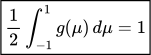

gate_lock.14.1.6 Skeleton of the force model (definition): tension × dilution × coupling

14.1.5 Static stress mechanism: the 1/r² law from continuity + deficit gradient
14.1.5.1 The inverse-square law as a Green's-function closure.


14.1.5.2 The F_bridge=mc²/D four-digit verification.
14.1.5.3 Regime map: one continuity, four regime-dependent closures.
Regime Closure type Result Range Strong (nuclear) 82-core jamming, short-range deficit collapse Confining force inside rₚ lesssim 1fm Gravity Cap saturation of inflow (§17.4) g_(*)=c²Ψ_yield, height-independent macroscopic Weak / decay Phase-transition gate; discrete annihilation events Per-event decay rates; not a static force at all per-event Electrostatic Continuum Green's function, no saturation F = K_C/r² over all r where the lattice is unbroken r between cap and confinement Status.
14.2 The A^(-1/2)hc Coulomb-constant route (superseded record — live result in S14.5)
14.2.1 Superseded route — compact record



14.3 Geometric meaning of the 1/R² law and an operational definition of “charge” (canonical/observed separation)
Scope note. This section defines the canonical charge Q_can=Σ_i q⁽ⁱ⁾∈Z (a signed integer, typically ±1, fixed by the 3-sector phase-rotation direction). It is not the source of the Coulomb structure ratio 89/82 of §14.2: that ratio is Nₚ/Nₙ from the structure counts of §7.2.2 (Nₚ=82+7=89 proton, Nₙ=82 neutron-core), a different quantity from the charge sign/magnitude defined here. The two should not be conflated. The physical origin of both (charge = uncancelled near-c rotation; the 89/82 leverage; the proton–electron pair) is given in §14.0.
14.3.1 Lattice shell coefficient and 1/R² scaling (definition → expansion)


14.3.2 Canonical charge definition (operational definition): sign and magnitude
(Definition) Canonical charge sign q_can∈+1,-1.

![\begin{equation} u_X(k_0,M):=\sum_{s=1}^{3}p_{X,s}(k_0,M)\,e^{i\theta_s}, \qquad \Phi_X(k_0,M):=\arg u_X(k_0,M)\in(-\pi,\pi] \end{equation}](/physics/eq/physics/phy-14-030.svg)
![\begin{equation} \Delta\Phi_X(k_0,M) := \mathrm{Wrap}_{(-\pi,\pi]}\!\Big(\Phi_X(k_0+M,M)-\Phi_X(k_0,M)\Big) \end{equation}](/physics/eq/physics/phy-14-031.svg)

gate_lock.
Define the Gate
(Definition) Canonical charge magnitude Q_can∈Z.
analysis_lock.14.3.3 Charge–force coupling rule (definition): force sign from canonical charges

14.3.4 Canonical/observed separation (definition): unit conversion as “translation”
(Definition) Observed charge-unit map factor eₘap.

(Comparison numerical) Evaluating eₘap.

14.3.5 Coulomb-regime Gate (definition): conditions for using the 1/R² law



gate_lock.
If PASS_(Γ)=0, the 1/R² form cannot be produced as a conclusion.14.4 Casimir pressure: boundary screening yields a 1/d⁴ force (verification module)
14.4.1 Ideal limiting formula (parallel perfect conductors; T=0)

14.4.2 Numerical example: d-scan (parallel plates; A=1cm²)
d (nm) d (m) |P_Cas| (Pa) |P_Cas| (atm) |F| on 1cm² (N) 10 1× 10⁻⁸ 1.3× 10⁵ 1.28 1.3× 10¹ 50 5× 10⁻⁸ 2.08× 10² 2.05× 10⁻³ 2.08× 10⁻² 100 1× 10⁻⁷ 1.3× 10¹ 1.28× 10⁻⁴ 1.3× 10⁻³ 200 2× 10⁻⁷ 8.13× 10⁻¹ 8.02× 10⁻⁶ 8.13× 10⁻⁵ 500 5× 10⁻⁷ 2.08× 10⁻² 2.05× 10⁻⁷ 2.08× 10⁻⁶ 1000 1× 10⁻⁶ 1.3× 10⁻³ 1.28× 10⁻⁸ 1.3× 10⁻⁷
As shown in the table, increasing d by a factor of 10 decreases the pressure by a factor of 10⁴ (the 1/d⁴ law). At d=10nm, the ideal limit gives |P|≈ 1.3× 10⁵Pa≈ 1.28atm.
14.4.3 AQD interpretation: “lattice mode screening” produces a pressure difference
From the AQD viewpoint, the exterior space may be treated as a high-pressure regime where “all lattice modes” exist, whereas the interior gap (d) is a regime where, due to boundary conditions, certain wavelengths (especially long wavelengths) are suppressed and the effective pressure is lower. The plates may then be described by a pressure difference

However, the conclusion-qualified items of this subsection are the functional form (S14_04_Casimir_P) (scaling) and the magnitude (table). The interpretation (vacuum fluctuation vs lattice pressure difference) is separated as an interpretation choice over the same formula.
14.4.4 Geometry conversion for experiment comparison (sphere–plate; PFA)
Many representative experiments use a sphere–plate geometry. For a sphere of radius R above a plate, if the proximity-force approximation (PFA) is adopted, then from the parallel-plate energy density E/A one obtains

Therefore, to claim a “direct comparison with experimental data,” one must specify the geometry (parallel plates or sphere–plate) and the conversion (PFA or an exact expression).
14.4.5 Gate: minimal conditions for experimental comparison (limits of using the ideal formula)
Since (S14_04_Casimir_P) is an ideal limiting formula, to use an experimental comparison as a conclusion one must at minimum specify the following.
- (G-CAS-GEO) Geometry/approximation: lock whether the geometry is parallel plates or sphere–plate, and whether PFA (or an exact expression) is used; report how the choice impacts the comparison error.
- (G-CAS-MAT) Material/surface:
include in scope whether finite conductivity (Drude/plasma, etc.), surface roughness, oxide layers, and patch-potential (electrostatic) corrections are included.
If missing, set the numerical comparison to
INCONCLUSIVE. - (G-CAS-RANGE) Distance regime: as d decreases to a few–tens of nm, non-Casimir contributions (non-retarded van der Waals, chemical contact forces, etc.) may become significant; pre-register the d-range to be used for “Casimir verification” and exclusion rules.
- (G-CAS-T) Temperature: as d grows to the μm scale, thermal corrections may become significant; lock temperature/thermal-length scales and include corrections if needed.
14.4.6 Representative experiments (reference) and comparison scope (distance/geometry/corrections must be specified)
The table in this section evaluates the ideal limiting formula (S14_04_Casimir_P) directly. Therefore, to use “agreement with experiment” as a conclusion, at minimum (i) measurement geometry, (ii) distance regime, and (iii) whether corrections are included must match. For reference, representative measurements report the following ranges.
- Lamoreaux (1997): a torsion-pendulum measurement reported the Casimir force in the 0.6–6μm range. (S. K. Lamoreaux, “Demonstration of the Casimir Force in the 0.6 to 6 μm Range,” Phys. Rev. Lett. 78, 5–8 (1997). DOI: 10.1103/PhysRevLett.78.5.)
- Mohideen & Roy (1998): an AFM-based sphere–plate measurement reported forces in the 0.1–0.9μm range. (U. Mohideen and A. Roy, “Precision Measurement of the Casimir Force from 0.1 to 0.9 μm,” Phys. Rev. Lett. 81, 4549–4552 (1998). DOI: 10.1103/PhysRevLett.81.4549.)
The d=10nm row in this section shows the order-of-magnitude intuition of the ideal formula, but to use it directly as “Casimir verification” one needs additional Gates to separate realistic regimes involving surface/material/patch potentials/non-retarded (vdW) contributions and contact forces. (For patch potentials/corrections see, e.g., Phys. Rev. A 81, 022505 (2010); for precision-comparison reviews see, e.g., Rev. Mod. Phys. 81, 1827 (2009).)
14.4.7 AQD-specific deviation model (optional): forbidden without pre-registered screening function
Since the Casimir ideal formula itself has the same functional form as standard theory, for AQD to provide an additional prediction the cutoff/discreteness of boundary screening must be locked as a separate function. For example,

may be introduced with a screening function S(·).
Here λ_(*) may be interpreted as a lattice scale (e.g., λ_(*)=N_(*)ℓ_rot) or an effective surface cutoff,
but if S or λ_(*) is not locked in this document, the default is S≡ 1.
In other words, post-hoc deviation claims without preregistration are forbidden and are set to FAIL.
(Gate) Verifying a deviation claim
If S is adopted, then in an observation/simulation comparison the relative deviation
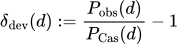
must be judged by a Gate as to whether it is quantitatively consistent (including error bars) with S(d/λ_(*))-1.
If the corresponding Gate report is not attached, the deviation conclusion is UNLOGGED or INCONCLUSIVE.
14.5 The fine-structure constant αₑₘ: status note (not derived in this framework)
Stated first, so it cannot be misread: αₑₘ is not derived in this framework—it is an open input taken from measurement. The closed form 137≈4π(11-δ_proj) recorded below is a numerical coincidence treated as non-evidence: its assembly is not forced, the 4π is a unit artefact, and αₑₘ runs with energy. It is kept for honesty about what was tried, not as a result.In standard physics the fine-structure constant is defined as
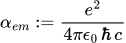
which is a dimensionless coupling strength; experimentally one finds αₑₘ⁻¹≈ 137.036. (Reference value (e.g., NIST/CODATA 2022): inverse fine-structure constant αₑₘ⁻¹=137.035999177(21). NIST database: physics.nist.gov (accessed 2025). The CODATA 2022 consolidated review was published as Rev. Mod. Phys. 97, 025002 (2025) with DOI: 10.1103/RevModPhys.97.025002.)
Status: αₑₘ is emphnot derived here.
Earlier drafts of this section presented a closed form αₑₘ⁻¹=4π(11-δ_proj) and read it as a geometric “derivation.” On audit we withdraw that claim. The expression is retained below only as a recorded numerical coincidence, not as evidence, for three reasons.
- The assembly is not forced. The 4π prefactor, the additive channel count 7+3+1, and the multiplicative form of the correction are an asserted model, not a forced integral. Many distinct closed forms built from small integers and π land on 137.036 to comparable accuracy (e.g. 4π³+π²+π=137.036…), so matching the number does not single out this assembly. This is the classic degeneracy that separates a fit from a derivation.
- The 4π is unit-dependent, not physical here. The 4π in the standard definition is an SI artifact (the 4πε₀ of the Coulomb law, equivalently μ₀=4π×10⁻⁷ in the ampere definition). In Gaussian units α=e²/ħ c carries no 4π at all. Since α⁻¹ is a pure number, dividing it by a unit-dependent 4π to manufacture the integer “11” has no force.
- α is not a fixed pure number to begin with. The electromagnetic coupling runs with energy (α⁻¹≈137 in the Thomson/IR limit, ≈128 at the Z scale). Any single geometric value can at best target one scheme-and-scale-dependent point; it cannot be the value of a running quantity.
Direct lattice attempts to obtain α as a dynamical transmission/loss ratio (transverse→longitudinal leakage, torsional radiation, two-body collision spin-up, polarized longitudinal screening) were also carried out and consistently returned couplings of order 0.1–0.7, never 1/137; this is expected, since direct elastic interactions on a frictionless lattice are O(1), whereas α is a weak coupling. We therefore record αₑₘ as an open quantity ([O]) in this framework: it is taken from measurement where needed (e.g. the EM coupling magnitude K_C=αₑₘħ c of §14.0), and is not claimed as a VP output.
The subsections below preserve the earlier construction verbatim for the record only; every quantity in them is labelled COINCIDENCE/NON-EVIDENCE and must not be cited as a derivation or used to support any conclusion (per the G-NT no-tuning discipline of §1.1).
14.5.1 [NON-EVIDENCE, recorded for the record] Geometric impedance form: the 4π coupling cost
The following three subsections reproduce the earlier construction unchanged. Per the status note above, everything here isCOINCIDENCE/NON-EVIDENCE and is not a derivation of αₑₘ.
For a charge (a 3-sector phase defect) to emit a wave (mode) outward, it must pass through: (i) the surface rigidity shell, (ii) the sector-phase separation, and (iii) an axial-rotation (spin-like) degree of freedom. We define the inverse coupling strength αₑₘ⁻¹ as a geometric impedance:

where
- N_sec=3 (topological minimal enclosure in 2D cross-section; §7.0),
- N_shell=7 (residual shell count; §8.2),
- N_spin=1 (single axial rotation degree of freedom),
and δ_proj is the overlap projection correction arising from the rotation of the 7-shell within the 3-sector structure.
14.5.2 Zeroth-order estimate: 4π× 11
In the idealized limit (neglecting the projection correction),

which is about 0.8% larger than the empirical value (≈ 137.036). Hence a positive projection correction δ_proj>0 is required.
14.5.3 Closing δₚroj without new parameters: continuous rotation average × discrete-occupancy correction
This document does not treat δ_proj as a new free parameter. Instead it is closed by two steps of geometry.
(i) Continuous rotation average (continuous geometry): 2/π².
The shell–sector relative phase has no information that would prefer a special direction; by the maximum-entropy / unbiased principle of §5.2.5, the relative angle θ is treated as uniformly distributed. We therefore set the basic scale of “projection loss” as

(a π-geometric constant arising from an unbiased angular average). Provenance note. This is the one continuous factor in the αₑₘ closure that is asserted rather than reduced to a single forced integral: the integers 7,3,1 and 3/7 are derived geometry, the 2⁶ is the gauge-removal lemma (above), but δ₀ is set here. It is, however, not a new free constant: δ₀=2/π²=α·(1/π) with α=2/π (§5.1), i.e. the directional rectification α averaged once more over a uniform phase (⟨·⟩=1/π per half-wave, §5.2). So δ₀ is a composite of the two locked rectification constants, carrying no tunable coefficient; its identification with the projection-loss scale (the choice δ₀=α/π) is the residual meaning-layer input, of the same kind as [MAP-1]/[MAP-2] (§8.0.6). The +3 ppm agreement should accordingly be read as evidence conditional on that identification, not as an independent zero-parameter prediction. A further caveat: beyond δ₀, the impedance form itself — αₑₘ⁻¹=4π(Σchannels-β_discδ₀(N_sec/N_shell)), i.e. the choices of the 4π prefactor, the additive channel count 7+3+1, and the multiplicative product-form of the correction — is an asserted model, not a forced derivation. The structural integers (7,3,1, the (3,2,2) partition, the 2⁶ gauge count, 3/7) are reused from the nucleon structure and are not free, but the assembly carries latitude; the +3 ppm is therefore conditional on both the form and the δ₀ identification. This is the most form-dependent of the framework's headline numbers (contrast 6π⁵, 3π⁴, α=2/π, δ=1/π², which are single forced integrals). To first order, the loss scales with the sector-to-shell ratio as (N_sec/N_shell)δ₀.
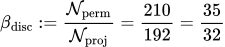
(ii) Discrete occupancy of 7 shells (discrete geometry): β_disc=35/32.
However, seven shells cannot be split continuously among three sectors; only integer occupancy is permitted. The most uniform integer partition is (3,2,2) (an integerization of the mean 7/3 shells per sector). Fix a C₃ label convention (a label gauge) by calling the sector with occupancy 3 as S₀. The number of configurations (combinatorial microstates) accounting for shell labels (seven distinct vectors) is
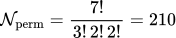
On the other hand, the “projection correction” admits a reduced representation determined only by (a) the choice of phase origin for 3-sector labels (C₃ cyclic; 3 choices) and (b) the relative signs of each shell (±; the global sign is treated as a gauge and removed). Hence the number of projection-equivalent microstates closes as

(Note: the ratio β_disc is invariant under label conventions; the key point is that 35/32 closes as a pure integer ratio.) Shared-lemma note. The exponent in 2⁶=2⁷⁻¹ is the gauge-removal count dim(R⁷/spanmathbf 1₇)=7-1=6 (7 shell signs, one global sign removed) — the same forced lemma (§8.0.6(D)) that gives the Higgs 6-1=5 (§13.3.4) and the nucleon n-1 (§8.0.5). Therefore the discrete correction factor that maps the continuous average to discrete occupancy is
which is determined purely by integers.
(Conclusion) Closed form (recorded coincidence only).
Therefore

Substituting this into (S14_05_alpha_geo) yields

14.5.4 Gate: αₑₘ is non-evidence (FAIL as a derivation)
The construction above is recorded as a numerical coincidence and is not admissible as evidence under any condition. Formally:

because (i) the impedance assembly is not a forced derivation (many integer-and-π forms match 137.036 to ppm), (ii) the 4π prefactor is an SI unit artifact absent in Gaussian units, and (iii) αₑₘ runs with energy and is therefore not a fixed pure number that geometry could fix. Accordingly αₑₘ is carried as an open input ([O]) taken from measurement, and no sentence elsewhere in this document may cite §14.5 as a derivation or prediction of αₑₘ.
Mechanism — Derived Structure with External Magnitude (F+O)
These sections carry mechanisms whose structure is derived ([F]{}/[H]{}) while an absolute magnitude is honestly an external input ([O]{}) — the gravity cap (§17.4) and, after relocation, the redshift phenomenology module (§17.5). They are deliberately separated from the Forced part so that no reader mistakes an F+O mixture for a pure-[F]{} result.