Quantum mechanics mapping (completion note: lock standard-QM elements as a mapping table)
Quantum mechanics mapping: The wavefunction enters as a mapped object, not an imported axiom. Collapse becomes a counting protocol with a Gate, not a mystery. Let the lattice dimension be d∈N, and define the lattice-node set.
The wavefunction enters as a mapped object, not an imported axiom. Collapse becomes a counting protocol with a Gate, not a mystery. 2π/3.
15.1 Lattice dispersion / plane-wave solutions leftrightarrow wavefunction (state space) mapping
15.1.1 Base set and scaling (definition)
Let the lattice dimension be d∈N, and define the lattice-node set by

Using the realization length a>0 and the realization time step Δ t>0 (their units are locked in the Realization chapter), define the real-space coordinate and the physical time corresponding to node n∈L and tick k∈Z as

15.1.2 Complex state field from the event log (definition)
For each node n and tick k, define the 3-sector event indicators by

Let the observation (aggregation) window have length M∈N and start tick k₀∈Z, and define

Define the sector-wise event counts (log aggregates) within the window as

Fix the sector angles by

Define the node-wise 3-sector composite phasor by

Also define the total event count and the event density by

Define the phase (principal value) of the composite phasor by
![\begin{equation} \varphi(\mathbf{n};k_0,M):=\arg Z(\mathbf{n};k_0,M)\in(-\pi,\pi]. \end{equation}](/physics/eq/physics/phy-15-008.svg)
Then define the node-wise complex state field (complex amplitude) by

Therefore

holds identically. The definitions above are operational: they construct a state field directly from event-log aggregates and do not invoke axioms from any external theory.
15.1.3 State space (definition) and inner product (definition)
Define the complex function space

as the state space. Define the inner product on S by
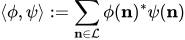
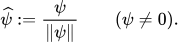
and the norm by |ψ|:=√(⟨ψ,ψ⟩). A normalized state is defined by
15.1.4 Discrete Fourier expansion and wave-number space (definition)
Define the d-dimensional Brillouin zone by

For sufficiently fast-decaying states (or for a finite lattice with periodic boundary conditions), define the discrete Fourier transform by

Here boldsymbolκ is the dimensionless lattice wave number. Define the real-space wave vector (with dimension L⁻¹) by

15.1.5 One-tick evolution operator, dispersion, and plane waves (definition)
Assume a regime in which tick evolution is linear and translation-invariant (i.e., the same rule under the same closure stack). Define the one-tick evolution operator by

Translation invariance means that for every m∈L, with the translation operator T_m defined by

one has

Under this condition, define the plane waves (lattice harmonic modes) by

Then φ_boldsymbolκ can be an eigenmode of U. Define its eigenvalue in phase form by
![\begin{equation} \mathcal{U}\,\phi_{\boldsymbol{\kappa}} = e^{-i\Omega(\boldsymbol{\kappa})}\,\phi_{\boldsymbol{\kappa}}, \qquad \Omega(\boldsymbol{\kappa})\in(-\pi,\pi]. \end{equation}](/physics/eq/physics/phy-15-021.svg)
Define the lattice dispersion (angular frequency) by
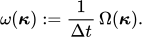
Therefore, a single-mode plane-wave solution can be written as

This follows directly from the definitions (S15_01_Udef)–(S15_01_dispersion_phase).
15.1.6 Mapping table to external text (standard QM) (target-text lock)
In this section, “standard QM” is treated as an external target text and is not used as a derivation basis. The following table fixes only a notation mapping to the standard-QM notation (target text).
| VP/lattice–event system (definition) | Standard-QM target text (term) | Mapping rule (locked) |
| Node n∈L | position variable x | x=an |
| Tick k∈Z | time variable t | t=kΔ t |
| Complex state field ψ(n;k₀,M) | wavefunction ψ(x,t) | ψ(x(n),t(k))leftrightarrow ψ(n,k) |
| Dimensionless wave number boldsymbolκ | wave vector k | k=boldsymbolκ/a |
| Eigenphase Ω(boldsymbolκ) | angular frequency ω | ω=Ω/Δ t |
| Mode exp(iboldsymbolκ·n-iΩ k) | plane wave exp(ik·x-iω t) | (S15_01_xt), (S15_01_kmap), (S15_01_omega) |
15.1.7 Declared scope: allowed vs forbidden uses (locked)
Allowed uses (internal computations in this document)
- The complex state field ψ defined by (S15_01_psi_def) and the identity (S15_01_abs2_rho).
- The Fourier expansion (S15_01_FT) and the eigenphase (dispersion) definition (S15_01_dispersion_phase).
- The plane-wave mode representation (S15_01_plane_solution) (mode basis in a translation-invariant regime).
Forbidden uses (may not be used as derivation grounds; target-text only)
- Using the axioms of standard QM (wavefunction axiom, operator axiom, projection postulate, etc.) as justification.
- Adopting specific continuum equations from standard QM (target text) in place of this document's internal closures/axioms.
15.2 Rewriting the Born rule, measurement, and collapse as event frequency and gates (link to observation protocols)
15.2.1 Partition of an observation module (definition)
Let the lattice region referenced by the observation module be a finite set Λ⊂L, and define the set of output labels by

Define a partition map that splits Λ into mutually disjoint subregions by

The family Ωₘ defines the outcome channels (output bins).
15.2.2 Event counts and outcome frequencies (definition)
For an observation window W(k₀,M), define the event count of outcome channel m by

The total event count is C_tot:=Σ_m∈MCₘ. Define the outcome frequency (normalized event frequency) by

Thus Pₘ is an outcome frequency computed directly from the event log.
15.2.3 Equivalent expression in terms of the complex state field (definition)
From the definition (S15_01_psi_def) and identity (S15_01_abs2_rho) in §15.1, for each channel one has

Therefore (S15_02_Pm) can be rewritten exactly as

Here (S15_02_Pm_bornform) is not derived from the foundations of standard QM. It is an identity that holds equivalently by construction from the event-log definition and (S15_01_psi_def).
15.2.4 Gate decision (condition for a measurement event; definition)
A measurement is an event that creates a log entry “some m was selected.” To formalize this, define an outcome-selection rule (gate) as

Here Gₘ(·;Θₘ) is the gate function for channel m, and Θₘ is a pre-registered set of threshold/decision parameters. Define the condition for producing a measurement log by
![\begin{equation} \mathrm{PASS}_{\mathrm{meas}} :\Longleftrightarrow \left[ \exists\,m^\star\in\mathcal{M}\ \text{s.t.}\ \mathcal{G}_{m^\star}\big(C_{m^\star}(k_0,M);\Theta_{m^\star}\big)=1 \right]. \end{equation}](/physics/eq/physics/phy-15-031.svg)
If PASS_meas does not hold, the protocol does not generate a measurement log (no outcome selection).
15.2.5 Operational definition of collapse (conditional renormalization) (definition)
When the measurement outcome m^* is fixed in the log (i.e., when (S15_02_PASS_meas) holds), define the following mask operator (channel filter) on the state field ψ(·;k₀,M) from the same window:

Then define the post-measurement state by conditional renormalization:

Here ψ_pre is the normalized state immediately before measurement (computed under the same protocol). Equation (S15_02_collapse) is a convention for re-expressing the state after the event log is fixed, and cannot be applied without a gate pass.
15.2.6 Mapping table to the standard-QM target text (target-text lock)
In this subsection, standard-QM terms (Born rule, measurement, collapse) are treated as target text. The following table fixes only the notation mapping based on (S15_02_Pm_bornform) and (S15_02_collapse).
| VP/event–gate system (definition) | Standard-QM target text (term) | Mapping rule (locked) |
| Outcome frequency Pₘ | probability pₘ | pₘleftrightarrow Pₘ |
| Σ_(Ωₘ)|ψ|²/Σ_(Λ)|ψ|² | “|ψ|² rule” | (S15_02_Pm_bornform) |
| Gate pass PASS_meas | condition for measurement to occur | (S15_02_PASS_meas) |
| Conditional renormalization (S15_02_collapse) | projection (collapse) notation | notation mapping only |
15.2.7 Declared scope: allowed vs forbidden uses (locked)
Allowed uses (internal computations in this document)
- Log-based computation of event counts Cₘ and outcome frequencies Pₘ ((S15_02_Cm)–(S15_02_Pm)).
- The identity (S15_02_Pm_bornform) (the ψ-form).
- Conditional renormalization (S15_02_collapse) after a gate pass.
Forbidden uses (may not be used as derivation grounds; target-text only)
- Adopting the standard-QM “measurement postulate” in place of the gate definition in this document.
- Back-injecting the standard-QM “probability interpretation” as the justification for the event-frequency definition.
15.3 Operators, commutation relations, uncertainty, and the spin/statistics link (3-sector): separating theorem / hypothesis / validation
15.3.1 Operational definition of observables (theorem)
Define a linear operator O:S→S on the state space S as an observable operator. For a normalized state ψ, define its expectation and variance by

Equation (S15_03_mean_var) is a purely operator-algebraic definition determined by the inner product (S15_01_inner).
15.3.2 Basic operators: position, translation, and finite differences (theorem)
For coordinate component j∈1,…,d, define the position (multiplication) operator X_j by

For the unit lattice vector e_j, define the translation (shift) operator T_j by

The commutation relation (exact identity) follows by direct computation:
![\begin{align} (\mathcal{X}_j\mathcal{T}_j\psi)(\mathbf{n}) &= a\,n_j\,\psi(\mathbf{n}+\mathbf{e}_j), \notag\\ (\mathcal{T}_j\mathcal{X}_j\psi)(\mathbf{n}) &= a\,(n_j+1)\,\psi(\mathbf{n}+\mathbf{e}_j), \notag\\ \Rightarrow\quad \big([\mathcal{X}_j,\mathcal{T}_j]\psi\big)(\mathbf{n}) &= (\mathcal{X}_j\mathcal{T}_j-\mathcal{T}_j\mathcal{X}_j)\psi(\mathbf{n}) = -a\,\psi(\mathbf{n}+\mathbf{e}_j) = -a\,(\mathcal{T}_j\psi)(\mathbf{n}). \end{align}](/physics/eq/physics/phy-15-037.svg)
Hence
![\begin{equation} [\mathcal{X}_j,\mathcal{T}_j]=-a\,\mathcal{T}_j, \qquad [\mathcal{X}_j,\mathcal{T}_j^{-1}]=+a\,\mathcal{T}_j^{-1} \end{equation}](/physics/eq/physics/phy-15-038.svg)
holds exactly.
15.3.3 Momentum-like operator and commutation relation (theorem + hypothesis)
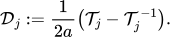
(Theorem) Symmetric-difference generator
Define the symmetric-difference operator D_j by
(Hypothesis H-Pmap) Mapping to the “momentum” notation in the standard-QM target text
Define the constant

as a mapping constant (derived from the realization input h). Define the momentum-like operator P_j by

By (S15_03_comm_XT2), P_j satisfies the exact commutation relation
![\begin{align} [\mathcal{X}_j,\mathcal{P}_j] &= \frac{\hbar_{\mathrm{map}}}{2ia}\Big([\mathcal{X}_j,\mathcal{T}_j]-[\mathcal{X}_j,\mathcal{T}_j^{-1}]\Big) \notag\\ &= \frac{\hbar_{\mathrm{map}}}{2ia}\Big(-a\mathcal{T}_j-a\mathcal{T}_j^{-1}\Big) = \frac{i\hbar_{\mathrm{map}}}{2}\big(\mathcal{T}_j+\mathcal{T}_j^{-1}\big). \end{align}](/physics/eq/physics/phy-15-042.svg)
For the plane-wave mode (S15_01_planewave),
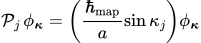
holds. Therefore, in the small-κ_j regime (slow-variation regime) where sinκ_j≃ κ_j,

We map this approximation to the standard-QM target-text notation p=ħ k only as a translation rule, and it must not be used as a derivation basis.
15.3.4 Uncertainty inequality (theorem; derivation as a mathematical theorem)
Derive an operator uncertainty inequality using the Cauchy–Schwarz inequality in an inner-product space:

For a normalized state ψ and two operators A,B, define

Let

Then

By (S15_03_CS),

Let z:=⟨ ψ,δAδBψ⟩∈C and decompose
![\begin{equation} z = \frac{1}{2}\langle \widehat{\psi},\{\delta\mathcal{A},\delta\mathcal{B}\}\widehat{\psi}\rangle + \frac{1}{2}\langle \widehat{\psi},[\delta\mathcal{A},\delta\mathcal{B}]\widehat{\psi}\rangle. \end{equation}](/physics/eq/physics/phy-15-050.svg)
Here X,Y:=XY+YX is the anticommutator and [X,Y]:=XY-YX is the commutator. Therefore

Also
![\begin{equation} \Im z = \frac{1}{2i}\left(z-z^{*}\right) = \frac{1}{2i}\left\langle \widehat{\psi},\left(\delta\mathcal{A}\delta\mathcal{B}-\delta\mathcal{B}\delta\mathcal{A}\right)\widehat{\psi}\right\rangle = \frac{1}{2i}\langle \widehat{\psi},[\mathcal{A},\mathcal{B}]\widehat{\psi}\rangle. \end{equation}](/physics/eq/physics/phy-15-052.svg)
Combining (S15_03_RS0)–(S15_03_Imz) yields
![\begin{equation} \Delta\mathcal{A}\,\Delta\mathcal{B} \ge \frac{1}{2}\left|\left\langle \widehat{\psi},\frac{1}{i}[\mathcal{A},\mathcal{B}]\,\widehat{\psi}\right\rangle\right| = \frac{1}{2}\left|\langle [\mathcal{A},\mathcal{B}]\rangle_{\widehat{\psi}}\right|. \end{equation}](/physics/eq/physics/phy-15-053.svg)
Equation (S15_03_uncertainty) is a mathematical theorem derived from the inner product and operator definitions.
15.3.5 Spin-like label from 3-sector structure (hypothesis) and statistics (hypothesis)
(Theorem) 3-sector probability vector
For node n and window W(k₀,M), define the sector fractions by

Define the normalized sector phasor by
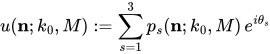
and its phase by
![\begin{equation} \Phi(\mathbf{n};k_0,M):=\arg u(\mathbf{n};k_0,M)\in(-\pi,\pi]. \end{equation}](/physics/eq/physics/phy-15-056.svg)
Thus Φ is an angular variable computed from the 3-sector occupancy fractions.
(Hypothesis H-S1) Definition of a two-valued spin-like label
Consider two consecutive windows (k₀,M) and (k₀+M,M) and define the phase increment by
![\begin{equation} \Delta\Phi(\mathbf{n};k_0,M) := \mathrm{Wrap}_{(-\pi,\pi]}\!\Big(\Phi(\mathbf{n};k_0+M,M)-\Phi(\mathbf{n};k_0,M)\Big). \end{equation}](/physics/eq/physics/phy-15-057.svg)
Here Wrap_((-π,π]) reduces a value into the interval (-π,π]. Define the spin-like label by

Treat σ=0 as indeterminate (gate failure). Map only σ=±1 to the standard-QM target-text “two-valued spin projection” notation, and classify σ=0 as a state with no target-text counterpart.
(Lemma T-S1) Two-valuedness is forced in the cyclic-shift regime (added v0.5.0).
Suppose the 3-sector occupancies evolve, between consecutive windows, by a cyclic shift: pₛ(·;k₀+M,M)=p_(s-r)(·;k₀,M) with r∈+1,-1 (one sector step per window — the synchronized-rotation regime of §14.0, where the sign is the CW/CCW rotation sense, §14.3.2). With θₛ=2π(s-1)/3, the phasor obeys u(k₀+M)=Σₛ p_(s-r)e^(iθₛ)=e^(2π i r/3)u(k₀), hence ΔΦ=Wrap_((-π,π])(2π r/3)=± 2π/3 exactly: σ=r∈+1,-1 and σ=0 cannot occur. Spatial parity reverses the rotation sense (θₛ↦-θₛ, so Φ↦-Φ and σ↦-σ): the label set is a single parity orbit +1,-1, a forced Z₂. Consequence for the grading: the two-valuedness of the label is a theorem conditional on the cyclic-shift premise ([F]{} given the premise); what remains hypothesis (H-S1 proper, [H]{}) is (i) that physical one-quantum states are in this regime, and (ii) the identification of σ with the target-text spin-tfrac12 projection (magnitude ħ/2, the SU(2) double cover, the statistics link), which this lemma does not address. The logic-gaps audit graded the entry “hypothesis”; the corrected grading is two-valuedness: conditional theorem; spin identification: hypothesis.
(Hypothesis H-STAT1) Exclusive-occupancy rule and mapping to statistics
Define an exclusive-occupancy regime as a regime in which two objects with the same label cannot stably co-exist simultaneously on the same node (or the same slot in a contact graph). Declare the occupancy rule as

Assign the standard-QM target-text terms “Fermi/Bose statistics” to the regime classification above only as a label mapping.
15.3.6 Validation items (judged only by gates; fixed list)
(V-OP) Operator-level agreement items
- (V-OP1) Under the same protocol, whether the mode eigenvalues of P_j satisfy (S15_03_P_eig) (Fourier-mode fit Gate).
- (V-OP2) In the slow-variation regime, whether the expectation of (S15_03_comm_XP_exact) converges to ⟨ tfraciħ_map2(T_j+T_j⁻¹)⟩≃ iħ_map (regime Gate).
(V-S) Spin-like label items
- (V-S1) Within the same partition module, whether the event frequencies of the two channels σ=±1 match the predicted frequencies computed from (S15_02_Pm) (two-channel Gate).
- (V-S2) Whether the occurrence rate of σ=0 is below a pre-registered upper bound (indeterminacy upper-bound Gate).
(V-STAT) Statistics-regime items
- (V-STAT1) In the exclusive-occupancy regime, whether the simultaneous-occupancy violation log count is 0 (exclusion-violation Gate).
- (V-STAT2) In the non-exclusive regime, whether the multi-occupancy distribution satisfies the pre-registered sampling protocol (sampling Gate).
15.4 Standard Model boundary: share (observational numbers) vs ban (gauge dynamics), and scope declaration
15.4.1 Form of the boundary declaration (definition)
In this section, “Standard Model” and “standard QM” are treated as external target texts. The role of this chapter is to provide mapping tables that translate target-text terms/symbols into this document's operational definitions (LOCK, Gate, event log). It provides no justification and no derivational support. Accordingly, fix the following two categories:

15.4.2 Shared items Cₛhare (observational numbers and reporting units; fixed list)
The following items are shared only as “reported quantities” or “reporting units.” Sharing means unit conversion and table-based correspondence; it does not mean adopting the target text's theoretical structure.
- (SH1) The choice of reporting units for mass, length, time, energy, etc. (SI or the document's realization units).
- (SH2) The numerical values themselves when given observationally (e.g., mass ratios, length ratios, frequency ratios).
- (SH3) Labels of reported quantities referred to by terms such as “charge,” “spin,” and “probability.”
15.4.3 Banned items C_ban (gauge dynamics and axiom structure; fixed list)
The following items, even if present in the target text, are not permitted in the derivation chain of this document.
- (BN1) Target-text dynamical generators such as gauge fields, gauge symmetry, Lagrangians, and action integrals.
- (BN2) Internal target-text construction principles such as renormalization, perturbation expansions, and vacuum structure.
- (BN3) Treating the axioms of standard QM (state axiom, measurement axiom, operator axiom) as grounds.
- (BN4) Adopting target-text continuum equations (e.g., a specific wave equation) in place of this document's closures.
15.4.4 Mapping table to the standard-QM/Standard-Model target text (including banned scope; fixed)
| This document (operational definitions / outputs) | Target text (term) | Handling (share / ban) |
| Event log Eₛ, counts Nₛ, frequencies Pₘ | probability p | share: report item; ban as justification |
| Complex state field ψ (event density + phase construction) | wavefunction ψ | share: notation mapping; ban as axiom |
| Gate PASS and conditional renormalization | measurement/collapse | share: notation mapping; ban as axiom |
| Operators X,T,P and commutators | operators/commutators | share: mapping table; ban target-text axioms |
| 3-sector phase-increment label σ | spin (projection) | share: label mapping; ban dynamics structure |
| Exclusive/non-exclusive occupancy regimes | statistics (Fermi/Bose) | share: label mapping; ban target-text principle |
15.4.5 Effective scope (regime declaration; locked)
The mapping of this chapter is defined only in the following regimes:
- (R1) A regime where an event log exists (C_tot>0) and a state field ψ can be constructed by (S15_01_psi_def).
- (R2) A regime where the observation-module partition Π, the gate functions Gₘ, and the thresholds Θₘ are pre-registered.
- (R3) If an operator mapping is claimed (in particular, the target-text mapping of P_j), a slow-variation regime (small |boldsymbolκ|) must be separately certified by a Gate.
If these regime conditions do not hold, no conclusions may be produced using the target-text mapping tables.
15.5 Blackbody radiation: the energy quantum reinterpreted as a lattice-stiffness threshold
This section does not derive energy quantization from a deeper principle; it reinterprets the quantum as the cost of crossing a rigidity-shell barrier, ε_b(ν)=h_VPν (the Planck hypothesis stated in lattice language, with h_VP calibrated to data; grade CALIB, §16.4). Given that reinterpretation, the spectrum shape follows from standard Bose–Einstein statistics over the rigidity-shell modes and the 3D mode count; the contribution here is conceptual (the quantum as lattice stiffness), not a derivation of h or of quantization. (Planck's original paper: M. Planck, “Ueber das Gesetz der Energieverteilung im Normalspectrum,” Annalen der Physik 309(3), 553–563 (1901). DOI: 10.1002/andp.19013090310.)
15.5.1 Geometry of mode count (statement): g(ν)∝ ν²
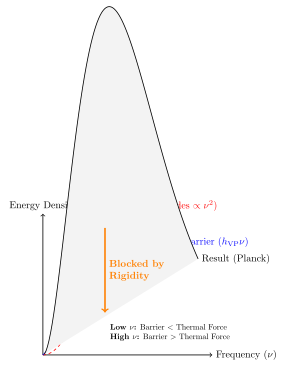
In a 3D cavity, the number of wave modes is given by the volume of a spherical shell in k-space. As a function of frequency ν, the mode density per unit volume scales geometrically as

(continuum geometry). Including the usual electromagnetic prefactors gives g(ν)=8πν²/c_ref³, but the key point here is that the ν² scaling comes from pure geometry.
15.5.2 Rigidity-shell barrier and the action constant h_VP (definition)
In VP theory, “softness” is not a property of the particle itself but the result of structural events (§3.2.1). For a high-frequency mode to exist, the lattice rigidity shell must be periodically deformed. Under linear elastic response, the strain rate ε is proportional to frequency. Hence the minimum barrier energy ε_b required to penetrate the shell (or to cross the critical deformation once) satisfies

Fix the proportionality constant in action (energy×time) units and define
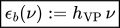
Here h_VP is not an arbitrary “unknown constant”; it is the minimum action (structural resistance coefficient) required for the VP shell to allow one cycle of deformation.
15.5.3 Integer event count n and the emergence of (e^x-1)⁻¹ (derivation)
The key point is that “excitation” is not continuous but is tallied as the number of barrier-crossing events. In a mode of frequency ν, one barrier crossing costs ε_b(ν)=h_VPν; therefore the accumulated energy after n crossing events is

This is not “postulating E=n hν” but follows from the fact that n is an event count and thus must be an integer (discreteness).
In thermal equilibrium at temperature T, the Boltzmann weight is

and the partition function closes as a geometric series:

Therefore the mean energy per mode is

This term produces the characteristic “-1” of the Planck spectrum.
15.5.4 Planck spectrum (conclusion): geometry × stiffness filter
The energy density per unit volume is u(ν)=g(ν)⟨ E⟩(ν), hence

Thus the high-frequency cutoff is not a “mystery of light”; it occurs because the rigidity shell structurally blocks (filters) high-frequency deformation.
Interpretive note (NON-LOCK)
If one loosely says “light is gas-like,” this should be read as a statement about excitation statistics on top of a jammed background (State 4), not as a claim that the vacuum medium itself is unjammed. A concise regime dictionary for this distinction is provided in Appendix L (see L.5).
15.5.5 Gate: conditions for using the blackbody regime (definition)
This derivation may be used as a “Planck spectrum derivation” only when the following conditions hold:

If conditions are not satisfied, this section is set to INCONCLUSIVE.
Open — What This Framework Does Not Claim
Stated plainly. §12 (electron one-second) carries an unresolved O(1) factor. Other open items are flagged in place within their parent sections in Part I—αₑₘ (§14.5, non-evidence) and the absolute magnitude of gravity (§17.4, a proven obstruction = the hierarchy problem).