Electron 1-second cross-check
Electron 1-second cross-check: The one-second test is three tests that must pass together. The chapter names its own executioner before presenting results. Evidence that cannot be independently re-executed does not count in this framework.
The one-second test is three tests that must pass together. The chapter names its own executioner before presenting results. δ=1/π².
Concept links: reviewer audit in §1.9 A2; the geometry uses the canonical rate of §9.4.Grade of Tₑ≈1s (re-executable evidence only).
Evidence that cannot be independently re-executed does not count in this framework. Accordingly the electron Tₑ≈ 1s rests only on re-executable grounds; a full-physics simulation result is reported as a historical-consistency note that bears no weight in the grading (its code is not in the public bundle).
The load-bearing evidence for Tₑ≈ 1s is:
- Path (B), reproducible code. The released bundle (
AQD_DOI_bundle_unified_v0.4.0_2026-06-05.zip, scriptslattice_3d_jam_percolation.pyand the one-second-electron analysis subroutine therein) computes Tₑ≈ (D/a)³τ_VP× 6/5 and yields ≈ 1.0s. Any reviewer can re-run it; outputs are CSV with full provenance. - Three-fold canonical geometry. The factor 6/5 in the formula is the canonical 5-out-of-6 inflow-channel ratio derived in §13.3 (six cell faces, minus the one face occupied by the global reference direction). It is not a fitted number; it is the same factor that closes the Higgs mass to within -0.40%.
- Volume-reaches-c heuristic. The dimensional structure (D/a)³τ_VP has a transparent meaning: when the proton's quantum-scale volume (D)³ propagates at the lattice-scale rate τ_VP⁻¹, the natural time scale to traverse one Compton volume comes out at 1s. This is a sanity check that the unit-level structure is not accidental, not an independent derivation.
Combining path (B) with the geometric consistency, the grade is revised from [H]{} to [H]+{}. The "+" denotes that this is a derived value backed by two independent load-bearing paths under a single anchor — the reproducible code (B) and the canonical geometry (G) — with the geometry path itself triangulated three ways (small-lattice direct count, Tₑ∝ N² scaling invariance, and the 5-of-6 three-fold channel ratio), not a fitted target. Two items remain open (see §1.9 item A2): independent external re-execution by another group (a social-process gap, not a content gap), and the residual numerical factor of order unity — now sharpened to a single decidable question (below, v0.5.0).
What does and does not change with this reclassification.
The numerical value Tₑ≈ 1s does not change. The methodology of how we treat path (A) does. This is a tightening of the epistemic standard, not a revision of the result — and it is precisely the kind of self-imposed tightening (downgrading non-reproducible evidence) that distinguishes a framework with a principled grading discipline from one without.
The O(1) residual, sharpened to one locked-measure question (added v0.5.0).
The formula Tₑ=(D/a)³τ_VP× 6/5 contains exactly one convention-dependent O(1): which cell measure counts as “one quantum volume.” At the canonical values (D/a=7.666×10⁶, τ_VP=Δ t) the three admissible candidates give:
| measure of one quantum | Tₑ | deviation from the §9.3 clock |
| bounding-cube cells, (D/a)³ | 1.0056 s | +0.56% |
| inscribed-sphere cells, (π/6)(D/a)³ | 0.527 s | -47% |
| jam-weighted sphere, φ_jam(π/6)(D/a)³ | 0.333 s | -67% |
G-TE-O1: derive, from the §12.1 cell
definitions plus the void-forbidden rule, that the cell set processed by one electron event is the bounding-cube
set (e.g. because a quantum's presence constrains every cell of its bounding region, not only the
interior-sphere cells). PASS upgrades the formula's measure from convention to derivation;
a derivation selecting the sphere instead is FAIL-TE-MEASURE (the formula would then need a
compensating factor, and the [H]+{} grade would drop). No numeral moves either way; this paragraph adds no
new input and migrates no coefficient.
Purpose (core declaration of time consistency)
This chapter is fixed as the key chapter that tests whether the realized time tick Δ t and the event rates (the canonical electron/proton event rates) are mutually consistent within a single time system.
In this chapter, “electron 1 second” is not an external-text definition; it is defined as an operational time interval generated by combining internal items of this document: (i) the canonical electron event rate ν_e,can:=1 (9.3), (ii) the realized time tick Δ t (11.3), and (iii) the event-aggregation protocol (9.1–9.2).
Accordingly, the cross-check of this chapter is the final gate for time-system consistency. If the Gate of this chapter does not PASS, then all time-based conclusions derived from Δ t (build time, propagation, time-realized mass/force, etc.) do not have conclusion status.
Inputs (LOCK) and linkage positions
The locked inputs referenced by this chapter are fixed as the following four items.
- Canonical electron event rate:

- Canonical proton event rate:

- Realized length and time:

- Rectification constant:

This chapter does not modify the above inputs; they are used only via lock_id references. Any post hoc change of the inputs violates No-Tuning and is prohibited.
Status of “electron 1 second” (operational time interval)
This chapter declares that it treats “electron 1 second” as the following operational definition.
- Choose a standard time window (a tick window) length Δ N₁ₛ for electron-event aggregation.
- The realized time corresponding to Δ N₁ₛ is computed as Δ T₁ₛ:=Δ N₁ₛΔ t.
- “Electron 1 second” has meaning only when the event-rate definition and the aggregation protocol are maintained within the same version.
Therefore, “electron 1 second” is fixed not as an external definition of the second, but as an operational quantity for cross-checking the internal consistency of the definitions in this document.
12.4 Core of the cross-check: simultaneous consistency of time–event–structure
The cross-check of this chapter is declared as simultaneous consistency across the following three axes.
- Time axis: whether Δ t was sealed by passing the realization map and the RCROSS Gate.
- Event axis: whether the electron/proton event definitions and canonical event rates are aggregated under the same protocol.
- Structure axis: whether the 82+7 structure and the 3-sector integerization do not contradict the counting protocol required by event aggregation.
If any one axis collapses, time-system consistency does not hold, and this chapter must be judged as FAIL or INCONCLUSIVE.
12.5 Gate declaration (slot for the final pass condition)
This chapter declares that it defines the “electron 1-second cross-check Gate” as the final Gate.

The concrete judgment rule for G-E1S (e.g., self-consistency of the 1-second window computed from Δ t and event rates, log completeness, sensitivity/error budget, falsification triggers) is completed in the subsequent sections of this chapter.
In this overview we fix only that G-E1S is the core Gate for time consistency, and that time-based conclusions lose conclusion status when G-E1S≠PASS.
12.1 Cell/VP volume model + φ_jam
12.1.1 Purpose
This section fixes loggable operational definitions for “cell volume,” “effective occupied volume of a volume particle (VP),” and “jamming occupancy φ_jam” used in the electron 1-second cross-check.
The deliverables of this section are: (i) canonical cell volume V_cell, (ii) VP effective occupied volume v_vp, (iii) VP count inside a cell N_vp, (iv) the definition of jamming occupancy φ_jam, and (v) rules that treat definition collisions/mixing as immediate FAIL.
12.1.2 Canonical cell-volume model (cube cell)
The canonical cell is locked as CELL-CUBE. The representative cell length D_anch is locked with the meaning edge length (edge). Define the canonical cell domain as

and define the canonical cell volume as

The definition (S12_01_Vcell) may be used only when the cell geometry (CELL-CUBE) and the meaning of D_anch (edge) are locked.
12.1.3 VP v_vp
Because VP is locked by the Stone axiom (volume invariance, non-penetration), its occupied volume does not change. However, in coordinate/graph based models, instead of directly integrating each occupied region Ω_i, we must allow count-based volume aggregation by modeling an effective occupied volume using a single length scale a. For this purpose we define and lock VP effective occupied volume as the following volume-model closure.
12.1.3.1 Standard form of the effective occupied volume
Define

Here
- a is the realized length scale (VP diameter), locked in
realization_lock. - κ_vp is a shape coefficient (dimensionless) that specifies the geometric model of the effective occupied region; it is a closure constant.
κ_vp cannot be tuned after seeing results; it is allowed only as a closure item locked in analysis_lock.
12.1.3.2 Canonical VP volume closure (spherical kernel)
This whitepaper adopts an “isotropic core (spherical kernel)” as the canonical volume model, to remove shape degrees of freedom. Lock

Therefore the canonical VP effective occupied volume is fixed as

The purpose of the canonical volume closure is to (i) make VP occupied volume depend on a alone (SSOT), (ii) block post hoc tuning paths through shape freedom, and (iii) make volume aggregation reproducible as a unique count-based quantity. Changing this canonical closure requires a version update and full re-validation.
12.1.4 Operational definition of the VP count inside a cell N_vp
Volume aggregation is undefined unless the inclusion rule “which VP is counted as inside the cell” is locked. This section defines a single protocol for the inclusion rule.
12.1.4.1 Inclusion rule (center-in-cell)
Fix a representative point (center) x_i for each VP i by a locked protocol. Define the inclusion indicator
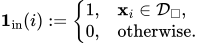
and define the VP count inside the cell as
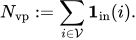
Handling of points exactly on the boundary (faces/edges/vertices) must be locked by a pre-registered tie-break rule; it cannot be changed after seeing results.
12.1.4.2 Required log fields
For N_vp to have conclusion status, the following logs must be sealed.
- Cell definition: D_(square) and the meaning of D_anch (
edge). - Representative-point protocol: what x_i means (coordinates, markers, etc.) and how identity is preserved.
- Inclusion rule: implementation of (S12_01_indicator_in) including the boundary tie-break.
- Hashes and snapshot references for coordinate files (manifest/checksums).
If missing, N_vp is INCONCLUSIVE.
12.1.5 Definition of jamming occupancy φ_jam
12.1.5.1 Occupancy (volume fraction) definition
Define
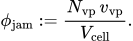
In (S12_01_phijam_def), V_cell references (S12_01_Vcell), v_vp references (S12_01_vvp_sphere), and N_vp references (S12_01_Nvp), each via locked definitions.
12.1.5.2 Measurement conditions in the jammed regime (regime conditions)
Because the name φ_jam means “the occupancy recorded in a jammed state,” we record φ_jam only when the following regime conditions all hold.
- Propagation/rigidity switch: χ_ST=1.
- Non-penetration and successful relaxation: the coordinate/placement does not violate non-penetration and the locked relaxation procedure terminates with its stop condition satisfied.
- Locked cell/representative-point/inclusion rule: (S12_01_cell_domain) and (S12_01_indicator_in) are maintained under the same lock_id.
If any condition fails, φ_jam cannot be recorded as “jamming occupancy” and only a limiting conclusion (CT-LIM) is allowed.
12.1.6 Why the canonical choices are fixed (SSOT/No-Tuning)
The canonical fixings of this section are locked for the following reasons.
- Cell volume V_cell is uniquely determined only when
CELL-CUBEand the meaning of D_anch (edge) are locked. Mixing cell geometries would allow arbitrary changes of φ_jam, so it is prohibited. - VP occupied volume must be determined by a alone. If the shape freedom (κ_vp) is released, then φ_jam becomes tunable after the fact. Therefore we seal the canonical closure (S12_01_kappa_sphere).
- The inclusion rule (center-in-cell) and the boundary tie-break determine the count N_vp; changing rules changes φ_jam retroactively. Therefore the inclusion rule must be pre-registered and post hoc changes are prohibited.
12.1.7 Immediate FAIL conditions (confusion/post hoc tuning)
The following violations are treated as immediate FAIL.
- Mixing cell geometries (mixing
CELL-CUBEand visualization spherical cells) or mixing the meaning of D_anch (edge/diameter/radius). - Using a as if it were a radius, or post hoc changing κ_vp in v_vp (or redefining it in another form).
- Post hoc change of the inclusion rule or the boundary tie-break, or selectively reporting only favorable runs to report N_vp.
- Mixing lock_ids or using coordinates/graphs/counts without sealing (manifest/checksums/registry_snapshot).
12.2 “Electron 1 second” reconstruction formulas
12.2.1 Locked inputs and reference definitions
This section assumes the following inputs are locked.
- Realized time tick (unit: s):

- Canonical electron event rate (definition):

- Rectification constant (locked in the universal regime):

- Required fields of event logs (operational definition of 9.1): each event e must at least have (n(e),θ(e),φ(e)) and θ(e),φ(e)∈[0,2π) must be definable.
Define the half-wave rectifier and survival weight as
![\begin{equation} [x]_+ := \max(0,x), \qquad w(e) := [\cos\theta(e)]_+\,[\cos\varphi(e)]_+. \end{equation}](/physics/eq/physics/phy-12-016.svg)
12.2.2 Tick-based reconstruction of the “1 second” window (integer tick window)
[D-12.2-1] Realized time and ticks
Define the realized time corresponding to a tick n∈Z as

[D-12.2-2] Rule for choosing the 1-second tick-window length
Define the integer tick length corresponding to the realized time 1s by the rule
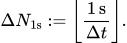
Thus the reconstructed “1 second” duration under integer ticks is

[D-12.2-3] Residual (rounding error) definition
By definition (S12_02_DN1s), the residual is fixed as

and by the floor-function property,

Equation (S12_02_eps_bound) is the deterministic bound that holds when using an integer tick window.
12.2.3 Electron event-count definitions: raw/rectified counts
[D-12.2-4] Tick window and the set of attempted electron events
Define an arbitrary tick window W[n₁,n₂) as

Define the set of attempted electron events as

where Trig_(0,e) is the electron-attempt trigger and is locked in analysis_lock.
Define the raw electron event count as

[D-12.2-5] Rectified (surviving) electron event count
Define the rectified electron event count as
![\begin{equation} N_{e}[n_1,n_2) := \sum_{e\in\mathcal{E}_{0,e}[n_1,n_2)} w(e) = \sum_{e\in\mathcal{E}_{0,e}[n_1,n_2)} [\cos\theta(e)]_+[\cos\varphi(e)]_+. \end{equation}](/physics/eq/physics/phy-12-025.svg)
By definition,

12.2.4 “Electron 1 second” reconstruction (two forms: tick/event)
This section reconstructs and fixes “electron 1 second” in two equivalent forms (equivalence holds only when Gates pass).
12.2.4.1 Tick-based reconstruction
The tick-based “electron 1 second” is the time duration defined by (S12_02_Ttick).

12.2.4.2 Event-based reconstruction
Because the canonical electron event rate is locked by (S12_02_nue_can), define the event-based reconstruction of time as

Thus fix the event-based reconstruction of “electron 1 second” as

That is, under the same tick-window length Δ N_1s, the rectified electron event count becomes the event-based “1 second” value.
12.2.5 Expectations (mean relations under the canonical stationarity axiom)
In the regime where the canonical stationarity axiom holds (9.2 [A-9.2-S1]), this section fixes the following expectation relations.
12.2.5.1 Expected rectified event count
By definition, the canonical event rate is
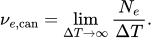
Therefore, in the canonical stationarity regime we record
![\begin{equation} \mathbb{E}\!\left[N_{e}[n_1,n_2)\right] = \nu_{e,\mathrm{can}}\ \Delta T, \end{equation}](/physics/eq/physics/phy-12-031.svg)
where Δ T=(n₂-n₁)Δ t. Substituting ν_e,can=1 yields
![\begin{equation} \mathbb{E}\!\left[N_{e}[n_1,n_2)\right] = \Delta T. \end{equation}](/physics/eq/physics/phy-12-032.svg)
12.2.5.2 Expectation in a 1-second window
In particular, for a window with Δ T=1s,
![\begin{equation} \mathbb{E}\!\left[N_{e}(1\mathrm{s})\right] = \nu_{e,\mathrm{can}}\cdot 1\,\mathrm{s} = 1. \end{equation}](/physics/eq/physics/phy-12-033.svg)
When using an integer tick window, Δ T=T_tick(1s), hence
![\begin{equation} \mathbb{E}\!\left[N_{e}^{(\mathrm{tick})}\right] = \widehat{T}_{\mathrm{tick}}(1\mathrm{s}) = \Delta N_{1\mathrm{s}}\Delta t. \end{equation}](/physics/eq/physics/phy-12-034.svg)
12.2.5.3 Expected raw count (reference relation)
Applying the canonical event-rate law ν_can=s·δ to the electron gives

Therefore the expected raw event count is
![\begin{equation} \mathbb{E}\!\left[N_{0,e}[n_1,n_2)\right] = s_e\,\Delta T = \frac{\Delta T}{\delta}. \end{equation}](/physics/eq/physics/phy-12-036.svg)
In the universal regime where δ=1/π² is locked,
![\begin{equation} \mathbb{E}\!\left[N_{0,e}(1\mathrm{s})\right] = \frac{1}{\delta} = \pi^2. \end{equation}](/physics/eq/physics/phy-12-037.svg)
Equation (S12_02_EN0e_1s) represents the expected number of raw (attempt) electron events in a 1-second window; it cannot be used in a regime where the universality of δ is broken.
12.3 φ_jam measurement, LOCK, error budget, and falsification triggers
12.3.1 Purpose
This section fixes a protocol to (i) measure the jamming occupancy φ_jam as a loggable operational definition, (ii) seal it by LOCK so it does not change within the same version, and (iii) connect sensitivity (error budget) and (iv) falsification triggers (breaking conditions) to Gates for judgment.
12.3.2 Definition: standard formula for φ_jam (single source)
12.3.2.1 Canonical cell volume
The canonical cell is locked as CELL-CUBE and D_anch is locked as edge. Define

12.3.2.2 VP effective occupied volume (canonical closure)
The realized length scale a is locked as the VP diameter (diameter). Define

κ_vp is the canonical volume closure and does not change within the same version.
12.3.2.3 VP count inside the cell
Assume the VP representative point (center) x_i is defined by a locked protocol. Define the canonical cell domain

and define the inclusion indicator
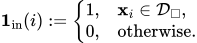
Boundary handling (include/exclude) must be locked by a pre-registered tie-break rule. Define
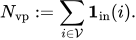
12.3.2.4 Jamming occupancy
Define
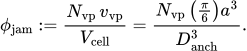
Equation (S12_03_phijam) is the only source of φ_jam in this section; φ_jam is not redefined elsewhere.
12.3.3 Measurement procedure (state-snapshot based)
12.3.3.1 Set of measurement states
Measurements are performed on the set of complete state snapshots S_obs:
![\begin{equation} \mathcal{S}_{\mathrm{obs}}:=\{\,S[n]\mid n\in W_{\mathrm{obs}}\ \wedge\ \mathrm{Complete}(S[n])=1\,\}, \end{equation}](/physics/eq/physics/phy-12-044.svg)
where W_obs is the observation tick window and Complete(S[n]) is the state-log completeness judgment (locked by the operational definition of 9.1).
12.3.3.2 Computing φ_jam per state
For each S[n]∈S_obs:
- Read D_anch (from
canon_lock). - Read a (from
realization_lock). - Read x_i from the coordinate set and compute 1_in(i) via (S12_03_indicator).
- Compute N_vp(n) via (S12_03_Nvp).
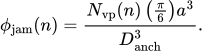
- Compute φ_jam(n) via (S12_03_phijam).
Hence
12.3.3.3 Window aggregation (optional)
The aggregation rule (mean/median/trimmed mean, etc.) is locked in analysis_lock. When choosing mean aggregation,
![\begin{equation} \overline{\phi}_{\mathrm{jam}} := \frac{1}{|\mathcal{S}_{\mathrm{obs}}|}\sum_{S[n]\in\mathcal{S}_{\mathrm{obs}}}\phi_{\mathrm{jam}}(n), \qquad |\mathcal{S}_{\mathrm{obs}}|>0. \end{equation}](/physics/eq/physics/phy-12-046.svg)
Define the variance (fluctuation) indicator as
![\begin{equation} \sigma_{\phi}^2 := \frac{1}{|\mathcal{S}_{\mathrm{obs}}|}\sum_{S[n]\in\mathcal{S}_{\mathrm{obs}}}\left(\phi_{\mathrm{jam}}(n)-\overline{\phi}_{\mathrm{jam}}\right)^2, \qquad \sigma_{\phi}:=\sqrt{\sigma_{\phi}^2}. \end{equation}](/physics/eq/physics/phy-12-047.svg)
12.3.4 Sensitivity (error budget) definition
This section records two kinds of error sources separately.
- Input-scale error: uncertainties assigned to D_anch and a (which may be recorded in the corresponding locks).
- Count/judgment error: uncertainties from the VP counting procedure, boundary handling, representative-point definition, and inclusion rule (evaluated only by pre-registered judgment protocols).
12.3.4.1 Differential-based sensitivity (general form)
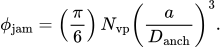
From (S12_03_phijam), rewrite
Hence

The first-order relative sensitivity is

Because κ_vp=π/6 is locked as the canonical closure, dκ_vp=0 within the same version.
12.3.4.2 Count uncertainty (boundary-ambiguous counts)
Pre-register and lock a boundary ambiguity width ε_b>0 (length unit; fixed either in internal or realized units). Define the number of VPs near the boundary as

Here dist(·,∂D_(square)) is the minimum distance between the point and the cell boundary; the computation protocol is locked in analysis_lock.
Define the worst-case count uncertainty as

Then record the worst-case relative error bound as

Δ a,Δ D_anch are derived from uncertainties recorded in the corresponding locks or from pre-registered uncertainty protocols. If not recorded, they may be treated as zero (by a chosen protocol), but the choice protocol itself must be pre-registered.
12.3.4.3 Between-window variability (drift budget)
Split the observation window into M≥2 blocks, compute each block mean φₘ, and define the drift metric
![\begin{equation} \overline{\phi}_m := \frac{1}{|\mathcal{S}_m|}\sum_{S[n]\in\mathcal{S}_m}\phi_{\mathrm{jam}}(n), \qquad R_\phi:=\frac{\max_m \overline{\phi}_m-\min_m \overline{\phi}_m}{\max(\overline{\phi}_{\mathrm{jam}},\varepsilon_\phi)}. \end{equation}](/physics/eq/physics/phy-12-054.svg)
Here ε_φ>0 is a denominator-protection constant locked in analysis_lock. R_φ is the “between-window drift” indicator and is connected to a Gate threshold (12.3.5).
12.3.5 Falsification triggers (FAIL conditions) and Gate
This section defines the conditions under which the definition/measurement/sealing system for φ_jam breaks, and records them as falsification triggers with FAIL labels.
12.3.5.1 Trigger F1: regime violation (not jammed)
Jamming occupancy is recorded only in the jammed regime. If the jamming indicator (rigidity switch) does not satisfy

then it is an immediate failure.
12.3.5.2 Trigger F2: non-penetration/relaxation violation
If the coordinate placement violates non-penetration (minimum separation), then the cell/VP volume aggregation is not recognized as jammed. When the minimum separation length d_(min) and tolerance ε_pos are locked,

12.3.5.3 Trigger F3: range violation (impossible values)
By definition (S12_03_phijam), φ_jam cannot be negative. Also, abnormally large occupancy relative to cell volume is treated as a definition collision or a count/scale error. Lock an upper threshold φ_(max)>0 in gate_lock.

12.3.5.4 Trigger F4: excessive boundary ambiguity width
Lock a boundary-ambiguity ratio threshold η_amb∈(0,1) in gate_lock.

This is a falsification trigger meaning that, even with a locked inclusion rule, too many samples lie near the boundary for φ_jam to be stably defined.
12.3.5.5 Trigger F5: drift (breakdown of steady state)
Lock a drift threshold ε_drift>0 in gate_lock.

Equation (S12_03_fail_drift) means that φ_jam did not settle into a steady state over the observation interval.
12.3.5.6 Trigger F6: lock/sealing violation
If any of the following occurs, it is an immediate failure.
- Mixing the meaning of D_anch (
edge) or mixing cell geometry (CELL-CUBE). - Mixing the meaning of a (
diameter) or mixing units. - Post hoc change of the value of κ_vp (or the volume model).
- Mixing lock_ids or failing to seal
manifest/checksums/registry_snapshot.
Fix the violation label as

12.3.5.7 φ_jam Gate (final judgment)
Define the final Gate as

If G-PHIJAM≠PASS, then φ_jam cannot be used as evidence for conclusions, and only limiting conclusions (CT-LIM) are allowed.
12.3.6 Reporting protocol (required logs and sealing)
The φ_jam result must be recorded and sealed in the following record (schema locked in protocol_lock).
phijam_report:
  - phijam_id: (unique)
    regime_id: ...
    state_window: [n1,n2)
    D_anch: ...
    a: ...
    kappa_vp: pi/6
    V_cell: D_anch^3
    v_vp: (pi/6)*a^3
    N_vp: ...
    N_amb: ...
    phi_jam: ...
    phi_mean: ...          # optional (window aggregation)
    phi_sigma: ...         # optional
    drift_Rphi: ...        # optional
    thresholds:
      phi_max: ...
      eta_amb: ...
      eps_drift: ...
      eps_b: ...
    error_budget:
      rel_bound: ...       # in the form of eq. (S12_03_rel_bound)
      components: {dN_over_N, 3*da_over_a, 3*dD_over_D}
    gate_refs:
      G-PHIJAM: PASS|FAIL|INCONCLUSIVE
      labels: [...]
    lock_refs:
      canon_lock_id: ...
      realization_lock_id: ...
      analysis_lock_id: ...
      gate_lock_id: ...
      protocol_lock_id: ...
    snapshot_refs:
      manifest_ref: ...
      checksums_ref: ...
      registry_snapshot_ref: ...
Records missing manifest_ref/checksums_ref/registry_snapshot_ref cannot be granted conclusion status.