Appendix E. Geometric origin of the electron mass and direct measurement
Appendix E. Geometric origin of the electron: This appendix assumes the following inputs are locked. In the universal regime where δ=1/π² applies. The goal is to fix (i) the electron radius rₑ, (ii) the electron resistance integral S, and (iii) the electron mass mₑ in closed form via define→substitute→eliminate.
This appendix assumes the following inputs are locked. In the universal regime where δ=1/π² applies.
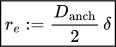
Corrected in place (v0.5.0). Earlier versions of this appendix ran the mass resistance integral to the event-rate radius rₑ=(D_anch/2)δ, which inserts a spurious factor π² into mₑ (yielding ≈ 5.04 MeV). Per the §13.5.4 canon the mass-bearing length is the Compton length λ_(C,e)=D_anch/2; rₑ=r₀δ governs only the event rate νₑ=1 (§9.3). The integral below is corrected accordingly; the historical error is recorded here, not hidden.
E.0 Locked inputs and goals
This appendix assumes the following inputs are locked.
- Action-unit constant: h.
- Operational anchor speed constant: c_ref.
- Realized length (volume-particle diameter): a.
- Anchor length: D_anch.
- Rectification coefficient: δ (in the universal regime, δ=1/π²).
- Lattice unit energy (single source of truth):
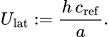
The goal is to fix (i) the electron radius rₑ, (ii) the electron resistance integral S, and (iii) the electron mass mₑ in closed form via define→substitute→eliminate.
E.1 Definition of the electron radius rₑ (canonical)
Define the electron radius as follows.
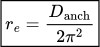
In the universal regime where δ=1/π² applies,
E.2 Operational definition of the electron resistance integral S (layer integral)
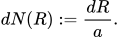
Define the radial coordinate R on 0≤ R≤ λ_(C,e) (the mass-bearing Compton length, §13.5.4). If the thickness of one layer is fixed as the VP diameter a, then the number of layers (dimensionless) in an infinitesimal interval dR is
Define the electron resistance integral S by the following integral.
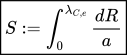
Since a is locked as a constant, expanding the integral gives
![\begin{align} S &=\int_{0}^{\lambda_{C,e}}\frac{dR}{a} =\frac{1}{a}\int_{0}^{\lambda_{C,e}} dR =\frac{1}{a}\Bigl[R\Bigr]_{0}^{\lambda_{C,e}} =\frac{\lambda_{C,e}}{a}. \end{align}](/physics/eq/physics/phy-axe-005.svg)
Therefore

Since λ_(C,e)=D_anch/2,

(No δ enters: the spurious universal-regime form S=D_anch/(2aπ²) of earlier drafts is withdrawn; see the correction banner above and §13.5.4.)
E.3 Definition of the electron mass mₑ and closed form
Applying the mass=resistance axiom (operational definition) to the electron,

we define it as above. Substituting (AppE_S_final) gives
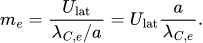
Also, substituting (AppE_Ulat) into (AppE_me_expand1) gives

Therefore, under the same lock version,

it is fixed in this closed form — coinciding with the §13.5.4 calibration node (an anchor, not a prediction).
E.4 Sensitivity (dependence on changes in locked values)
From (AppE_me_final), when h,c_ref are locked,

(δ no longer enters the mass; it governs only the event rate, §9.3.)
E.5 Deterministic verification script (electron mass evaluation)
# verify_appendix_E.py
# Purpose: compute r_e, S, m_e using only LOCK values from registry, and
#         leave a log (identifiers/hashes) of the computation process as a deterministic script.

import json
import hashlib
from math import pi

def sha256_file(path: str) -> str:
    h = hashlib.sha256()
    with open(path, "rb") as f:
        while True:
            b = f.read(1024 * 1024)
            if not b:
                break
            h.update(b)
    return h.hexdigest()

def read_json(path: str) -> dict:
    with open(path, "r", encoding="utf-8") as f:
        return json.load(f)

def main():
    canon = read_json("registry/canon_lock.json")
    realz = read_json("registry/realization_lock.json")
    prot  = read_json("registry/protocol_lock.json")
    snap  = read_json("registry/registry_snapshot.json")

    # [LOCK] constants
    h_Js = canon["constants"].get("h_Js", 6.62607015e-34)
    c_ref = realz["inputs"]["c_ref_m_s"]
    a_m   = realz["inputs"]["a_m"]
    D_anch = canon["inputs"]["D_anch_m"]
    assert abs(D_anch/4.852620477e-12 - 1) < 1e-6, "canon D_anch not reconciled to v0.4.1 (2*lambda_Ce=4.8526 pm)"

    # delta: either explicit numeric or derived from pi
    delta_item = canon["constants"].get("delta_rect", "1/pi^2")
    if isinstance(delta_item, (int, float)):
        delta = float(delta_item)
    else:
        delta = 1.0 / (pi**2)

    GeV_to_J = prot["unit_conversions"]["GeV_to_J"]

    # [DERIVED] U_lat
    U_lat_J = (h_Js * c_ref) / a_m
    U_lat_GeV = U_lat_J / GeV_to_J

    # [DERIVED] lambda_Ce (mass-bearing length, S13.5.4), event-rate radius r_e, S, m_e
    lam_Ce = D_anch / 2.0            # Compton length = mass-bearing length
    r_e = lam_Ce * delta             # event-rate radius (nu_e = 1 only; NOT used for mass)
    S = lam_Ce / a_m
    m_e_GeV = U_lat_GeV / S
    assert abs(m_e_GeV / 5.10999e-4 - 1) < 2e-3, "m_e must reproduce 0.511 MeV (S13.5.4 canon)"

    out = {
        "registry_snapshot_id": snap["registry_snapshot_id"],
        "locks": snap["locks"],
        "hashes": {
            "canon_lock_sha256": sha256_file("registry/canon_lock.json"),
            "realization_lock_sha256": sha256_file("registry/realization_lock.json"),
            "protocol_lock_sha256": sha256_file("registry/protocol_lock.json"),
            "registry_snapshot_sha256": sha256_file("registry/registry_snapshot.json"),
        },
        "derived": {
            "U_lat_J": U_lat_J,
            "U_lat_GeV": U_lat_GeV,
            "r_e_m": r_e,
            "S_dimless": S,
            "m_e_GeV": m_e_GeV,
        }
    }

    print(json.dumps(out, indent=2, ensure_ascii=False))

if __name__ == "__main__":
    main()