Axioms and Primitives (Volume Particle / Lattice / Quantum Cell)
Axioms and Primitives: The cell lives inside the axioms — it may aggregate, never legislate. Three axioms and a list of forbidden smuggled assumptions. If χ_ST=0 we classify as non-stiff; if χ_ST=1 we classify as stiff. This chapter fixes, for the entire document, the minimal building blocks of the world as primitives. Grade [F] forced.
The cell lives inside the axioms — it may aggregate, never legislate. Three axioms and a list of forbidden smuggled assumptions. If χ_ST=0 we classify as non-stiff; if χ_ST=1 we classify as stiff.
Chapter declaration: a single backbone starting from primitives
This chapter fixes, for the entire document, the minimal building blocks of the world as primitives. The primitives are (i) the Volume Particle (VP), (ii) the Stone regime, and (iii) the Cell (Anchor Cell). Their relationship is fixed as a single backbone as follows.

In Eq. (primitive_chain), items to the right depend on items to the left. Retroactive interpretation in the opposite direction (changing a left-hand definition because a right-hand result is inconvenient) is not allowed.
VP axiom set (fixing a minimal set of axioms)
The Volume Particle (VP) is the basic unit constituting space. The properties of VP are fixed by the following axiom set. Each axiom has a distinct meaning; redundant statements across axioms are forbidden.
(VP-A1) Stone axiom: infinite rigidity (incompressible) and identity
Every VP has the “Stone” property. The Stone property is fixed as follows.
- Incompressible: the internal volume of a VP does not change. The internal volume of the same VP does not decrease or increase due to state change or configuration change.
- Non-penetration: two different VPs cannot occupy the same spatial region simultaneously. In other words, occupied regions of VPs do not overlap.
- Identity: VPs are treated as identical basic units; no intrinsic “species” differences are introduced at the axiomatic level. Differences are expressed only by configuration, contact relations, and local state variables (defined later).
This axiom does not introduce “rigidity” as an additional dynamical law; it is introduced as a constraint that restricts the set of admissible configurations. In short, the Stone axiom fixes the domain of “possible configurations” first.
(VP-A2) Full-packing axiom: space is fully occupied
Space is fully occupied by VPs. The full-packing axiom is fixed as follows.
- Full occupation: inside the region of interest (a cell or a domain), space is represented by the union of VP-occupied regions.
- Where defects live: an explicit “void” degree of freedom that violates full packing is not introduced as a primitive. Instead, defects, throats, gaps, and deficits appear only as local structural quantities defined as consequences of configuration and adjacency (later fixed as objects).
- Boundary treatment: a boundary does not mean “outside VP.” It is fixed as a procedural boundary introduced by domain selection (cell selection). The boundary type (closed/open/driven) is locked as part of the protocol.
(VP-A3) Local-rule axiom: contact-based configuration and local update
Changes of VP configurations are defined only by local rules. The local-rule axiom is fixed as follows.
- Contact-based: VP–VP interaction is expressed only through “contact” or “proximity.” Contact is reduced to adjacency; adjacency is recorded via a graph or lattice structure.
- Local update: changes (rearrangement, driving, relaxation) occur locally, and the update rule is protocol-locked. Updates are never defined in a way that exits the set of admissible configurations.
- Place for state variables: internal state variables carried by a VP (e.g., phase, orientation, local indicators) are only given a slot in this axiom. The concrete list and meaning of those state variables are defined and locked later.
(VP-A4) Adjacency axiom: lattice/graph as a primary object
A configuration is externalized as an adjacency structure. The adjacency axiom is fixed as follows.
- Adjacency graph: for a VP set V inside a domain, define an edge set E by an adjacency relation and construct a graph G=(V,E).
- Lattice/network: in this document, “lattice” does not mean a regular array; it is fixed to mean a network object whose adjacency graph provides connectivity/transfer inside the domain.
- Place for measurement: length-like quantities (distance, thickness, gap, etc.) are derived by combining the adjacency structure with the cell definition. They are not given as primitives that define adjacency itself.
(VP-N1) Effective stiffness depends on observation time: dynamic rigidity, jamming, and unjamming
The Stone axiom (VP-A1) locks a constraint: the internal volume of each VP does not change. However, experimentally reported “stiffness” (or stress response) is typically determined by whether a VP ensemble can rearrange within the time scale of observation. That is, the relevant observable is dynamic stiffness, not static stiffness, and the same configuration can appear “soft” or “hard” depending on observation time / driving rate.
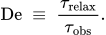
To summarize this with minimal operational variables, introduce a relaxation time τ_(rm relax) and an observation time τ_(rm obs), and use the following dimensionless number as a regime label.
Eggshell transition: a minimal state machine (conceptual)
In this document, “critical” does not mean a single number; it is defined as a regime transition. The response of a VP ensemble can be summarized by the following minimal sequence.
- [A] Flexible regime (elastic-fluid): rearrangement possible (Delesssim 1). “Softness” is observed under slow driving (chemical/thermal, etc.).
- [B] Jammed regime (jammed-solid): a rigid network spans the domain (Degg 1); externally this is observed as “mass/core.”
- [C] Unjamming (shell failure): when the required rigidity (or curvature demand) exceeds a yield limit, the rigid backbone breaks and unjammed channels open.
- [D] Inflow/outflow (flux channel): through the open channels, particles/deficits redistribute abruptly (a speed cap is set by protocol).
- [E] Self-repair (re-jamming): when the load is relaxed, a jamming network reforms and the regime closes.
This sequence justifies the approach of not trying to compute stiffness microscopically to arbitrary precision,
but instead locking the observed critical (yield/saturation) conditions together with the protocol (LOCK),
and then performing derivations and Gate verdicts on top of that.
Therefore, whenever critical scales such as c², g_*, and g^* appear in a conclusion, one must always record the protocol (time window / driving rate / geometry) together;
without that record, the result is treated as INCONCLUSIVE.
Minimal closure: unjamming trigger and self-healing dynamics
To turn the above conceptual sequence into verifiable statements, this document proposes the following minimal operational closure candidates.
First, the trigger of “eggshell” failure (unjamming) is fixed as: a protocol-defined demand Ψ_(rm req)(t) exceeds a yield threshold Ψ_(rm yield).

Here Ψ_(rm req) is locked in analysis_lock (together with type/dimension/unit) by exactly one definition among stress, energy density, curvature demand, event rate, etc.,
and Ψ_(rm yield) is locked together under the same protocol (no post-hoc adjustment).
To align symbols with later saturation/yield descriptions (e.g., Appendix G), one can introduce the effective demand after yielding as follows.

By definition, Ψ_(rm eff)(t)≤ Ψ_(rm yield).
Second, introduce a macroscopic state variable ξ(t)∈[0,1] representing the “health” of the jamming network (ξ=1: jammed, ξ=0: fully unjammed). Close self-repair (re-jamming) with a first-order relaxation; the simplest form is the following piecewise dynamics.
![\begin{equation} \dot \xi(t)= \begin{cases} -\dfrac{\xi(t)}{\tau_{\rm break}}, & \Psi_{\rm req}(t)>\Psi_{\rm yield},\\[6pt] +\dfrac{1-\xi(t)}{\tau_{\rm heal}}, & \Psi_{\rm req}(t)\le \Psi_{\rm yield}. \end{cases} \end{equation}](/physics/eq/physics/phy-03-004.svg)
Here τ_(rm break) and τ_(rm heal) are time scales depending on regime/environment/defect distribution and are locked in analysis_lock.
If needed, an effective stiffness (or resistance) can be connected by a linear mixture such as
K_(rm eff)(t)=K_(rm soft)+(K_(rm jam)-K_(rm soft))ξ(t),
and the stiffness indicator χ_ST of Sec. 3.2 can be closed as a threshold function
χ_ST=1[ξ≥ ξ_(rm th)] (the threshold ξ_(rm th) is protocol-locked).
Third, to connect the “inflow/outflow (flux channel)” of stage [D] to the flux definition in Sec. 4.1, introduce the channel-open indicator
![\begin{equation} \chi_{\rm open}(t):=\mathbf{1}[\Psi_{\rm req}(t)>\Psi_{\rm yield}] \end{equation}](/physics/eq/physics/phy-03-005.svg)
and one can fix, as an operational cap for a cut flux J (Definition (flux_def)), at least

This is the minimal statement that treats “inflow at the speed of light” not as an identity (=) but as an upper bound (≤). Whether a nonzero flux can exist in the regime χ_(rm open)=0 is judged separately by the protocol definition.
This closure is not a substitute for microscopic rules. It is a minimal model to describe dynamic rigidity (time-scale dependence) and the jamming–unjamming transition in an experimentally decidable form. The purpose of these equations is not “decimal places” but to separate and record (i) when a transition happens (Trigger) and (ii) how fast the system recovers (Time-scale) as measurable parameters.
Stone regime and its relation to the VP axioms
Stone is another name for the infinite rigidity introduced in VP-A1; in this document it is not an “additional entity.” Stone means the following.
- The regime in which the incompressibility constraint of VPs applies globally is called the “Stone regime.”
- In the Stone regime, “volume change” is not treated as a degree of freedom; derivations proceed only via configuration (adjacency) and local update rules.
- The scope of applicability (when the Stone regime is assumed) is locked as a regime declaration; extensions outside the Stone regime are introduced only as closure candidates in separate sections.
Therefore, “Stone” is a shorthand that refers to an axiom set; introducing Stone does not import a new evidence system.
Cell definition: a primary object for aggregation and coordinates
A Cell is a unit of aggregation introduced to describe VP configurations and also a reference for coordinates. A cell can be defined only within the constraints of VP-A1~ VP-A4. The core of the cell definition is to lock the following three items.
- Object attribution: the cell is fixed as object
OBJ-CELL; a cell represents a domain selection that groups a VP set. - Cell geometry: lock the geometry type of the cell (e.g., cubic cell), and lock the meaning of the representative cell length (edge length / diameter / radius) as exactly one.
- Representative cell length: the representative cell length (e.g., D_anch or an equivalent notation) is locked as a canonical input in
canon_lockand is never reinterpreted in later sections.
A cell is not “a property of VP”; it is “a way of describing VP configurations.” That is, the cell exists only as a tool for describing a world constrained by axioms, not as a source of axioms.
3.5 Coupling the VP axioms with the cell definition: what is prior and what is derived?
The coupling priority between the VP axiom set and the cell definition is fixed as follows.
- Priority 1 (VP axioms): the set of admissible configurations (incompressible, non-penetration, full packing, local updates, adjacency) is fixed first.
- Priority 2 (cell definition): within the admissible set, the cell selects a domain and performs aggregation and coordinatization.
- Priority 3 (derived quantities): inside the cell, counting, distributions, paths, throats, and event aggregation are defined, and derivations of length/time/energy/mass follow.
Therefore, the following retroactive moves are forbidden.
- Retroactively changing the cell geometric meaning (diameter/radius/edge) so that a derived result takes a desired numerical form.
- Retroactively relaxing or reinterpreting the VP axioms (incompressible, non-penetration, full packing) based on a derived result.
- Swapping the adjacency-definition rule (graph construction convention) to fit a result without performing versioning.
Allowed change exists only by versioning (a new lock_id). After a version upgrade, one must rerun the entire chain
VP axioms → cell → derived quantities → Gate verdicts.
3.1 VP axioms (minimal assumptions)
3.1.1 [D]
In this section [A] denotes an axiom. An axiom is a starting point that is not further derived in the theory and is not modified within a single version. In this section [D] denotes a definition. A definition is a linguistic /formal convention that fixes the meaning of all subsequent statements; if a definition changes, the same symbol would point to a different target, therefore definitions are also not modified within a single version. This section locks infinite rigidity, full packing, and the local rule as [A] for the VP world, and locks the essential terms used by those axioms as [D]. We also list examples of assumptions that are easy to sneak in but are prohibited within the same version.
3.1.2 [D] Primitive objects and basic terms
[D-1] VP
A Volume Particle (VP) is the basic constituent unit of space. A VP is defined not as a “point” or a “coordinate” but as an object that has an occupied region. The set of VPs is denoted by V.
[D-2] configuration
Inside a domain (see [D-4]), each VP i∈V has an occupied region Ω_i. A configuration is defined as the set Ω_i_i∈V. Configurations are classified as “admissible” or “inadmissible”; the criterion is determined by [A].
[D-3] non-overlap
For two distinct VPs i≠ j, define impenetrability (non-overlap) as the property that the intersection of occupied regions is empty:

Non-overlap is used only as a condition on admissible configurations, not as a force law or an equation of motion.
[D-4] boundary
A domain D is a finite region of interest in which derivations and aggregations are performed. Domain selection is a procedural choice and does not change the properties of VPs. A boundary is the separation introduced by choosing a domain; the boundary type (closed/open/driven) is not an axiom but a protocol item.
[D-5] Full Packing
Define Full Packing as the property that the union of VP occupied regions fills the domain. In this section, “fills” is locked to mean that we introduce no new degrees of freedom for empty space. That is, void space inside the domain is not treated as an independent object; it is treated only as a structural quantity defined as a consequence of configuration and adjacency.
[D-6] adjacency
Two VPs i,j are said to be “in contact” when a pre-registered contact predicate (one of: distance-based, surface-based, etc.) is satisfied. The contact predicate itself is a definition item and may not be replaced after seeing results. Adjacency is the discrete record of contacts. Define the adjacency graph as G=(V,E), where (i,j)∈E means that i and j are adjacent.
[D-7] neighborhood
Define the local neighborhood of VP i by

The neighborhood is the minimal unit that determines “what information is local.”
[D-8] global update
A local update is an operation that changes part of a configuration by depending only on a chosen VP i and its neighborhood N(i). Denote it by an operator U_i. A global update is an update that can be expressed as a finite composition of local updates:

The composition order and selection rule are fixed as a protocol and may not be arbitrarily swapped after seeing results.
3.1.3 [A] Fixing the VP axiom set (minimal assumptions)
[A-1] Infinite rigidity (Stone): volume invariance and non-overlap
The infinite-rigidity axiom is fixed by the following two statements.
- Volume invariance: the internal volume of every VP does not change. That is, in any admissible configuration the “volume measure” of each occupied region Ω_i is preserved. This holds regardless of configuration changes, updates, or driving.
- Non-overlap: in every admissible configuration, VP occupied regions do not overlap ([D-3]). Non-overlap is not relaxed after seeing results; any configuration that violates it is judged inadmissible and cannot be used as an input for derivation/verification.
This axiom does not introduce “rigidity” as a dynamical law. Infinite rigidity is a constraint axiom that restricts the admissible configuration set; no later section interprets it as “tuning a rigidity value.”
[A-2] Full Packing: banning empty space as an independent degree of freedom
The full-packing axiom is fixed as follows.
- Inside the domain D, space is fully occupied by VPs ([D-5]). That is, we do not add “unoccupied space” as an independent object (or an independent field).
- Any structure that appears inside the domain, such as a gap, a deficit, or a throat, is defined not as “empty space itself” but only as a structural quantity derived from VP configuration and adjacency.
Therefore, the full-packing axiom forbids a mixed world of the form “space = VP + (additional medium).” If an additional medium is introduced, the meaning of full packing changes, hence it is not allowed within the same version.
[A-3] Local Rule: neighborhood-dependent updates
The local-rule axiom is fixed as follows.
- Locality: every change (rearrangement, relaxation, driving, transport) is expressed as a composition of local updates that depend only on the local neighborhood N(i) ([D-8]).
- Admissibility preservation: a local update U_i may not generate a configuration that violates [A-1] and [A-2]. That is, updates are defined only in a way that preserves non-overlap and full packing.
- Pre-registration of rules: the selection rule for local updates (which i is chosen), composition order, repetition condition, and termination condition are fixed as a protocol and may not be changed after seeing outcomes.
The local-rule axiom forbids a “one-shot global rule.” If a one-shot global rule is introduced, what counts as local information and what counts as global information can be retroactively adjusted, which structurally violates No-Tuning.
3.1.4 [D] Immediate consequences (admissible/inadmissible verdicts)
The axioms in this section immediately provide the following verdict criteria.
- Violating [A-1] (volume invariance or non-overlap) yields an inadmissible configuration.
- Violating [A-2] (adding empty space as an independent degree of freedom, or treating gap/throat/deficit as an independent object) yields an inadmissible description.
- Violating [A-3] (a global update that cannot be described by neighborhood-based local updates, or post-hoc modification of rules) yields an inadmissible procedure.
These verdicts are not softened by “interpretation.” The verdict is determined automatically by definitions and axioms; changing the meaning of axioms in order to dispute a verdict is forbidden within the same version.
3.1.5 Examples of prohibited extra assumptions (brief)
The following are examples of additional assumptions that are easy to insert on top of the minimal axiom set, but are prohibited within the same version. The list is only to clarify what is prohibited; it does not introduce new axioms.
- A universal interaction assumed as a function of distance only: adding a universal function f(d_(ij)) for every VP pair (i,j) and using it as the ground for all later derivations.
- Introducing a global continuous field: introducing a continuous field (scalar/vector, etc.) defined over the whole domain as a primary object, then treating the VP configuration as a secondary consequence.
- Axiomatizing equilibrium/optimization goals: adding a global principle of the form “a global objective is always minimized/maximized” and retroactively constructing local rules to fit that goal.
- Axiomatizing a probability distribution: fixing a specific distribution (e.g., a particular noise model or randomness) as a primary axiom for the initial condition or update process and justifying results as a consequence of that distribution.
- Automatically axiomatizing isotropy/homogeneity: adding “same in all directions” or “same at all positions” as an axiom and erasing anisotropy/defect structures that appear in actual configurations/adjacency.
- Implicitly axiomatizing cell geometry: promoting the choice of a particular cell geometry (cube/sphere, etc.) into an “axiom” without separately recording its influence on derived results.
If any of the above must be adopted, it cannot be silently merged into the axiom set. It must be (i) explicitly written as a definition or closure, (ii) scope-locked, and (iii) judged by Gates. “Quiet insertion” within the same version is prohibited.
3.2 Jamming lattice and Point-J
3.2.1 Fluidity as Failure Rate
In this theory, since VPs have infinite rigidity (Stone), we do not add “softness” or “viscosity” as new axioms. Observed “fluidity” is defined not as an intrinsic material property but as the statistics of events—collapse and recovery of the stiffness network (the jamming lattice). Thus we do not declare fluid/solid as separate phases (additional axioms); instead, on the same VP axioms we judge them via a stiffness failure rate.
Failure rate
Lock a protocol P and an observation window W=[t₀,t₀+Δ t] (LOCK). Let N_total(W) be the total number of update/observation steps in W, and at each step n=1,…,N_total(W) construct a jamming lattice mathfrakJₙ. Using the stiffness indicator χ_ST(mathfrakJₙ) defined in 3.2.3.3, define the total number of “non-stiff (unjamming) events” by
![\begin{equation} N_{\mathrm{unjam}}(W) :=\sum_{n=1}^{N_{\mathrm{total}}(W)} \mathbf{1}\!\left[\chi_{\mathrm{ST}}\!\left(\mathfrak{J}_n\right)=0\right] \end{equation}](/physics/eq/physics/phy-03-007.svg)
(the event index n and the construction convention for mathfrakJₙ must be part of P). The fluidity index is then defined as
![\begin{equation} \phi(\mathcal{P};W):=\frac{N_{\mathrm{unjam}}(W)}{N_{\mathrm{total}}(W)}\in[0,1] \end{equation}](/physics/eq/physics/phy-03-008.svg)
04_vp_whitepaper/LOCK/fluidity_phi_lock.json.
Interpretation: “it resists when struck, but flows when pushed”
φ depends on the observation window and the driving rate. For a short observation time scale τ_(rm obs) as in high-speed impact, rearrangements are suppressed (Deborah-like (deborah_like) gives Degg 1), χ_ST=1 persists within W, and a “solid-like” response with φ≈ 0 appears. Conversely, under slow driving, rearrangement/slip events accumulate (Dell 1), events with χ_ST=0 repeat, φ increases, and a “fluid-like” response appears. Moreover, under a large load, if the yield condition (unjamming_trigger) is satisfied, φ can surge, producing an unjamming (channel-opening) transition.
Reader map (NON-LOCK)
For convenience, a compact mapping between this failure-rate definition and the familiar solid/liquid/gas language is provided in Appendix L. Appendix L is explicitly interpretive (NON-LOCK): it introduces no new axioms and is never used as an input to any locked numerical derivation.
Purpose and premises
This section externalizes a VP configuration into an adjacency structure, distinguishes within a domain the regimes in which “global transmission (connectivity)” holds or fails, and defines their boundary as Point-J. The “stiff/non-stiff” used here is not grounded on external continuum notions such as elastic moduli. In this section, stiff/non-stiff is a structural regime defined only by (i) an adjacency graph, (ii) a set of domain boundaries, and (iii) pre-registered judgement conventions.
Reader note (4-3-1 dictionary)
For a compact state-language mapping (solid–liquid–gas vs. jammed–flowing–unjammed) tied to φ and χ_ST, see Appendix L.
3.2.2 Definition of the jamming lattice
3.2.2.1 Domain and boundary sets
Define the domain D as a finite region composed of one cell or a union of cells. Inside the domain, designate “two opposing boundary sets.”

∂D⁻ and ∂D⁺ are two subsets selected on the domain boundary ∂D and are used only as a criterion to judge whether global transmission holds.
The selection rule for the boundary sets (e.g., which face is taken as ∂D⁻) is fixed as a procedure locked in analysis_lock.
3.2.2.2 Contact predicate and contact graph
Let the VP set be V and each VP be indexed by i∈V. Define a binary contact predicate C(i,j) for two VPs i,j by

The contact convention can be defined as (i) distance-based, (ii) surface-based, (iii) persistent-contact-after-relaxation-based, etc., but regardless of the choice, the convention itself must be locked as a definition and cannot be replaced after seeing results.
Define the contact graph (contact network) G_c by

The contact graph is a discrete externalization of the configuration; regime judgement below is performed based on G_c.
3.2.2.3 Node sets touching the domain boundaries
Define the VP node sets that touch the boundary sets ∂D⁻, ∂D⁺ by

The criterion for “touches” (e.g., whether the occupied region crosses the boundary, or whether the VP is within a threshold distance from the boundary) is fixed as a convention locked in analysis_lock.
V⁻ and V⁺ are used as the source/target node sets for global transmission.
3.2.2.4 Jamming lattice
In this section the “jamming lattice” is defined as the bundle of the following four elements.

A jamming lattice mathfrakJ simultaneously includes (i) the domain, (ii) the contact graph, and (iii) the node sets touching the opposing boundaries. The stiff/non-stiff regimes and Point-J are defined only on mathfrakJ.
3.2.3 Definition of stiff / non-stiff regimes
3.2.3.1 Global transmission and “spanning”
If there exists a path in the contact graph G_c from some node in V⁻ to some node in V⁺, we define that “global transmission (spanning connection)” holds. Define the indicator by

Here ileadsto j means that a path from i to j exists in G_c.
3.2.3.2 Bottleneck sensitivity (single cut) and the stiffness backbone
Spanning alone (χ_span=1) does not define “stiffness.” If spanning is maintained by only a single edge or a single node (a chain-like connection), it can collapse immediately by a local defect, and in this section we do not treat it as stiffness. Therefore we define a “bottleneck sensitivity” measure. Define the min-cut size between the two boundary node sets V⁻,V⁺ by

κ_(min) is a structural indicator of “how many edges must be cut to break global transmission.”
The algorithm used to compute κ_(min) (exact/approximate, weighted/unweighted, etc.) is locked in analysis_lock.
Define the stiffness backbone B as a subgraph of the contact graph that satisfies the following conditions.

- (Spanning) Within B, the sets V⁻∩V_B and V⁺∩V_B are connected by a path.
- (Bottleneck lower bound) The min-cut size defined on B satisfies a pre-registered integer lower bound κ_ST:

- (Maximality) Among the subgraphs satisfying the above two conditions, choose B as the one that satisfies a pre-registered “maximality convention” (e.g., maximum number of edges, maximum number of nodes, or maximum score).
κ_ST and the maximality convention are locked in analysis_lock.
This section fixes only the definition and does not force a particular value (e.g., κ_ST=2) as an axiom.
3.2.3.3 Definition of the stiff regime
Define the stiff-regime indicator by

That is, the stiff regime is defined as the set of jamming lattices with χ_ST(mathfrakJ)=1. The essence of the stiff regime is not only “existence of global transmission” but also “existence of a backbone that satisfies a bottleneck lower bound.”
3.2.3.4 Definition of the non-stiff regime
Define the non-stiff regime as the complement of the stiff regime:

The non-stiff regime includes the following two cases.
- (Non-spanning) χ_span(mathfrakJ)=0: no global transmission path exists.
- (Bottleneck collapse) χ_span(mathfrakJ)=1 but no subgraph satisfies the bottleneck lower bound (kappa_threshold): global transmission exists but is structurally fragile, hence a “stiffness backbone” does not hold.
Therefore, the non-stiff regime is fixed to include both “no connection at all” and “a connection exists but without a bottleneck lower bound.”
3.2.4 Switch observables (definitions only)
In this section, “switch observables” are observables (or computables) defined to judge transitions between stiff and non-stiff regimes. We define three types.
3.2.4.1 Primary switch: regime indicator
The primary switch observable is the stiff-regime indicator χ_ST (Eq. (chi_ST)). If χ_ST=0 we classify as non-stiff; if χ_ST=1 we classify as stiff. This classification is a definition and is not softened by numerical approximation or interpretation.
3.2.4.2 Secondary switch: min-cut size
The secondary switch observable is the min-cut size κ_(min) (Eq. (kappa_min)). κ_(min) is an integer; a larger value means that boundary-to-boundary transmission is less sensitive to removing a single edge. This section does not add an extra physical interpretation of κ_(min) and keeps it as a purely structural indicator.
3.2.4.3 Tertiary switch: backbone existence and size
The tertiary switch observable is the existence and size of the stiffness backbone B.

Only when the backbone selection convention is locked do N_B and E_B become comparable observables.
If the convention changes, the backbone can change even for the same configuration, hence the selection convention must be locked in analysis_lock.
3.2.5 Definition of Point-J
Define Point-J as “the boundary at which the stiffness switch transitions when a control parameter is varied.” To do so, define a control parameter u and a family of configurations mathfrakJ(u).
3.2.5.1 Control parameter u (example set)
The control parameter u is defined as an internal indicator that changes the structure of the jamming lattice mathfrakJ monotonically. Examples of admissible control parameters in this document are as follows (choose one or combine).
- Contact-density indicator:

i.e., the mean degree (mean number of contacts).
- Critical-throat-based indicator: if throat objects are defined, use a throat-related indicator (e.g., a representative throat thickness, number of throats, bottleneck-chain indicator, etc.) as u. The throat definition and estimator must be pre-registered in
analysis_lock. - Occupancy-based indicator: if the cell definition is locked, use a monotone indicator obtained from occupancy aggregation (counting) inside the domain as u. The occupancy indicator definition (what is counted and which cell geometry is used) must be locked in
canon_lockandanalysis_lock.
This section does not force a specific choice of u as an axiom.
The chosen u must be locked in analysis_lock and cannot be replaced after seeing results.
3.2.5.2 Point-J (transition point)
Given a family of jamming lattices mathfrakJ(u) parameterized by u, define Point-J by

That is, we define the location of Point-J as the smallest u at which χ_ST transitions from 0 to 1.
If in practice u is given only on a discrete sample grid (e.g., u₁ How to judge “the first transition” (e.g., whether it is stably 1 over repeated runs, or exceeds a certain fraction, etc.) must be locked as a Gate convention in The Anchor Cell is the minimal domain fixed for aggregation and coordinatization of a VP configuration.
The Anchor Cell definition holds only when the following three items are simultaneously locked (LOCK). In this section, the canonical cell geometry is fixed as Fix the geometry type of the canonical Anchor Cell as Define the representative length D_anch of the canonical Anchor Cell as the edge length of Define the canonical Anchor Cell domain D_(square) by The canonical cell volume is fixed by the geometric definition V_(square) is a derived quantity of the canonical definition; if the meaning of D_anch is not locked, V_(square) cannot be used. From the representative canonical cell length, fix the half-length scale r₀ as the following derived definition. The meaning of r₀ is locked as follows. Therefore, statements like “r₀ is the radius of a sphere” hold only when a separate visualization mapping is locked (see 3.3.4 below).
Using r₀ as a sphere radius without such a lock is a definition conflict and is immediate Since the visualization mapping cannot be adjusted after seeing results, the visualization mode must be chosen as one element of the following discrete set and locked in The two modes generate different spherical domains and cannot be mixed within the same section/output. Define the visualization sphere domain by where x_c is the visualization center (geometric center), and r_vis is the radius of the visualization sphere.
The choice of x_c is only a choice of origin for visualization and does not affect canonical derivations.
The visualization radius r_vis is defined only by the mapping rules below. The equal-diameter mode maps the canonical representative length D_anch to the diameter of the visualization sphere.
In this mode, lock From (vis_equal_diameter) it follows immediately that but this equality is permitted only when the visualization mode is locked to The equal-volume mode maps the spherical visualization domain such that its volume equals the volume of the canonical cube cell.
In this mode, lock Therefore the visualization radius is fixed as In this mode, r₀=D_anch/2 remains a canonical half-length scale and cannot be identified with r_vis.
That is, If one needs the sphere diameter in the equal-volume mode, introduce a separate derived symbol and use it.
In that case D_vis is a different symbol from D_anch and may not be conflated as the same name/symbol. The inverse mapping that reconstructs the canonical representative cell length from the visualization domain must be uniquely determined by the visualization mode.
Fix the inverse mapping as follows. The inverse mapping is used only for labeling visualization outputs and axis annotations in figures.
Using the inverse mapping to retroactively tune or redefine the canonical input (D_anch) is forbidden. For the definitions in this section to hold, the following confusion-prohibition rules must always be satisfied; any violation is immediate The quantum diameter is carried as a single anchored constant, D_anch:=2λ_(C,e)=4.8526pm — the same 632.99 nm / mₑ anchor used everywhere else (master SSOT table; single-anchor layering in §11.6, §13.4). It is not determined three independent times; one anchor sets its absolute pm value, and the surrounding structure is forced: What makes the anchor non-arbitrary is structural, not a triangulation. (i) The ratios are π-forced: D/rₚ=π(mₚ/mₑ)=6π⁶, so fixing D fixes rₚ,mₚ,mₑ and the rest with no further input — there is no tunable knob. (ii) The anchor forces a falsifiable prediction: through §10.9 the value of D fixes the visible-light propagation angle χ hypersensitively (0.03% in D ⇒ up to ≈0.17° in χ; corrected from “>1°”, see §LT). A fitted constant cannot generate a narrow-sense optical prediction of this kind; this is the framework's answer to objection B1. Two results then corroborate the structure around the anchor: the proton-mass route returns mₚ/mₑ=6π⁵ (-19 ppm), and the jamming simulation independently reproduces the length to 0.04% (4.8542pm — a selected length with a 7% distribution, scale-anchored to A_geo=cΔ t/a at 0.16%; §11.6). and any longer numeral appearing in the worked cross-checks below (e.g. §9.4) is a computational placeholder, not a precision claim. Consequently every D-anchored output inherits this 0.04%: mₑ=2hc/D, the predicted rₚ=D/(6π⁶), the light angle χ (§10.9), and the length-route νₚ cross-check (§9.4). By contrast the canonical π/integer results — 3π⁴, 6π⁵, 5π, αₑₘ⁻¹, α=2/π, δ=1/π², 82=81+1 — contain no D and carry their stated (exact or independently-graded) accuracy regardless of D. Finally, the rounding is common to both Define ℓ_rot as a length scale introduced by a rotational driving (or rotational selection) protocol.
Before its numerical value, the following semantic fields must be locked. Reinterpretation as a radius is forbidden. If a radius is needed, introduce a derived symbol and use it explicitly. If any field is missing, ℓ_rot is not well-defined; any equation/table/figure/log that uses ℓ_rot is judged immediate In this document, the current status of ℓ_rot is a reference value.
That is, among canonical inputs we fix The meaning of Therefore, in the current version ℓ_rot is a “possible input” but not a “required input” and does not form the evidential basis of the core chain (canonical → events → realization → mass/force). Fix the usage rules of ℓ_rot in its current status ( The following are allowed, provided the scope is locked to the rotational-driving regime and the relevant Gates are passed. The following are immediately forbidden; upon detection they are immediate To adopt ℓ_rot as a canonical input (an input of the mandatory chain), it is not permitted as an in-version edit but only as a LOCK version-up.
The adoption is fixed by the following procedure. Adoption is a declaration that promotes the classification of ℓ_rot as Because promotion changes Under the new lock_id combination, the following must be performed. After promotion, conclusions belong only to the new lock_id combination and cannot be mixed with pre-promotion conclusions. The status of ℓ_rot directly determines its global impact scope in the document.
We declare the scope as follows. In the current status ( If promotion ( The following violations related to ℓ_rot are judged immediate 
analysis_lock and may not be modified after seeing results.3.3 Definition of the Quantum Cell (Anchor Cell)
3.3.1 Status of the Anchor Cell (canonical domain)
OBJ-CELL) and the cell geometry type (CELL-CUBE or CELL-SPHERE-VIS).
CELL-CUBE, and CELL-SPHERE-VIS is allowed only as a visualization mapping.
A visualization mapping may not directly participate in a canonical derivation; to make it participate, a separate LOCK (version-up) and Gate judgement are required.3.3.2 CELL-CUBE

CELL-CUBE. That is,


3.3.3 Fixing r₀ := Dₐnch/2 (half-length scale)
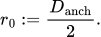
L), and its unit notation is locked in the same family as the unit of D_anch.
FAIL.3.3.4 CELL-SPHERE-VIS
CELL-SPHERE-VIS is a mapping rule that associates the canonical cell (CELL-CUBE) with a spherical domain only for visualization.
The visualization cell does not replace the canonical cell; in canonical derivations the cell is always the cube domain of (cell_geom_cube).
3.3.4.1 Locking the visualization mode (discrete choice)
analysis_lock.
3.3.4.2 Standard definition of the visualization sphere domain

3.3.4.3 VIS-EQUAL-DIAMETER

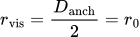
VIS-EQUAL-DIAMETER.
Identifying r₀ with a sphere radius when this mode is not locked is forbidden.3.3.4.4 VIS-EQUAL-VOLUME

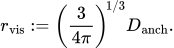


3.3.5 Inverse mapping rule (visualization sphere → canonical cube)
(A) Inverse of VIS-EQUAL-DIAMETER

(B) Inverse of VIS-EQUAL-VOLUME

3.3.6 Confusion-prohibition rules (immediate FAIL)
FAIL.
edge in CELL-CUBE and cannot be used as a diameter or radius in the same context.
VIS-EQUAL-DIAMETER and VIS-EQUAL-VOLUME simultaneously or interchange them.
VIS-EQUAL-DIAMETER is locked. Using r₀=r_vis in any other mode is immediate FAIL.
FAIL.
3.4 Handling of ℓ_rot (reference value)
Concept links: D=ℓ_rot is computed in §9.4; its dynamical origin A=a/g^*, D=2πλ/A is §11.6; the geometric basis of the wavelength mapping is §10.9.
The status of D: a single anchor that is not free.


RCROSS(633/532) channels (§11.4): in D=2πλ/A the cross-consistency reduces to A₆₃₃/A₅₃₂=λ₆₃₃/λ₅₃₂=633/532 with D cancelling, so the two-wavelength agreement is a ratio independent of the value or rounding of D; both channels remain near-transverse (χ≈ 89.8–89.9^(∘), a D-limited distribution) under (lightangle_master).3.4.1 Definition of ℓ_rot and required lock fields
OBJ-CELL, OBJ-CORE, OBJ-THROAT).


L); lock its unit notation to one of the registry-approved length units (e.g., pm).
FAIL.3.4.2 Current status: “reference value (CANON-REF)”

CANON-REF is as follows.
3.4.3 Rules for using a reference value (allowed vs forbidden)
CANON-REF) as follows.3.4.3.1 Allowed uses (only inside the extended regime)
3.4.3.2 Forbidden uses (forbidden in reference status)
FAIL.
3.4.4 Adoption (promotion) procedure: reference value → canonical input (CANON-PRIMARY)
3.4.4.1 Adoption declaration (explicit promotion type)

CANON-PRIMARY denotes a canonical input that participates directly in the mandatory derivation chain.
At the promotion point, one must explicitly specify
3.4.4.2 LOCK version-up (issuing a new lock_id)
canon_lock, a new canon_lock_id must be issued.
Since computational/judgement procedures that involve ℓ_rot can also change, a new analysis_lock_id may be required.
The version-up includes the following.
3.4.4.3 Full re-derivation and full re-judgement (re-verification)
registry_snapshot, manifest, and checksums and freeze the new version.
3.4.5 Declaring scope of impact (before/after promotion)
3.4.5.1 Current impact scope (reference value)
CANON-REF), the impact scope of ℓ_rot is limited as follows.
3.4.5.2 Impact scope after adoption (promotion)
CANON-PRIMARY) occurs, the impact scope expands as follows.
3.4.6 Immediate FAIL rules for confusion and violations
FAIL.