Appendix G. Geometric derivation of gravity: lattice yield limit and saturation theory
Appendix G. Geometric derivation of gravity: It is a back-substitution from the measured surface gravity of Earth at the standard reference (CODATA g₀=9.80665ms⁻²). Inserting this single number lets the saturation theorem reproduce the observed magnitude of g, but the magnitude itself is not predicted within this appendix.
It is a back-substitution from the measured surface gravity of Earth at the standard reference (CODATA g₀=9.80665ms⁻²). Inserting this single number lets the saturation theorem reproduce the observed magnitude of g, but the magnitude itself is not predicted within this appendix.
Provenance note on Ψ_yield (added in v0.2.0).
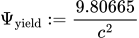
The pinning value
used below is not derived microscopically from the lattice geometry. It is a back-substitution from the measured surface gravity of Earth at the standard reference (CODATA g₀=9.80665ms⁻²). Inserting this single number lets the saturation theorem reproduce the observed magnitude of g, but the magnitude itself is not predicted within this appendix.
What is derived geometrically (in the main text §17.4) is the cap mechanism, the inflow law from quantum annihilation, the equivalence principle as a result at the velocity-saturation (cap) level (beyond the cap it is open; see §17.4 note), the velocity-driven pressure law, the height-independence (Beverloo-type) of the steady cap flow, and the universality of the cap form across celestial bodies. These structural results are independent of any choice of Ψ_yield.
The honest separation between "structure derived [F]" and "absolute scale anchored from measurement [O]" is the same epistemic situation as the standard-physics hierarchy problem. See §17.4 (Gravity: cap mechanism and the four-wall theorem) for the full statement: §17.4.0 on annihilation-driven inflow as the root cause of gravity; §17.4.3 for the five-step argument that the rise-then-saturate pattern forbids a global GM/R² closure; §17.4.4 for the four-wall enumeration of why no purely microscopic chain produces 9.8m/s² as an absolute number; §17.4.6 for how the hourglass theorem explains inter-body surface gravity differences while leaving the per-body absolute value as a back-substituted input.
G.-1 Applicable regime (Gate): derivation only in the stiffness regime
All derivations in this appendix assume the stiffness regime defined in 3.2 (χ_ST=1).
If, within the observation window, the fluidity index φ(P;W) is meaningfully large (i.e., stiffness failure is frequent),
then the step that treats the “lattice stiffness limit” as a fixed constant is not justified,
so the conclusion for that time window/protocol is treated as INCONCLUSIVE.
Therefore, all upper-bound/saturation conclusions in this appendix qualify as conclusions only in regimes with φ≈ 0.
G.0 Core claim: 9.8 is the yield strength of space (the lattice)
In this theory, gravity is not “a force by which mass attracts,”
but is redefined as the restoring pressure of a jammed lattice attempting to fill the Void.
Because the lattice has finite material properties (rigidity / transmission limits),
there exists an upper limit on the maximum acceleration that the lattice can transmit directly to matter under contact/rest conditions.
Denote this by g_* (lattice yield limit).
Each body carries its own back-substituted yield value Ψ_(rm yield)^(body) (§17.4.6; Earth
9.80665/c² kept here as the canonical [INPUT] example — the per-body values are owned by the
Earth–Cosmos volume's per-body appendix as of the v0.6.0 handover); at Earth's surface
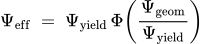
Ψ_(rm geom)≈Ψ_(rm yield)^((⊕)), so
the representative value observed at the surface g≈ 9.8rm m/s² is
interpreted not as “a value that grows without bound as mass increases,” but as a value near the lattice yield limit.
G.1 Defense logic: gravity is observed as a (2)-channel quantity, not a single component
Reports of values that appear like g>9.8 on Jupiter/the Sun (or values back-calculated from orbital data) are
not an immediate contradiction. The reason is that the observation protocol (context) differs.
In this appendix, we decompose gravitational acceleration into two components (channels):
Note (operational definition): “sum” does not mean simple addition within the same protocol.
The above decomposition does not mean “they add simultaneously in the same experiment to produce a single scale reading.”
In this theory, observables branch by protocol, and
the actually comparable observables are defined as follows:
That is, the component read by orbital data (far-field motion) and the component read by a scale/normal force (contact rest) are
in principle different channels.
(A) (g_(rm geom)) : channel of curvature
It is the geometric curvature component created by mass deficit.
It governs orbits (satellites/probes), tides, and far-field motion, and can continue to grow with mass/radius.
(B) (g_(rm restore)) : channel of restoring pressure
It is the restoring acceleration, under contact/rest conditions, by which the lattice pushes in directly to block the Void.
This component is limited by the lattice rigidity (c²) and the yield curvature demand (Ψ_(rm yield)),
and only this component saturates.
G.2 Geometric part: identity between deficit–curvature demand–potential acceleration
In jamming/granular media (hourglass/silo), vertical stress saturates with depth; this is
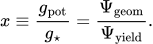
analogous to Janssen-type shielding. Accordingly, we allow a gentle saturation curve of the following kind.
Normalized variable:
Representative kernel:
Or (a “velocity-like” form inspired by the master-curve of hourglass discharge rate):
(However, this form tends to break the small-x linearity (Φ x);
when applying directly to acceleration, a correction (e.g., linear-near matching) is required.)
In this theory, g_* does not mean “the gravitational field is fixed to 9.8 everywhere in the universe,” but
the maximum acceleration under contact/rest conditions by which the lattice can directly support matter.
(i) Moon/Mars/Earth:
If a solid surface (contact) exists and g_(rm pot)
then surface mechanics appears identical to conventional predictions.
(ii) Jupiter/Sun:
There is no solid surface (continuous fluid/plasma),
so even if g_(rm pot)gg g_* is possible,
a “solid-contact-based surface reference” with g_(rm restore)≤ g_* does not form.
Therefore, it is difficult to define “g measured by a scale at the surface” itself.
Far-field motion/orbits are explained by g_(rm geom)≈ g_(rm pot).
(iii) Near neutron stars/black holes:
g_(rm pot) becomes extremely large, but
a “solid-contact-based static condition” typically collapses/transitions to fluidization/nonlinear states,
and the lattice restoring-pressure component saturates at g_*.
The excess is dispersed into other constraints (fluid pressure/electromagnetism/rotation/compaction stress, etc.).




![K \equiv c^2 \quad [{\rm m^2/s^2}]](/physics/eq/physics/phy-axg-005.svg)

![\Psi_{\rm geom}(R) \;\equiv\; \frac{R_s}{2R^2} \;=\; \frac{GM}{c^2R^2} \quad [m^{-1}]](/physics/eq/physics/phy-axg-007.svg)