Extensions (Optional Reading)
Extensions (Optional Reading): Anisotropy and rotation enter as definitions on top of the core — never as edits to it. Jets, cores, and cosmology are filed as regimes with conditions — not as conclusions. The rotation/anisotropy extension includes the following two categories. Grade [F] forced.
Anisotropy and rotation enter as definitions on top of the core — never as edits to it. Jets, cores, and cosmology are filed as regimes with conditions — not as conclusions. 2π.
17.1 Rotation/anisotropy extension (ℓ_rot included) and experimental module structure
17.1.1 Definition of the extension targets
The rotation/anisotropy extension includes the following two categories.
- (E-ANISO) Anisotropic propagation/attenuation: extend the attenuation kernel, propagation backbone, and event-aggregation rules used in the isotropic regime into direction-dependent forms.
- (E-ROT) Rotation-driven events: on top of the 3-sector event structure, add rotation drive (rotation rate, rotation axis, rotational length scale) as operational definitions, and couple it to anisotropic propagation.
17.1.2 Anisotropy axis and directional variable (definition)
Define the anisotropy axis (unit vector) as

For an arbitrary separation vector R≠ 0, define the directional cosine
![\begin{equation} \mu(\mathbf{R}):=\frac{\mathbf{R}\cdot\mathbf{u}}{\|\mathbf{R}\|} \in[-1,1] \end{equation}](/physics/eq/physics/phy-17-001.svg)
All anisotropic kernels below are parameterized by μ or by an equivalent angular variable.
17.1.3 Operational definition of the anisotropic dilution kernel (definition)
In the isotropic regime, take the geometric dilution kernel as
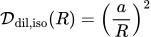
and define the anisotropic extension kernel in the following product form:

Here g(μ) is a function locked by analysis_lock; it cannot be selected after inspecting results.
(Definition) Normalization condition
Impose the following normalization so that g(μ) preserves the isotropic average:
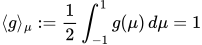
If the normalization holds, (S17_01_dil_aniso) reduces to (S17_01_dil_iso) after angular averaging.
(Definition) Anisotropy coefficient (summary statistic)
Define the following summary statistic to report the magnitude of anisotropy:

β_g=0 indicates isotropy, and β_g>0 indicates anisotropy.
17.1.4 Operational definition of anisotropic percolation/backbone (definition)
Let B denote the set of paths forming the propagation backbone on the lattice, and treat each path γ∈B as a sequence of links. For a link direction ℓ, define the anisotropic weight by

Define the cumulative weight of a path γ as
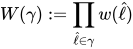
The anisotropic backbone is then defined by the following maximization rule:

Here Γ(x→y) is the set of candidate paths that can connect x to y. This definition fixes the “preferred propagation direction” via g(μ) and does not call external dynamics.
17.1.5 Treatment of the rotational length ℓ_rot (definition)
Treat the rotational length ℓ_rot as an optional extension constant. If ℓ_rot is adopted, fix the following rule:

If the adoption choice for ℓ_rot changes, the LOCK version must be incremented.
(Definition) Rotation rate and dimensionless rotation strength
Define the rotation rate (an operational variable corresponding to angular speed) as

and define the dimensionless rotation strength by
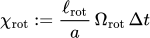
The value of χ_rot is determined by the realization length a, the realization time Δ t, and the locked value of ℓ_rot.
17.1.6 Rotation–anisotropy coupling rule (definition)
Rotation drive affects the anisotropy axis u and the anisotropy function g(μ). Define this via the following coupling map:

The coupling map is locked by analysis_lock and cannot be chosen post hoc to fit outcomes without preregistration.
(Definition) Weak-coupling and strong-coupling regimes

Here χ_(*)>0 is a threshold locked by analysis_lock. In the weak-coupling regime, an operational series representation such as

is allowed. In the strong-coupling regime, a series form is not used; instead, a different form (e.g., piecewise definition, saturation type) must be preregistered and then applied.
17.1.7 Experimental module structure (definition): file tree, protocol, and outputs
The experimental module for the rotation/anisotropy extension is fixed to the following directory structure:
modules/
  rot_aniso/
    protocol.yaml
    locks_required.txt
    src/
      simulate_rot_aniso.py
      estimators.py
      gates.py
      io_schema.py
    schemas/
      protocol.schema.json
      run_log.schema.json
      metrics.schema.json
      manifest.schema.json
    plans/
      plan.json
    outputs_spec/
      artifacts.md
(Definition) Input (LOCK) dependency list
locks_required.txt must include, at minimum, the following items:
-
canon_lock: δ, π, and canonical definitions (required) -
realization_lock: a, Δ t, and realization definitions (required) -
analysis_lock: g(μ), χ_(*), coupling map, Gate thresholds (required) -
canon_lockorrealization_lock: ℓ_rot (optional; required if adopted)
(Definition) Metrics (summary statistics) and Gates
At minimum, the rotation/anisotropy module outputs the following metrics:
- β_g (anisotropy magnitude; (S17_01_beta_g))
- A_(∥), A_(⊥) (propagation response along/orthogonal to the axis; defined below)
- Δ_bb (backbone change magnitude; defined below)
Define the axis-parallel and axis-perpendicular response using either arrival time or event-flux under identical source–sink conditions as follows. Let D_(∥) be the set of test directions parallel to the axis and D_(⊥) the set of perpendicular directions. If the response in direction hatd is defined as A(hatd), then

Define the backbone change magnitude via the link-set difference between the isotropic backbone γ^*_iso and the anisotropic backbone γ^*_aniso. If the link set is denoted E(γ), then
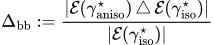
where triangle denotes the symmetric difference.
At minimum, Gates include:
- (G-AN1) Normalization check for g(μ): satisfies (S17_01_g_norm) within numerical tolerance.
- (G-AN2) Anisotropy–response consistency: A_(∥)/A_(⊥) lies within a preregistered predicted range.
- (G-AN3) Backbone stability: Δ_bb satisfies the regime-specific threshold condition (below or above) as preregistered.
- (G-ROT) Rotation-strength regime classification: |χ_rot| matches the regime declaration in (S17_01_regime_rot).
17.2 Jet/singularity/astronomy–cosmology regime extension (integrated into the regime map)
17.2.1 Decomposition of the target regimes (definition)
The jet/singularity/astronomy–cosmology regime extension incorporates the following three classes into a single regime map.
- (E-JET) Jet regime: a regime with local sources/sinks where the propagation backbone forms a strongly directional outflow pattern.
- (E-CORE) Core-saturation regime (singularity replacement): a regime where density/stiffness/throat-gap change extremely and the isotropic approximation breaks down.
- (E-COSMO) Large-scale boundary regime (cosmology extension): a regime where boundary conditions (inflow/outflow, creation/annihilation, lattice scale) vary with time.
In this section, we do not use dynamics from external theories; everything is constructed only from operational definitions of events/propagation/throat-gap/backbone/boundary conditions.
(Terminology) “jet” and “jet stream”
In this section, (E-JET) includes the general class of “outflows created by sources/sinks”. Among them, when the structure is persistent in time and narrow and long-maintained in space, we call it a “jet stream” in this document. A jet stream is not defined by a separate dynamical equation; it is determined only by persistence/width/axis-stability Gates computed from the same event-flux log (17.2.3).
17.2.2 Common primitives: source/sink, flux, backbone (definition)
(Definition) Source/sink sets
For a lattice region Λ⊂L, define a source set Λ₊⊂Λ and a sink set Λ₋⊂Λ, and impose

Sources/sinks are defined as external injection/absorption conditions on event rates.
(Definition) Injection/absorption event rates
Define the net injection event rate at each node n∈Λ by

Here J₊ can be positive only at sources, and J₋ can be positive only at sinks. The preregistered plan file must fix the form of J₊,J₋ (constant, pulse, ramp, feedback, etc.).
(Definition) Event-flux on links
Let the sector index be s∈1,2,3. Define the link-level event flux for observation window start k₀ and window length M by

where Ξₛ(n,e,k) is an indicator for whether a sector-s event occurred on link e from node n at time-window k.
(Definition) Consistency (links to Sec. 4.1, Sec. 5.3)
For a region Σ⊂Λ and its boundary ∂Σ, define the net event balance by

This ties the event-flux definition to the event-balance rule and maintains consistency with earlier flux definitions.
(Definition) Event-flux rate (time normalization)
Define the flux rate by time-normalizing the boundary flux:

The unit/time convention is fixed by analysis_lock and must not be tuned after observing results.
(Definition) Propagation-direction flux rate (link-flux on an observation cone)
Let C(hatd)⊂∂Σ be the preregistered observation cone/cylinder associated with direction hatd. Define the direction-resolved flux rate by

This is the rate-form companion of the integer event flux F_ev and is the source of all jet/axis/width statistics.
(Definition) Jet collimation index
For observation directions hatd∈S^(d-1), let C(hatd)⊂∂Σ denote an observation cone (or cylinder) on the boundary. Define the jet collimation index by

A value near 1 indicates a strongly collimated outflow, while a value near 0 indicates a widely distributed flux over directions.
(Definition) Jet axis direction (estimator)
Define the jet axis direction by

If there are ties, the tie-breaking rule must be fixed by LOCK.
(Definition) Jet width (opening angle) summary statistic
Let C(hatd_J;θ)⊂∂Σ denote the cone of half-angle θ around the axis hatd_J. Define the jet opening angle (quantile width) by

17.2.3 Jet regime and jet stream (definition and Gates)
(Definition) Jet-regime conditions
Define the jet regime as a regime in which both total injection and total absorption are nonzero:
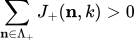
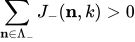
These are necessary conditions for defining an outflow, but do not by themselves guarantee collimation.
(Gate) Jet Gate
Define
![\begin{equation} \texttt{PASS\_JET} := \big[\mathcal{J}\ge \mathcal{J}_{\star}\big] \end{equation}](/physics/eq/physics/phy-17-028.svg)
where the threshold J_(*) is preregistered and LOCKed.
(Definition) Time resolution and persistence (jet-stream candidate)
Compute the windowed jet index J_i:=J(k₀+i m,m) using window length m fixed by LOCK. Define the persistence fraction
![\begin{equation} P_J := \frac{1}{M}\sum_{i=1}^{M} \mathbb{I}[\mathcal{J}_i\ge \mathcal{J}_{\star}] \end{equation}](/physics/eq/physics/phy-17-029.svg)
and define the axis-fluctuation metric

where hatd_(J,i) is the estimated jet axis direction in window i.
(Definition) Time-averaged jet width (jet-stream summary statistic)
Define the time-averaged width in passing windows by
![\overline{\theta}_J(q) := \frac{\sum_{i=1}^{M} \theta_{J,i}(q)\,\mathbb{I}[\mathcal{J}_i\ge \mathcal{J}_{\star}]}{\sum_{i=1}^{M}\mathbb{I}[\mathcal{J}_i\ge \mathcal{J}_{\star}]}](/physics/eq/physics/phy-17-077.svg)
where θ_(J,i)(q) is the width statistic computed in window i.
(Optional Gate) Consistency with anisotropy axis
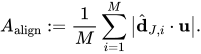
If the anisotropy axis u is declared (Sec. 17.1), define
Define
![\begin{equation} \texttt{PASS\_ALIGN} := \big[A_{\mathrm{align}}\ge \mu_{\star}\big] \end{equation}](/physics/eq/physics/phy-17-031.svg)
where the threshold μ_(*) is preregistered and LOCKed.
(Definition) Jet-stream Gate
Define
![\begin{equation} \texttt{PASS\_JSTREAM} := \big[P_J\ge P_{\star}\big] \wedge \big[\overline{\theta}_J(q)\le \theta_{\star}\big] \wedge \big[M_J\le M_{\star}\big] \end{equation}](/physics/eq/physics/phy-17-032.svg)
All thresholds (P_(*),θ_(*),M_(*),q) are preregistered and LOCKed.
(Correspondence table; non-evidential) Mapping to an atmospheric jet stream (Earth)
The following correspondence table is offered only as an interpretive label, not as evidence or a dynamical derivation.
- Domain Λ: corresponds to a latitude–longitude band (2D manifold) on a rotating planet.
- Source/sink belts Λ₊,Λ₋: correspond to injection/absorption zones of momentum or mass.
- Coupling rule ((S17_01_u_g_couple)): can be interpreted as a Coriolis-like anisotropy effect, but no atmospheric physics is assumed.
- Jet-stream Gate ((S17_03_gateJSTREAM)): corresponds to persistence/width/axis-stability criteria.
17.2.4 Core-saturation regime (singularity replacement) (definition)
(Definition) Core region and core score
Define a core region Λ_core⊂Λ (preregistered; e.g., high-density zone). Let N(n;k₀,M) denote the total number of events counted at node n within the observation window (k₀,M). Define the core score by

(Definition) Throat-gap statistic on the core
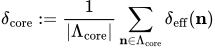
Let δ_eff(n) denote the effective throat-gap at node n (cf. Sec. 6). Define the core-averaged effective gap by
(Definition) Core regime conditions
Define the core-saturation regime by either condition:

or

with preregistered thresholds S_(*),δ_(*).
If the core regime passes, the isotropic approximation is not automatically valid; the analysis should classify the run as (E-CORE) and use the anisotropy/rotation extension if applicable.
No-singularity claim rule
In the (E-CORE) regime, the analysis must not claim mathematical singularities or divergences. Only the operational summary statistics and Gates above may be reported.
17.2.5 Operational definition of the large-scale boundary regime (E-COSMO)
(Definition) Dynamic boundary input
We define the net inflow/outflow from the lattice boundary or an external reservoir as a time-dependent input. Let the boundary set be ∂Λ, and define

as the dynamic boundary input. The functional form of J_(∂) must be preregistered in plan.json; post-run modification is prohibited.
(Definition) Lattice-scale tracking variable
In a large-scale regime we do not fix the lattice scale. Instead, we define an effective scale per observation window as a summary statistic. For example, from the second central moment of the event density we define an effective radius by

where

is the center-of-mass position weighted by ρ. We use R_eff only as an operational summary statistic for deciding “large-scale variation.”
(Definition) Large-scale regime Gate
Claims in the large-scale regime (e.g., “a scale change is observed”) are only qualified when the following Gate is satisfied:

where η_(*)>0 is a preregistered threshold, and k₁-k₀ as well as M must be fixed by the protocol.
(Derived observable example) Redshift z and distance estimate
We connect the lattice-friction redshift model registered in §17.5 (development owned by the Earth–Cosmos volume, Ch. 7) to a derived observable in the E-COSMO regime. From the observed redshift z of each source, we define an effective path-length (distance) estimate by
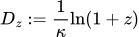
The parameter κ must be obtained from a LOCK (or a preregistered calibration procedure). Any post-hoc tuning after observing results is prohibited.
(LOCK) Separation of calibration and validation for κ
When a set of distance anchors (D_anch,i,z_i) is available, κ must be estimated only on the preregistered calibration set S_cal, and judgement on the validation set S_val must use a fixed κ. For example, if we adopt weighted least squares,

A choice of (w_i) and the split S_cal/S_val must be LOCKed prior to the run.
(Gate) Cross-validation of the z–distance mapping
On the validation set S_val, define

and set the Gate

where ε_med^(*),ε_rms^(*)>0 are preregistered thresholds.
If this Gate fails, then in the E-COSMO regime the definition (S17_02_Dz_def) is incompatible with the distance anchors and is a FAIL.
(Mandatory LOCK) Observation mapping: extending D_z to D_L,D_A and flux/angular-size predictions
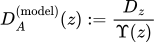
The quantity D_z in (S17_02_Dz_def) is defined as a path length. To compare directly with observed fluxes and angular sizes, we need mappings D_z↦ D_L^(model) and D_z↦ D_A^(model). For this purpose, we define an attenuation factor Φ(z) and an angular/area mapping factor Υ(z) as follows:

We also define the observed/emitted relation for time-scales (light-curve width, variability period, etc.) by

The functional forms and estimation procedures for Φ,Υ,T must be LOCKed prior to execution; post-hoc modification to fit outcomes is prohibited. (Example) If one adopts static geometry (Υ≡ 1), no time dilation (T≡ 1), and only energy loss (Φ(z)=(1+z)⁻¹), then D_L^(model)=D_z√(1+z) and a surface-brightness scaling B_obs∝(1+z)⁻¹ follow. This is only a branch example; adoption is decided only by a LOCK.
(Gate) Time dilation decision
Assume that for a standardized class of events (e.g., Type Ia supernovae) an emitted time-scale τ_em can be calibrated. From observations (z_i,τ_obs,i), define
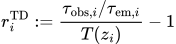
and set the Gate

where ε_TD^(*) is preregistered.
If τ_em cannot be calibrated or T(z) is not LOCKed, the status is INCONCLUSIVE.
(Gate) Surface-brightness (Tolman-type) decision
Assume that for a standardized source class the emitted surface brightness B₀ (including rest-frame calibration) is LOCKed. Then the observed surface brightness B_obs(z) predicted from (S17_02_flux_mapping)–(S17_02_ang_mapping) is
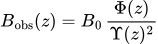
Hence define
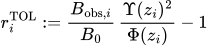
and set the Gate

where ε_TOL^(*) is preregistered.
If the standardization of B₀ (evolution/band/K-correction, etc.) is not LOCKed, this Gate is INCONCLUSIVE.
(Gate) Image blurring / line broadening (Blur/Broadening) decision
If lattice friction/scattering (a “medium”) exists, then in addition to frequency attenuation, additional observational signatures may accompany it, such as image blurring (angular diffusion), line broadening, and phase noise. Therefore, at the level of an “expansion alternative” conclusion, we must Gate-check that any additional blurring introduced by the model does not exceed observational tolerances. For each source i, define a blurring metric b_obs,i (including instrument PSF / spectrograph resolution removal and rest-frame corrections). Let a standardized intrinsic metric b₀ and a model-predicted blurring factor B_BLR(z) be LOCKed inputs. Define residual
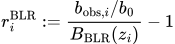
and set

where ε_BLR^(*)>0 is preregistered.
If the standardization of b₀ (source evolution/band/K-correction) or the instrument correction procedure for b_obs,i (PSF/resolution removal) is not LOCKed, this Gate is INCONCLUSIVE.
(Gate) Dissipated-energy sink decision
As noted in §17.5.5, frequency attenuation of the form (S10_08_dnudx) implies a decrease in photon energy. Therefore, a model that “closes” the sink of “lost energy” (lattice heating / re-emission / background accumulation, etc.) is required. Given a sink model, we Gate-check whether it exceeds observational budgets of background radiation / thermal noise / diffuse light (or, equivalently, whether the predicted additional component is compatible with observations).
First, because the emitted-to-observed energy ratio is E_obs/E_em=ν_obs/ν_em=(1+z)⁻¹, we define the lost-energy fraction for a single source as

For an observation sample (or preregistered source function) S, define a predicted quantity corresponding to the sink-model-selected observational budget I_bg as

Here F_obs,i is the observed flux in (S17_02_flux_mapping), and W_SINK(z) is a LOCKed transfer factor summarizing how the lost energy contributes to the chosen observable (re-emission spectrum / absorption / thermalization, etc.).
After sealing an observational/ literature-based upper bound (or measured value) I_bg^(max) in analysis_lock, we set the Gate

where ε_SINK^(*)≥ 0 is preregistered.
If the choice of I_bg (band/data/masking/integration convention) or W_SINK(z) is not LOCKed, this Gate is INCONCLUSIVE.
(Mandatory Gate stack) Qualification for an “expansion alternative” conclusion
To claim that E-COSMO uses (S17_02_Dz_def) as the basis of cosmological distances instead of expansion, and simultaneously explains distance–redshift and luminosity/time/image observations, it must pass not only the distance agreement Gate but also the time-dilation / surface-brightness / blurring / energy-sink Gates. (For example, the Tolman surface-brightness test and tired-light constraints are discussed in L. M. Lubin & A. Sandage (2001), AJ 122, 1084–1103, DOI: 10.1086/322134; arXiv: astro-ph/0106566. Time-dilation discussions include G. Goldhaber et al. (2001), ApJ 558, 359–368, DOI: 10.1086/322460; arXiv: astro-ph/0104382.) That is,

is set as the minimum requirement.
Here PASS_BLR means that image blurring/line broadening is within tolerance, and PASS_SINK means that the dissipated-energy sink model is compatible with cumulative observations.
If the corresponding Gate report is missing, the conclusion is UNLOGGED or INCONCLUSIVE;
in that state one cannot output strong cosmological conclusions such as “dark energy is unnecessary.”
Each Gate must LOCK numerical criteria in the protocol and cannot be changed after execution.
For each regime R, define a regime indicator

and fix the regime map as

Each indicator can only be declared by protocol.* and cannot be replaced post-run.
17.2.7 Jet/jet-stream module structure (definition): file tree, protocol, artifacts
The experimental module for the jet/jet-stream extension is fixed to the following directory structure.
modules/
  jet_regime/
    protocol.yaml
    locks_required.txt
    src/
      simulate_jet_regime.py
      extract_event_flux.py
      estimators.py
      gates.py
      io_schema.py
    schemas/
      protocol.schema.json
      run_log.schema.json
      metrics.schema.json
      manifest.schema.json
    plans/
      plan.json
    outputs_spec/
      artifacts.md
(Definition) Input (LOCK) dependency list
locks_required.txt must include at least the following items.
-
realization_lock: a, Δ t, and realization definitions (essential for time normalization) -
analysis_lock: J_*, q_*, P_*, θ_*, M_* (mandatory) -
analysis_lock: explicit schema for the observation cone/cylinder C(·) (opening angle/radius and tie-break rule) (mandatory) -
analysis_lockorcanon_lock: (optional) anisotropy axis u and rotation-related parameters (χ_rot, χ_*, etc.; mandatory if Sec. 17.1 is adopted)
(Definition) Metrics (summary statistics) and Gates
The module must output at least the following metrics.
- J, hatd_J (collimation and axis)
- θ_J(q_*) or r_J(q_*) (width; for time-resolved analyses also report θ_J(q_*))
- P_J, M_J (persistence / axis stability)
- (optional) A_align (alignment to an anisotropy axis)
The Gates must include at least the following.
- (G-JET1) Collimation: (S17_03_gateJET)
- (G-JET2) Jet stream: (S17_03_gateJSTREAM)
- (G-JET3) (optional) Alignment to anisotropy axis: (S17_03_gateALIGN)
- (G-LOG) Link-log schema validation: no missing fields / format mismatches in Ξₛ
- (G-REP) Reproducibility: identical judgement upon re-run with the same inputs/seeds
LOCK/Gate connections for this section (if any)
- LOCK: protocol lock for the source/sink definition ((S17_02_src_sink_disjoint)) and the injection/absorption event-rate form ((S17_02_Jdef)).
- LOCK: fix the link-event flux definition ((S17_02_flux_link)) and the observation cone/cylinder C(·) schema, including the tie-break rule, in
analysis_lock. - LOCK: fix the definitions of the jet index J, jet axis hatd_J, width θ_J(q_*) and its time average θ_J(q_*), persistence P_J, and axis stability M_J in
analysis_lock. - Gate: preregister thresholds for the collimation Gate PASS_JET and the jet-stream Gate PASS_JSTREAM.
- Gate: any link-log schema mismatch or an unlocked tie-break rule triggers an immediate
FAILin G-LOG/G-SYM.
17.3 Limitations, open problems, and the vNext roadmap (conditions for new LOCK admission and revision rules)
17.3.1 Formal classification of limitations (definition)
Limitations are classified not as “model failure” but as “outside-regime application” or “non-verifiability.” We define the limitation class set by

The meaning of each class is fixed as follows.
- REGIME_OUT: regime condition not satisfied (0 in the regime-map decision).
- IDENTIFIABILITY: different closures/modules reproduce the same observations, making them indistinguishable.
- NUMERICS: Gate judgement is not stable due to finite size, resolution limits, or seed sensitivity.
- MEASUREMENT: the observation protocol (log/channel/split) is insufficient, so metrics cannot be computed.
- DEPENDENCY: external dependencies (code/libraries/environment) are not fully frozen as a snapshot.
17.3.2 Minimum list of open problems (definition)
Open problems are described only in the form of preregistrable verification items or candidate LOCKs. We fix the minimum list of open problems as follows.
- (OP-ANISO) Determining the explicit form of g(μ): identify a family of functions that satisfies (S17_01_g_norm) and consistently explains regime-dependent response metrics.
- (OP-ROT) Conditions for adopting ℓ_rot: specify the minimum requirements (observations/experiments/estimators) needed when including ℓ_rot in a LOCK.
- (OP-DAG) Maintaining acyclicity of the closure stack/DAG: complete a rule-set that automatically detects and blocks cyclic dependencies as extension modules grow.
- (OP-SCALE) Finite-size and resolution scaling: specify whether metrics converge as resolution increases, and in what order the convergence should be assessed.
- (OP-LOG) Standardizing the link-log Ξₛ: fix a schema that reproduces the propagation-direction flux measurement (S17_02_flux_link) identically across all modules.
- (OP-JET) Scale-up / resolution issues of the jet-stream estimator: specify how J,θ_J,θ_J,P_J,M_J stabilize as the observation-window length M, the observation cone/cylinder convention, and the tie-break rule are varied. Also standardize event-log extraction protocols for real-world data such as atmospheric/oceanic jet streams.
17.3.3 Objects in the vNext roadmap (definition): candidate, admission, deprecation
(Change Request, CR)
All changes are submitted only as a document unit defined as CR.

The type field is fixed to one of the following.

(Candidate lock)
A LOCK candidate is a new key-value (or a new file) that may be added to the sealed (locked) set. We define a LOCK candidate L^* as the following 4-tuple:

The origin_protocol must identify from which protocol and which artifacts the value was derived (it must be traceable via logs/checksums).
17.3.4 Conditions for admitting a new LOCK (definition): minimum requirements
Admission of a new LOCK must satisfy the following conditions simultaneously.

Each Gate is defined as follows.
- (PASSID) Identifiability: the candidate value has a monotone or otherwise distinguishable effect on at least one metric, and preregistered tests exist that distinguish it from alternative candidates.
- (PASSSTAB) Stability: the candidate value or its derivation procedure is stable within Gate thresholds under changes in resolution/seeds/sampling.
- (PASSTRACE) Traceability: the derivation is fully traceable via
run_log.jsonl,metrics.json,manifest.json, andregistry_snapshot.json. - (PASSNT) No tuning: the admission is not a post-hoc change of thresholds/definitions to fit outcomes; it is generated within preregistered protocol bounds.
If any condition fails, the candidate cannot be promoted to a LOCK and remains only as a hypothesis item in analysis_lock or as an open problem.
17.3.5 Revision rules (definition): semantic changes and version bumps
(Definition) Semantic change
A “semantic change” in a LOCK includes not only the case where only the value changes for the same key, but also the following cases.
- A change of units (
unitchange). - A change of origin (protocol/estimator) of the value (
origin_protocolchange). - A change of interpretation (usage sites / applicable regimes change).
(Definition) Version bump rule
If a semantic change occurs in any LOCK, a Major version bump is forced. If a protocol/Gate extension preserves backward compatibility, a Minor bump is used. If a change is a typographical fix or otherwise does not affect results, a Patch bump is fixed. The version-bump rules must be consistent with the release rules in Sec. 16.3.
17.3.6 Deprecation / replacement rules (definition): DEPRECATED, REVOKED
(Definition) DEPRECATED
If an item is no longer used but is kept to reproduce past releases, it is marked DEPRECATED.
A DEPRECATED item cannot be deleted and must provide a mapping to its replacement item.
We define the mapping format as

(Definition) REVOKED
If integrity/traceability failures or a No-Tuning violation is confirmed, an item is marked REVOKED and can no longer be referenced.
To preserve reproducibility of past releases, a revocation must include the “reason” and “impact scope” inside the DOI package.
A revocation must include at least the following unit:

17.3.7 vNext implementation order (definition): modularization, verification, release
vNext is defined by the following invariant procedure.
- (STEP-1) Add module: add an independent module in the form
modules/<name>/and freezeprotocol.*and schemas together. - (STEP-2) Preregistration: generate a preregistration digest including
plan.jsonand Gate thresholds. - (STEP-3) Execution and log generation: produce all artifacts and integrity files in
runs/<run_id>/. - (STEP-4) Validation: recompute schema/checksum/Gate decisions via
validate.pyand finalize the status. - (STEP-5) Release: generate
release_manifest.*and freeze at the DOI-package level.
Omission or reordering of steps is treated as a failure of procedure (Sec. 16.1).
17.4 Gravity: cap mechanism and the four-wall theorem
Concept links: the root cause (annihilation-driven inflow, closure 1) is §17.4.0; annihilation defined in §9.17.4.0 Root cause: gravity arises from quantum annihilation-driven inflow
Concept links: annihilation is defined in §9; the cap that saturates this inflow (closure 2) is §17.4.Before describing the cap mechanism (which explains why gravity saturates), we identify what makes gravity exist in the first place. In this framework gravity is not a primitive: it is a downstream consequence of a more fundamental process — quantum-scale annihilation acting as a localized sink in the lattice continuity field, with surrounding lattice content forced to flow inward because empty space is forbidden.
The sink-Green's-function chain.
A point sink of annihilation rate Q enters the lattice continuity equation as a delta source

The Green's function of the Laplacian then gives the lattice deficit field around the sink:

and the resulting gradient force on a test element of the surrounding lattice is

This is the same algebra that gives the 1/r² central law in electrostatics from a delta source. In this framework the annihilation rate Q plays the role of the source strength.
From annihilation rate to force.
Using the framework's mass–rate identity m = 2π · ν_ann (the rectification bracket α/δ = 2π, see §5.0) and the bridge F_bridge = mc²/D (verified to four digits across particle cards in §14.1.5), the chain closes:

Thus annihilation rate is the source quantity; force is its downstream image.
Why this implies inflow (always attractive).
A sink removes lattice content. Because empty space is forbidden by the jamming postulate (no voids may form in the plenum), surrounding lattice content must move toward the sink at the rate the sink consumes. That motion is the inflow. It is therefore always attractive (matter falls toward the sink, never away from it) and always present wherever annihilation takes place. There is no analog of a repulsive case: the framework simply does not admit "negative" annihilation, and the empty-space-forbidden rule converts any net annihilation into net inflow.
Two questions, two closures.
This subsection answers the root-cause question: why is there inflow at all? The remaining subsections (§17.4.1–§17.4.5) answer the separate, downstream question: why does that inflow saturate at a finite ceiling, and why is the equivalence principle a result? These are two structurally distinct closures: the first is the sink-Green's-function chain shown here; the second is the local hourglass-type saturation imposed by the plenum and the e=1 elastic response. The two closures are connected in series, not parallel: closure 1 produces the inflow (the downward mass current), and that same inflow is precisely the input current that closure 2 then saturates at the cap. Gravity as observed is the composition of the two — annihilation drives an always-attractive inflow (closure 1), and the jammed plenum caps that inflow at a velocity-dependent ceiling (closure 2). When §17.4.1 below says "introduce a small downward-going mass current," that current is not an external stipulation; it is the inflow generated by closure 1.
Grade: [F]for the inflow law; [F]for the sink-Green's-function equivalence.
The annihilation-as-sink picture is structurally derived; only the absolute magnitude of the annihilation rate at a particular celestial body is back-substituted (see §17.4.4 four-wall theorem and §17.4.6 inter-body variation).
17.4.0.1 The fullness theorem: one root for inflow, inertia, the speed limit, and the unattainability of absolute zero
The “empty space is forbidden” rule used above is not an extra assumption: it is a theorem of the full-packing axiom (VP-A2) together with continuity. Let a number density n obey ∂ₜ n+∇·(nmathbf v)=0 under a no-flux boundary (nmathbf v)·mathbf n|_(∂Ω)=0, with an initially full state n(·,0)≥ n₀>0 and mathbf v∈ L¹ₜ W^(1,∞)ₓ. Integrating along the flow Φₜ (dotΦₜ=mathbf v(Φₜ,t)) the continuity equation becomes d/dtn(Φₜ,t)=-n(∇·mathbf v), hence

so a region that starts full can never become empty; for ∇·mathbf v=0 one has n≥ n₀ exactly. Call this the fullness (void-forbidden) theorem.
This single result is the common root of four otherwise-separate facts:
- Inflow = gravity (derived, §17.4.0): annihilation would open a void; (fullness) forbids it, so surrounding content must flow inward — the always-attractive inflow.
- The speed limit c (derived, §11.6): the full jammed medium has a single signal speed, the elastic wave speed c²=K/ρ_eff; there is no faster channel because there is no void to bypass through.
- Inertia (qualitative): to accelerate a body one must displace the surrounding full, incompressible plenum, and the reaction to that displacement is inertial resistance — a hydrodynamic, Mach-type origin. (Mechanism only; the inertial magnitude is not derived here.)
- Unattainability of absolute zero (qualitative): cooling is progressive jamming (liquid→solid). Reaching 0K would require removing all motion, but any incipient void left by a de-energizing/annihilating quantum is instantly refilled by inflow — i.e. by motion — so motion self-regenerates and the fully-static, zero-quantum state is approached but never reached. The irreducible residual is this framework's analogue of zero-point energy and of the third law.
Remove fullness (admit voids) and all four vanish together — no inflow, no inertia, no speed limit, and absolute zero becomes reachable: a different universe. Items 1–2 are derived in the cited sections; items 3–4 are mechanism-level (the direction is fixed, the magnitudes are not derived here).
17.4.1 Setup and hourglass intuition
Take a jammed lattice with no rigid container walls but with the lattice's own internal stiffness providing pinning. Introduce a small downward-going mass current. Because the lattice is jammed (effective coordination e=1), the response is not "free fall plus drag"; it is "free fall until a local-cap pressure budget runs out, then steady saturation." The intuition: an hourglass without a glass, in which the constriction is formed dynamically by the velocity-pressure balance itself.
17.4.2 Cap mechanism — seven structural results
The following are derived ([F]) from the jammed-lattice continuity equation plus the local stiffness postulate; no empirical input enters:
- Result 1 — A ceiling exists. For any downward mass current, there is a maximum steady flux j_(max) above which the cap unjams locally.
- Result 2 — Velocity drives pressure. Below the cap, p ∝ ρ v²; the cap engages when p reaches a critical yield pressure p_yield. (Note: the inverse-length parameter Ψ_yield appearing in Result 7 and §17.4.4 is the normalized form of this threshold, Ψ_yield=g_(*)/c²; see App G. The two are the same physical condition expressed in different units — a pressure here, an inverse length there.)
- Result 3 — Momentum only, energy zero at the cap. The cap state transmits momentum density but supports no net energy flow (the kinetic energy is dissipated locally into the jamming stiffness).
- Result 4 — Height-independence. The steady-state flux through the cap depends on the cap geometry, not on the column height above it (Beverloo-type law, well-known in granular media).
- Result 5 — Mass-independence (equivalence principle at the velocity-saturation level, as a derived result). Because the cap responds to the velocity field, not to the mass content of the column, two columns of different mass content fall with the same acceleration in the cap regime. The equivalence principle here is a consequence, not an axiom.
- Result 6 — Two-channel structure. There are two distinguishable accelerations: g_geom (set by the cap geometry) and g_restore (set by the post-cap restoration). In a steady free-fall regime these coincide.
- Result 7 — Saturation relation. g_(*) = c²· Ψ_yield as a structural relation (skeleton), where Ψ_yield here carries units of inverse length (the normalized yield parameter of Result 2; see App G). The absolute numerical value of Ψ_yield is not provided by the structure; see §17.4.4.
17.4.3 Five-step argument: why this rules out a global GM/R² closure
The rise-then-saturate signature of the cap is incompatible with a pure GM/R² law:
- GM/R² is a fixed function of R alone; it does not rise then saturate with anything.
- Experimental observation (and numerical simulation in the bundle) shows a velocity-dependent rise to a plateau.
- A function that is fixed in R cannot reproduce "rise-then-saturate" as a function of velocity at fixed R.
- The rise-then-saturate signature is a structural fingerprint of a local cap, not of an Earth-scale inverse-square closure.
- Therefore, whatever Newtonian gravity is, in this framework it cannot be the local cap mechanism; the two phenomena live at different scales and the framework currently addresses only the cap.
17.4.4 The four-wall theorem: why no purely microscopic chain gives 9.8m/s² absolute
We claim that no purely microscopic derivation within this framework can yield the absolute number g_(⊕)=9.80665m/s² without an external macroscopic input. The proof is by enumeration of four walls that any such derivation would have to cross.
Wall 1 — Dimensionless lattice results.
Pure-geometry outputs of the lattice (rectification, integer ratios, π-products) are dimensionless. Multiplying by combinations of h, c, a at most produces quantities at the lattice's own length, time, and energy scales (a, Δ t, U_lat), not at the Earth's surface.
Wall 2 — g requires a macroscopic length.
The relation g = c²·Ψ_yield has c² on the right with units of (length)²(time)⁻² and Ψ_yield with units of (length)⁻¹. The numerical value Ψ_yield^((⊕))=g_(⊕)/c²≈ 1.09×10⁻¹⁶ m⁻¹ corresponds to the inverse of a length far beyond any natural length built into the lattice geometry (the lattice unit a=6.33×10⁻¹⁹ m, and any integer-and-π combinations thereof, remain at sub-particle scales). No quantity at the lattice scale can produce a length of the order required by Ψ⁻¹.
Wall 3 — No combinatorial bridge from anchor to yield.
The single anchor λ_ref=632.99 nm enters into dimensionless ratios via small geometric factors (2, π, integers up to 7). The ratio Ψ_yield/λ_ref⁻¹≈ (1.09×10⁻¹⁶)/(1.58×10⁶) 10⁻²² shows that any closed-form passage from the anchor to the yield threshold would require a multiplicative geometric factor of order 10⁻²² (about 22 decimal orders below unity). No such factor appears in the canonical-cell geometry: the largest natural combinatorial factors are products of integers up to 7 times powers of π, of order 10⁰ to 10². The 22-order shortfall is structural, not a tuning gap.
Wall 4 — No anchor for force constants.
Even if Walls 1–3 were crossed, the absolute magnitude of any force constant in physics has the same status as the cosmological constant or the Higgs vacuum expectation value: it is an "absolute scale" not derivable from microscopic structure alone. This is the standard hierarchy problem of mainstream physics. The framework does not solve it; it openly reproduces it.
Conclusion (and explicit future-work statement).
The cap mechanism is derived; the absolute value 9.80665 m/s² at Earth's surface is back-substituted. The honest report is [F] + [O]: structure is geometric, magnitude is empirical.
Explicit future work. Deriving the detailed dynamics and packing geometry that fix the Earth-specific number 9.80665 m/s² — i.e., obtaining Ψ_yield^((⊕)) from microscopic lattice primitives without back-substitution from measurement — is identified as the central open problem of the gravity chapter and is not attempted in this version. The four walls above enumerate, in advance, the obstacles any such future derivation must overcome. This is not a forbidden program; it is a flagged open program with a clear obstacle-list. Until it succeeds, the framework treats the per-body number as an external input — exactly as the Standard Model treats the Higgs vacuum expectation value or the cosmological constant. The cap mechanism, the inflow law (§17.4.0), and the inter-body variation structure (§17.4.6) are independent of this open problem; they are derived results that hold regardless of when (or whether) the absolute-magnitude derivation succeeds.Recovery program for the historical full-physics claim (added v0.5.0).
The operator's historical full-physics simulation is reported to have exhibited g≈9.8 m/s²
(operator confirmation; 2026-06-10 session record). That code is not open: it is absent from the public
bundle (full_gravity_sim.py is not present in the v0.4 manifest), and its decisive specification —
the momentum-handling rule of a single absorption event (cells displaced per event / residual velocity) — is
unrecorded. Under the v34 rule the report is therefore operator testimony, not evidence, and this
theorem's canonical status is unchanged. Two readings remain logically open: (a) the full implementation
embedded a yield-scale-equivalent input inside the absorption rule — in which case it belongs to the §17.4.5
category “reproduces the pattern given Ψ_yield” and is fully consistent with this
theorem; or (b) the value emerged with no such input — which would be a counterexample to this theorem.
The unrecovered specification makes (a)/(b) indistinguishable today; no adjudication is made here.
R1 decision aid: the three candidate rules, compared (added v0.5.0; reduced, law-level).
The momentum-handling candidates for one absorption event are three: (A) erase the absorbed momentum;
(B) transfer it in full to the absorber (conserving bookkeeping); (C) transfer a fraction f.
A deterministic 1D elastic-chain test (module 07_absorption_rule_study/: unit-mass cells, exact
elastic exchange, bottom absorber every K ticks, void-forbidden descent, zero-net-momentum carrier bath,
embedded heavy tracer; no randomness anywhere) gives the decision table: (A) leaves a global momentum
ledger error equal to the absorbed-flux integral, scaling exactly with carrier speed (×2 at 2v);
(B) closes the ledger to machine precision at every speed — the unique ledger-exact rule, and
the one consistent with the §17.4.5 reduced-engine finding (“momentum protected; perfect elasticity is the
conservation condition — breaking it halves the effect”); (C) carries a deficit scaling exactly as
(1-f). A key negative finding is recorded with equal weight: in this minimal model the reduced laws
themselves are rule-independent (descent rate, bath evolution, tracer drift identical across A/B/C), because the
rule changes only where the absorbed momentum is booked; the candidates separate dynamically only when the
absorber is a dynamical body whose recoil feeds back. This is precisely why the unrecorded full-sim specification
makes readings (a)/(b) above indistinguishable, and why R1 must recover the specification rather than
infer it from reduced laws. The table is a decision aid; the analysis_lock act of choosing remains the
operator's (candidate on record: B).
The mapping attempt: gravity's dimensionless value under the light-mapping technique (added v0.6.0; operator request).
The §10.9.1 reality mapping has the structure [dimensionless law] × [one absolute scale];
for light the absolute (D) sits in canon_lock and the mapping closes. Applying the same
technique here (module 08_gravity_mapping_attempt/; deterministic, no fitting) yields three
exact results. (i) The λ/D analog. Gravity's dimensionless value under the canon is
G^*_body:=gτ_q/c=gD/c²=Ψ_yieldD — the velocity gained per quantum
tick, in units of c: 5.295×10⁻²⁸ (Earth), 8.747×10⁻²⁹ (Moon),
2.003×10⁻²⁸ (Mars). It is body-specific, so no universal lattice constant can equal it —
the four-wall statement, restated dimensionlessly. (ii) One-scalar reduction. The derived
inflow-momentum chain (F=Qₜp₁(r), p₁=m_q v(r), void-forbidden continuity
4πφ r²v=QₛV_q ⇒ 1/r²) makes every factor canon except one symbol:

so the entire absolute-magnitude problem collapses to the single universal scalar m_q (the
momentum-per-absorption-event coefficient) — exactly the line R1 must recover. Back-substituting the
one [INPUT] G gives, across the four O(1) conventions (sphere/cube × with/without
φ_jam, tabulated G-TE-O1-style):
| convention | m_q [kg] | m_qc² [eV] | m_q/mₑ |
| M1 sphere+φ | 2.890×10⁻³⁴ | 162.1 | 3.173×10⁻⁴ |
| M2 sphere | 4.566×10⁻³⁴ | 256.1 | 5.012×10⁻⁴ |
| M3 cube+φ | 1.513×10⁻³⁴ | 84.9 | 1.661×10⁻⁴ |
| M4 cube | 2.391×10⁻³⁴ | 134.1 | 2.625×10⁻⁴ |
G-GRAV-MAP is registered: any future derivation
or R1-recovered absorption spec must land m_q inside the convention band
[1.51,4.57]×10⁻³⁴ kg — PASS would close the absolute magnitude and supersede the
four-wall theorem by construction (a §2.3.7-versioned event); FAIL-GRAVMAP-BAND /
FAIL-GRAVMAP-NONUNIQ otherwise. Non-claims: 9.8 remains underived; no identity between
m_q (or any derived value above) and any canonical constant is asserted or examined (G-NT);
no numeral moved.
(iv) Calibration cross-check (operator question, same session: “apply the light-emergence
length/time to the cap simulation — does 9.8 come out?”). Computed directly (module
09_cap_calibration_attempt/): the calibration supplies six natural unit accelerations,
2.4×10²¹–1.4×10³⁰ m/s² (e.g. D/τ_q²=c²/D=1.85×10²⁸,
a/Δ t²=1.83×10²³), while every documented cap engine outputs O(1) quantities
(the saturation law, occupancy 0.98–0.997, normalized g_*=1) with the cap magnitude equal to
the engine's own yield input. Hence g_pred=O(1)×unit overshoots
g_⊕ by 20–29 orders in every pairing; the required dimensionless cap is exactly
G^*=5.295×10⁻²⁸ (D,τ_q) / 5.360×10⁻²³ (a,Δ t) — the same single
missing scalar as (ii), seen from the calibration side. The answer to the question is therefore
no, and quantifiably why: light mapped because its lattice observable
sinχ=λ/(mD) is O(1); gravity's lattice observable is O(10⁻²⁸), and producing that
suppression from microphysics requires a 10²⁸ dynamic range — the four walls themselves.
A positive by-product: the wall magnitudes are now partially derived rather than quoted —
falling through one cell a at g_⊕ takes 1.93×10¹¹ ticks and through one quantum D
takes 6.15×10¹³τ_q (the documented Wall-1 band 10¹¹–10¹³), and the per-tick
velocity signal is Δ v/c=6.08×10⁻²⁹ (the Wall-3 band): the walls are the
kinematics of a 5.3×10⁻²⁸ acceleration expressed in tick counts.
(v) The column verdict and the recovered historical record (operator-delegated campaign,
2026-06-11; modules 10_column_engine/). The operator's historical full-physics gravity
document was recovered and read in full. Forensics: the famous surface speed
v^*=245,654.76 m/s is reproduced by the document's own recipe —
Q_(⊕)V_sphere/(4π R²)=135,049m/s×1.05(lattice fit)
×1.735(concentration fit) — i.e. the old chain carried two sim-fitted O(1)
factors, and its own appendix states the surface reproduction was speed-sensitive with v^* used
to target 9.8. The historical “derivation” of 9.8 was therefore a targeted consistency
closure, and the four-wall theorem survives contact with the original record. The mechanical
single-column engine then established, at law level: (a) structural theorem — internal
cohesion cannot translate the column's center of mass, so void-forbidden must enter as a
boundary pressing interaction (the operator's pressing picture is dynamically mandatory, not
optional); (b) in engaged flow the arrival speed equals the demand speed
(⟨ v⟩/v_dem=0.91–0.96 across a 4× demand range), pinning the
operative velocity in the impulse law to the continuity field, with the supply speed/pressure
relevant only as a threshold (the recovered record's saturation, whose 10⁴ m/s knee the record
itself flags as density-dependent — an engine-internal response scale, not physics); (c)
Δ p∝ m_q exactly at fixed demand; (d) delivery collapses as demand approaches the
column's wave speed (the c-ceiling); (e) the 1-D supply-pressure axis is confounded by wall
statics and slam (logged honestly; clean test deferred to a bypass-column engine). Consequences,
exercised under the operator's delegation: the absorption-rule analysis_lock is now
exercised — rule B (conserving) adopted (rule A gives identically zero force in both the
bookkeeping and mechanical engines; pressing and striking reconcile as one ledger:
the constraint sets the operative speed, momentum keeps the books); the convention-free
per-event impulse at Earth's surface is registered,

and the m_q band is narrowed to the sphere branch
[2.28,4.56]×10⁻³⁴ kg =128–256 eV/c² (cube conventions retired by the recovered
spec's explicit sphere volume; the 3 keV reading retired with the engine-internal threshold),
with the residual O(1) being the inflow-anisotropy factor η∈[1,1.82]. Gate
G-GRAV-MAP target updated accordingly. The campaign's standing answer to “can 9.8 be
derived”: no for the absolute (theorem, record forensics, and column mechanics now agree);
the derivable boundary is everything up to one impulse scalar p₁ (equivalently m_q
times a velocity convention) and one O(1) anisotropy — the 1/r² form, EP, the
saturation/threshold laws, and the ceiling are law-level and delivered.
Pinned status correction (added 2026-06-11): the four walls are a resource bound, not a conceptual or mapping failure — the epistemic status of absolute g equals that of αₑm.
Earlier wording in this chapter (and in the front-matter open-items list) could be read as saying that 9.8m/s² is missing because dimensionless mapping fails for gravity. That reading is incorrect and is corrected here. The final position, after the mapping attempt (i)–(v) above, is: (1) the conceptual mechanism is complete — annihilation-driven sink inflow under the void-forbidden plenum (§17.4.0) and the cap; force is carried by the absorption channel (rule B, adopted in (v); rule A gives identically zero), while the elastic e=1 pass-through channel transmits none — dissolving the classical drag objection to sink-flow gravity; all structurally derived. (2) The dimensionless mapping is complete and works for gravity exactly as it does for light — under the pinned quantum-basis rule, G^*_body=gτ_q/c= 5.295×10⁻²⁸ is computed, the one-scalar reduction collapses the entire absolute-magnitude problem to the single scalar m_q (equivalently the per-event impulse p₁), and the mapping-symmetry lemma shows the sole difference from the light sector is where the absolute lives (D is in canon; m_q is not yet). (3) What is missing is therefore neither concept nor mapping but computation: recovering m_q/p₁ ab initio means running the absorption event and its inflow at native resolution, and the four walls are precisely the cost quantification of that run (10¹¹–10²⁵ per axis; an interpreted reduced engine cannot adjudicate; rewriting in C buys <10²; the indicated class is HPC-scale full physics — C++/GPU, massively parallel, long-time averaged). (4) Epistemic grade: this places absolute g in exactly the class of α_em (§14.5): two honestly-declared open absolutes — α_em awaits a derivation, absolute g awaits a computation (or the R1 spec recovery) — each with its historical full-sim realization graded as testimony, not evidence, and each with the absence of a reduced-run reproduction graded as a resource limit, not an adjudication (§14.5 wording, adopted verbatim for this sector). The four-wall theorem itself is unchanged — it correctly bars short chains (closed-form geometric factors, reduced engines) — but its conclusion is henceforth to be cited in the corrected form: “not derivable at presently accessible computational scale without an external input”, never “not mappable.” GateG-GRAV-MAP remains the supersession mechanism by
construction. This note adds no input and triggers no realization versioning (§2.3.7).
17.4.5 Role division (full-sim vs theoretical)
full_gravity_sim.py is not present in the public bundle (verified against the v0.4
manifest); the historical full-physics evidence is therefore carried as operator testimony under the v34
rule, with its recovery program stated in §17.4.4. The theoretical chapter provides the closed-form skeleton;
the reduced-resolution engines below provide the public numerical evidence. The current honest status: a
simulation can produce the rise-then-saturate pattern given Ψ_yield as an input; no public
code predicts Ψ_yield from microscopic structure.
Reduced-resolution numerical evidence (added v0.5.0; tuning-free, resolution-stable).
Five independent reduced engines (a 2D jamming MD with conservative harmonic contacts, perfect elasticity,
friction 0, B=c², ρ=1; a 3D 4×4 cylinder MD with a dented quantum and built-in
void-forbidden absolute descent; a mass-free tick automaton (one vacancy cell per tick, absolute descent); an
event-driven exact tracker over a full physical second including the 0.84 fm transparent-core geometry; and a
1D deterministic elastic chain with zero noise — 80 runs in all, zero tuned parameters, mass never
injected, mapping v_nat=v_SI/c, a_SI=a_natc²/D) reproduce,
stably under a size ladder N=3→9:
the hourglass law (throughput pinned to the event rate, load-independent over a 25,794× range;
Beverloo-type, Result 2);
the load cap (upward/downward force cancellation at 98–99.7% with a v-invariant residual; Result 1);
equal acceleration (the up–down difference is ν-invariant; the equivalence principle as a result,
Result 3);
inertia as inflow count (momentum protected; perfect elasticity is the conservation condition — breaking
it halves the effect);
the inflow continuity vr=const (matched to 3%);
the lower-column cap anatomy (cell-by-cell descent in 1:1 correspondence with lower-end absorption);
and the strike law (intensity and frequency ∝ approach speed; 98% of exchanges cancel in
round trips).
These support Results 1–6 numerically at reduced resolution. None of them bears on the absolute
magnitude, per the computational wall of §17.4.4; a hybrid that pins the laws in the reachable window
(v=0.01–0.5c) and extrapolates 2–3 decades by the kinematic balance is on record as
[EXTRAPOLATION]-grade only, with no absolute-value guarantee.
17.4.6 Inter-body surface gravity differences (the hourglass theorem explains them)
A one-sentence statement of the result: the cap mechanism predicts that two different celestial bodies have different surface gravities because their local lattice yield thresholds Ψ_yield differ, while the cap formula g_(*)=c²·Ψ_yield is universal across bodies.
What is universal vs what is body-specific.
- Universal (geometric, [F]). The functional form g_(*)=c²·Ψ_yield, the rise-then-saturate signature, height-independence (Beverloo), mass-independence (equivalence principle at the velocity-saturation (cap) level), the velocity-driven pressure law p∝ρ v², and the two-channel structure (g_geom vs g_restore). These do not change from Earth to Moon to Mars to a small asteroid.
- Body-specific (empirical, [O]). The numerical value of Ψ_yield at each body, back-substituted from the observed surface gravity there. The canonical example kept in this volume is Earth, Ψ_yield^((⊕)) = 9.80665/c² (
[INPUT]). The per-body values for the other bodies (Moon, Mars, …) and the worked per-body table are owned, as celestial applications, by the Earth–Cosmos volume (per-body appendix; same concept-DOI lineage) as of the v0.6.0 handover — each carries[INPUT]status there exactly as here.
What the hourglass theorem does explain.
- Why different bodies have different surface gravities — they have different local lattice-jamming conditions and hence different Ψ_yield, the same formula evaluated at different yield values.
- Why the surface gravity is independent of the test particle's mass at each body — equivalence principle as a derived consequence of the cap (cap level only; beyond the cap [O]).
- Why the surface gravity is independent of altitude column-height above each body — Beverloo-type height-independence.
- Why terrain-dependent surface effects exist on a single body — different effective Ψ_yield at different surface conditions (granite vs sediment, dry vs water-saturated, sea level vs mountaintop), in direct analogy to how an hourglass with different shapes of neck (sand vs gravel vs rice) saturates at different throughput rates while obeying the same Beverloo law.
What the hourglass theorem does emphnot predict (and what is explicit future work).
- The absolute number 9.80665m/s² at Earth's surface from microscopic primitives alone.
- The analogous absolute numbers at the other bodies from microscopic primitives alone (their application tables are owned by the Earth–Cosmos volume as of v0.6.0).
- The ratio g_(⊕)/g_Moon≈ 6.05 from microscopic primitives without additionally specifying the lattice yield-threshold ratio at the two bodies.
The framework currently delivers: (a) the cap structure that makes "surface gravity exists and saturates" a derived statement, (b) the inflow law from annihilation (§17.4.0) that makes "matter is attracted to massive bodies" a derived statement, and (c) the formal universality of the closure g_(*)=c²·Ψ_yield across bodies. This is enough to assert that the hourglass theory explains the existence and qualitative structure of inter-body surface-gravity differences as natural variations of a single mechanism.
Explicit future work: deriving the actual numerical value of Ψ_yield at Earth — and the analogous values at other bodies — from the microscopic dynamics and packing geometry of the inflow at the body's surface. This is the open program the four-wall theorem (§17.4.4) catalogues the obstacles to. We flag it as open, planned future work, not as a hidden weakness. Celestial applications: canonical home (added v0.5.0). The downstream celestial ecosystem of this mechanism — orbital revolution and Kepler consistency, axial spin from a one-sided inflow, tidal evolution and locking, and the per-body application tables — is developed and owned by the companion Earth–Cosmos volume (Chapters 3–5 and its appendix; published as its own record, DOI10.5281/zenodo.20568874). This
section remains the canonical home of the mechanism and of the magnitude-honesty results (four-wall
theorem, §17.4.4; recovery program R1–R4).
17.4.7 Honest summary
We have a derived mechanism with an empirical magnitude. The mechanism predicts: existence of gravity from annihilation-driven inflow (§17.4.0), equivalence principle (cap level), height-independence, velocity-driven pressure, two-channel structure, and inter-body universality of the cap form (§17.4.6). The magnitude — the actual number 9.80665m/s² at Earth and the analogous values at other bodies — is not predicted from microscopic primitives in this version; it is read back from measurement at each body. This is exactly the situation of the Standard Model with respect to the Higgs vacuum expectation value: the structure is there, the absolute number is not. We do not claim to have solved the hierarchy problem. Two results here are easy to undervalue, however: the four-wall theorem (§17.4.4) is a derived no-go—a proof, by enumeration of the four obstacles, that the absolute magnitude cannot follow from these microscopic inputs alone; and an independent substrate reproducing the exact “structure-present, absolute-scale-absent” form of the Standard Model is a consistency check, not merely a shared blank. The magnitude stays an input; the structure, and the proof that the magnitude must be supplied externally, are results.
17.5 Lattice friction and redshift (energy dissipation during propagation) footnotesize(relocated from S10.8 in v0.5.0; Open-tier phenomenology — the hard Gates of S17.5.6 are registered and unmet, so no cosmological conclusion may cite this section)
Notation (v0.8): the effective path length, previously denoted D in this section, is renamed s_path to remove the symbol collision with the quantum diameter D_anch; equations and labels otherwise unchanged.10.5281/zenodo.20568874), Chapter 7, with the microwave
background in its Chapter 9. In brief: light loses a fixed energy fraction per unit path,
1+z=e^κ_opts with κ_opt=H₀/c, giving
d_L=(c/H₀)(1+z)ln(1+z) — fit there to the real Pantheon+ compilation (χ²/dof=0.50 vs
0.44 for ΛCDM; honestly recorded as degenerate, no observational advantage claimed). Against
this section's hard Gates: (iii) supernova time dilation is built in there (time-varying index
⇒ the (1+z) light-curve stretch — the decisive break from classical tired light) and tested on
data; (i) Tolman surface brightness follows as (1+z)⁻⁴ conditionally on a
reciprocity/focusing step which that volume itself registers as its own hard gate (open; without it the scaling
is (1+z)⁻²); (ii) CMB is reinterpreted in its Chapter 9 (Planck shape from quantized lattice
modes; the absolute 2.725 K and the T(z) ladder remain open there). Gate ownership: the development
and its data runs are owned by the cosmos volume; this section keeps the mechanism stub and the Gate registry,
and the E-COSMO embargo stands until pass evidence is registered here. The cosmos volume's
distance-ladder-free discriminator (angular-size minimum z_(min)=e-1≈1.72 vs ≈1.61) is recorded
there as presently undecidable at real-ruler scatter.17.5.1 Operational hypothesis (mechanism stub; development owned by the Earth–Cosmos volume)
Hypothesis on record: the propagation speed c is maintained while a small, cumulative energy dissipation (“lattice friction”) acts over long paths; it is fixed here only at the level of an operational equation for observables (§17.5.2). The physical account of the mechanism — why the loss exists, why it should be achromatic, and its confrontation with data — is owned by the companion Earth–Cosmos volume (Ch. 7; box above) as of the v0.6.0 handover.
17.5.2 Redshift equation and distance–redshift map (registry stub: equations, κ-lock, and INCONCLUSIVE rules; development owned by the Earth–Cosmos volume)
Assume that the photon frequency ν(x) decays along a path length x, and define
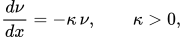
whose solution is

where s_path is the effective path length. Define the observed redshift as
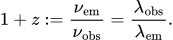
Then

and for zll 1 one has the linear approximation z≃ κs_path.
(Note) Meaning of sₚath vs observational distances (D_L,D_A)
In this section s_path is defined as the geometric effective path length of a ray.
It is not assumed to equal the observational luminosity distance D_L or angular diameter distance D_A.
Therefore, to use (S10_08_D_of_z) as a map to observational distances (for comparison against flux/size data), one must separately lock a mapping convention s_path↦ (D_L,D_A) in the E-COSMO regime (§17.2.5).
If that mapping is not locked, any conclusion that identifies (S10_08_D_of_z) with observational distance is INCONCLUSIVE.
(Estimation protocol) Estimating/fixing κ
To use (S10_08_D_of_z) as a distance map, one must LOCK κ. For example, from data (or simulation logs) (s_i,z_i) one may compute
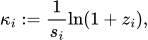
and then produce a single κ by a preregistered aggregation rule (mean/median/weighted least squares, etc.). Changing κ or the aggregation rule after seeing results is forbidden.
(Handover note) Mechanism link and development
Thus (S10_08_D_of_z) may be used as a computation module that takes κ as a locked
input ([INPUT]; estimated from data, not derived — the same status the Earth–Cosmos volume
assigns its κ_opt=H₀/c, fixed there by the low-z Hubble law) and outputs an effective
distance. The lattice-step mechanism link (per-step loss ε at the ℓ_rot scale),
the luminosity-distance form d_L=(c/H₀)(1+z)ln(1+z), and the data confrontation are owned by the
Earth–Cosmos volume, Ch. 7, as of the v0.6.0 handover (box at the head of §17.5).
17.5.3 Gate: achromatic line shifts and spectrum preservation
A minimal requirement for an observed redshift is that the entire line spectrum shifts by the same ratio. Define the effective attenuation rate by frequency as

and for a preregistered line set νₐ define the Gate

If this Gate is not passed, the use of (S10_08_D_of_z) as a “distance map” is FAIL.
17.5.4 Gate: separating redshift from intensity attenuation (extinction)
If one introduces intensity attenuation such as “early extinction of blue/short-wavelength light,” it must be stated as an attenuation term separate from (S10_08_dnudx). For example,
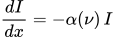
may be added, and spectral distortions (line broadening, color-index changes, image blurring, etc.) must be judged by Gates.
If the form/estimation procedure of α(ν) is not locked, the conclusion is INCONCLUSIVE.
17.5.5 Gate: energy conservation (sink of dissipated energy)
Equation (S10_08_dnudx) implies a decrease of photon energy E=hν.
Therefore a sink model is required: where does the lost energy go (lattice heating, transfer to background radiation, local re-emission, etc.)?
If the sink model is missing, the redshift–distance map of this section is judged INCONCLUSIVE.
17.5.6 Gate: decisive cosmological tests for a static-space redshift (registered, currently open)
A cumulative-loss (“tired-light”) redshift in a non-expanding plenum must also pass the standard tests that historically discriminate a static redshift from metric expansion. These are registered here as hard Gates; until each is locked and passed, the redshift–distance map of §17.5.2 is a phenomenological module only (grade [H]{}/INCONCLUSIVE), not a derived cosmology.
- Supernova time dilation. Type-Ia light-curve durations are observed to scale as (1+z) (temporal stretching). Pure frequency-loss in static space predicts no time dilation. PASS requires the framework to produce the (1+z) stretching of transient time-scales from a stated mechanism; absent that, this Gate
FAILs. This is the single sharpest discriminator and is currently unmet. - Tolman surface-brightness test. Bolometric surface brightness scales as (1+z)⁻⁴ under metric expansion but only (1+z)⁻¹ under static energy-loss alone. The framework must reproduce the observed exponent (after a pre-registered galaxy-evolution correction). Predicting the wrong exponent is
FAIL. - CMB spectrum and T(z). The microwave background is a near-perfect Planck spectrum with T(z)=T₀(1+z) confirmed to moderate z. A static-space model must (i) yield an undistorted blackbody via the §17.5.5 sink (energy removed from photons must not corrupt the Planck shape), and (ii) reproduce T(z)=T₀(1+z). Failure on either is
FAIL.
Each item is a published, quantitative discriminator, not a rhetorical objection. The honest current status: §17.5 supplies the map zleftrightarrow D with a fitted κ ((S10_08_kappa_i); κ/ε is estimated from data, not derived), but does not yet supply the mechanism that passes (1)–(3), and the §17.5.5 energy-sink Gate is itself unmet. The section is therefore carried as an open phenomenological module, and no cosmological conclusion may be drawn from it until these Gates are locked and passed.
Calibrated — Attaching SI Scale to the Forced Architecture
These sections give the dimensionless architecture its units, using only the single anchor and h,c. §13 carries the forced ratios (6π⁵, 5π) that feed the calibrated mass values; the electron mass is the calibration node (§13.5.4), an anchor, not a prediction.