Event (Quantum) Definition and Canonical Event Rate
Event (Quantum) Definition and Canonical: What counts as one event is fixed before anything is counted. The canonical rate splits exactly into scale times survival. This relation holds even without assuming the universal value of δ (e.g., δ=1/π²). Grade [F] forced.
What counts as one event is fixed before anything is counted. The canonical rate splits exactly into scale times survival. This relation holds even without assuming the universal value of δ (e.g., δ=1/π²).
Concept links: the annihilation/event rate defined here is the root cause of gravity (§17.4.0, cap §17.4); the canonical rate νₚ is computed in §9.4.Purpose of the chapter (locking operational definitions)
This chapter fixes “event (quantum event)” as a computable/loggable operational definition, and defines the “canonical event rate” by coupling event occurrences to time (ticks). The outputs of this chapter are locked into the following four bundles.
- Operational definition of state: what must be recorded as a state (required fields).
- Operational definition of event: which form of state change is counted as an event (trigger rules).
- Operational definition of annihilation: rules by which an event terminates/cancels under specified conditions (including label rules).
- Definition of the canonical event rate: based on the locked event definition, define a long-time averaged event rate, and fix the handoff point to later chapters (build time / mass / force / unit realization).
The definitions in this chapter rely only on internal premises—axioms (infinite rigidity / plenum / local rule), registries (LOCK/SSOT), rectification constants (α,δ), and integerization rules (3-sector, 82+7 structure)—without external-text justification.
Higher-level preconditions (regime/locks/symbol conventions)
The definitions of this chapter are valid only when the following preconditions are locked.
- Stone/plenum/local-rule regime: under the VP axiom set, events arise only as compositions of local updates.
- Canonical cell and coordinates: the canonical cell (
CELL-CUBE) and the center/boundary/cut conventions must be locked. - Rectification constants and survival convention: the definitions α=2/π and δ=1/π² are locked, and the operational definition of the survival weight w(e) is locked (when rectified event rates are used).
- Integer structure and labels: the 3-sector integerization and the shell-7 cancellation–survival convention are locked; if charge/electron labels are used, the label axis and thresholds are locked.
If the above preconditions are not locked, the event/state/annihilation definitions in this chapter are undefined and cannot be handed off to subsequent chapters.
Status of operational definitions (fixation as definitions)
In this chapter, an “operational definition” means the following.
- A definition must be mechanically decidable: from the log fields alone, the existence/non-existence of an event must be decidable automatically.
- A definition must be fixed to a single source of truth (SSOT): the same event must not be counted by different rules in different sections.
- A definition is not modifiable after the fact: changing a definition changes inputs to event rates, build time, and mass/force derivations; therefore any change is permitted only by a version bump.
Accordingly, every item in this chapter is presented only as “definitions/rules”, not as interpretive prose.
Connection skeleton: state / event / annihilation
The core skeleton of this chapter is fixed in the following order.

Here
- “state logging” is locked as a log record with required fields;
- “event trigger” is locked as a discontinuity/threshold transition rule decided by comparing pre/post states;
- “event aggregation” is locked as either the raw count N₀ or the rectified (survival-weighted) count N_(δ);
- “annihilation decision” is locked as a rule by which an event terminates via label cancellation or a threshold condition;
- the “canonical event rate” is defined as a long-time average (or regime-average), and is used as the time scale for build times Tₚ,Tₙ and downstream derivations.
This overview only declares the skeleton; the concrete definitions are completed in §9.1 and onward.
9.1 Operational definitions for quantum/event/state/annihilation
9.1.1 Purpose
This section fixes quantum, event, state, and annihilation as loggable operational definitions. The definitions include (i) required log fields, (ii) a decidable trigger function, (iii) prohibition of post hoc tuning (No-Tuning), and (iv) a single-source-of-truth (SSOT) convention; interpretive prose is not included.
9.1.2 Common time/window definitions (ticks and realized time)
[D-9.1-1] Tick index
Define the tick index as n∈Z. In event logs, every record must include the integer tick n as a required field.
[D-9.1-2] Realized time
When the realized-time tick Δ t is locked in realization_lock, define realized time as

[D-9.1-3] Time window
For two ticks n₁<n₂, define the time window as follows.

If Δ t is not definable, then Δ T cannot be used and all event rates must be recorded only on the tick basis.
9.1.3 Operational definition of state: log record (required fields)
[D-9.1-4] State record
Define a state as a “fixed snapshot at one tick”, and denote the state record by S[n]. The record S[n] must include the following fields (if any is missing, the state is undefined).
- state_id: unique state identifier (string).
- tick: n (integer).
- regime_id: regime identifier (locked in 4.3).
- lock_refs:
canon_lock_id,realization_lock_id,analysis_lock_id. - core_state_ref: reference to the core state (e.g., snapshot key or hash for
X82.csv). - shell_state_ref: reference to the shell state (e.g., snapshot key or hash for
S7). - center_ref: reference to (or value of) the center x_c.
- geometry_ref: references to the length scales used, such as Rₚ, L_q, D_anch (item name + lock_id).
- graph_ref: reference to the contact graph (e.g., hash or snapshot key of
G82.edgelist).
[D-9.1-5] Completeness condition for a state
A state record S[n] is defined as a “complete state” iff the following holds.
![\begin{equation} \mathrm{Complete}(S[n])=1 \Longleftrightarrow \text{all required fields in 9.1.3 exist and \texttt{lock\_refs} are sealed in the snapshot}. \end{equation}](/physics/eq/physics/phy-09-003.svg)
If Complete(S[n])=0, that tick cannot be used as an input for event decisions.
9.1.4 Operational definition of event: transition and trigger
[D-9.1-6] Transition
When two consecutive states S[n-1],S[n] are both complete, define the transition as
![\begin{equation} \Delta S[n] := (S[n-1]\rightarrow S[n]). \end{equation}](/physics/eq/physics/phy-09-004.svg)
[D-9.1-7] Event trigger function
Define that an event occurs for a transition Δ S[n] iff the following trigger function returns 1.
![\begin{equation} \mathrm{Trig}(\Delta S[n])\in\{0,1\}, \qquad \mathrm{Trig}(\Delta S[n])=1\ \Longleftrightarrow\ \Delta S[n]\ \text{is counted as an event}. \end{equation}](/physics/eq/physics/phy-09-005.svg)
The concrete rule of Trig must be locked in analysis_lock, and it must not be replaced after seeing results.
[D-9.1-8] Event record
If Trig(Δ S[n])=1, generate an event record e[n]. The required fields of an event record are as follows.
- event_id: unique event identifier (string).
- tick: n.
- pre_state_id: S[n-1].state_id.
- post_state_id: S[n].state_id.
- trigger_id: which trigger fired (enumeration).
- lock_refs:
canon_lock_id,realization_lock_id,analysis_lock_id. - regime_id: S[n].regime_id.
- event_payload: trigger-specific required data (9.1.4.1–9.1.4.3).
9.1.4.1 Trigger set (standard trigger IDs)
In this white paper, trigger IDs are fixed to the following enumeration (additional triggers are permitted only by a version bump).
- TRIG-GRAPH: trigger for contact-graph changes.
- TRIG-SHELL: trigger for shell split / cancellation–survival changes.
- TRIG-LABEL: trigger for charge/electron label changes.
- TRIG-EMIT: trigger for generating an emission record.
- TRIG-ANN: trigger for annihilation decision (9.1.6).
For each trigger, the concrete decision rule is composed only of “log comparisons”, and its thresholds are locked in gate_lock.
9.1.4.2 Definition of TRIG-GRAPH (contact-graph change)
Denote the contact graph by G_c[n] and its edge set by E_c[n]. Define the graph-change magnitude by
![\begin{equation} \Delta E[n] := |\mathcal{E}_c[n]\ \triangle\ \mathcal{E}_c[n-1]|, \end{equation}](/physics/eq/physics/phy-09-006.svg)
where triangle denotes the symmetric difference.
Lock the threshold E_(min)∈Z_(≥ 0) in gate_lock.
Define TRIG-GRAPH as
![\begin{equation} \mathrm{Trig}_{\mathrm{GRAPH}}(\Delta S[n])=1 \Longleftrightarrow \Delta E[n]\ge E_{\min}. \end{equation}](/physics/eq/physics/phy-09-007.svg)
The event_payload of a TRIG-GRAPH event must include references to (Δ E[n],E_(min),E_c[n-1],E_c[n]).
9.1.4.3 Definition of TRIG-LABEL (label change)
Denote the electron/positron/neutral label by
L[n]∈ELECTRON,ANTI_ELECTRON,NEUTRAL (see the definitions in 7.4 and 8.4).
Define TRIG-LABEL as
![\begin{equation} \mathrm{Trig}_{\mathrm{LABEL}}(\Delta S[n])=1 \Longleftrightarrow \mathcal{L}[n]\neq \mathcal{L}[n-1]. \end{equation}](/physics/eq/physics/phy-09-008.svg)
The event_payload of a TRIG-LABEL event must include (L[n-1],L[n]) and a reference (or hash) to V_surv used in the label computation.
9.1.5 Operational definition of quantum: minimal unit of an event
[D-9.1-9] Quantum
In this document, the reserved word “quantum” means one event record e[n].
![\begin{equation} \text{Quantum } q[n]\ \equiv\ e[n]\quad (\mathrm{Trig}(\Delta S[n])=1\ \text{when}). \end{equation}](/physics/eq/physics/phy-09-009.svg)
Thus a quantum is the minimal loggable unit, and any discussion of a quantum must be reducible to the required fields of e[n].
If a “size” or “weight” of a quantum is needed, it may refer only to items locked in analysis_lock, such as the survival weight w(e) or a count like N₀.
(Introducing an arbitrary size function for a quantum is forbidden.)
9.1.6 Operational definition of annihilation: rule of cancellation events
Define annihilation as a rule by which “the simultaneous existence of opposite labels cancels within a specified window and is removed”.
9.1.6.1 Definition of the annihilation windows (time/space)
Because annihilation decisions require a time window and a spatial window, lock the following thresholds.

Define the time window on the tick basis by
![\begin{equation} W_{\mathrm{ann}}[n] := W[n-\Delta n_{\mathrm{ann}}+1,\ n+1). \end{equation}](/physics/eq/physics/phy-09-011.svg)
Define the spatial window by the distance between emission points (8.4) x_emit.
9.1.6.2 Definition of annihilation candidates (opposite-label pairs)
Within the time window W_ann[n], define the set of emission-event records as
![\begin{equation} \mathcal{E}_{\mathrm{emit}}(W_{\mathrm{ann}}[n]) := \{\, e[m]\mid m\in W_{\mathrm{ann}}[n],\ \texttt{trigger\_id}=\texttt{TRIG-EMIT}\,\}. \end{equation}](/physics/eq/physics/phy-09-012.svg)
Each emission event carries references (by the definition in 8.4) to the emission point x_emit(e), the label L(e), and the survival vector V_surv(e).
Define two distinct emission events eₐ,e_b as an annihilation-candidate pair if they satisfy

9.1.6.3 Spatial proximity condition
Define the spatial proximity condition by

9.1.6.4 Cancellation condition (collapse of the sum of survival vectors)
Lock the cancellation threshold V_ann>0. Define the annihilation-cancellation condition by

9.1.6.5 TRIG-ANN
Define the annihilation trigger by
![\begin{equation} \mathrm{Trig}_{\mathrm{ANN}}(\Delta S[n])=1 \Longleftrightarrow \exists (e_a,e_b)\subset \mathcal{E}_{\mathrm{emit}}(W_{\mathrm{ann}}[n])\ \text{s.t.}\ \eqref{eq:S09_01_opposite_labels},\ \eqref{eq:S09_01_ann_spatial},\ \eqref{eq:S09_01_ann_cancel}\ \text{all hold}. \end{equation}](/physics/eq/physics/phy-09-016.svg)
The event_payload of a TRIG-ANN event must include references to (eₐ,e_b), the distance value, the norm of the vector sum, and the thresholds (ρ_ann,V_ann,Δ n_ann).
9.1.6.6 State-update rule for annihilation (label erasure)
When a TRIG-ANN event occurs, define the state-update rule by
![\begin{equation} \mathcal{L}[n]\leftarrow \texttt{NEUTRAL} \quad\text{and}\quad \text{the target emission records }(e_a,e_b)\text{ are labeled as annihilated}. \end{equation}](/physics/eq/physics/phy-09-017.svg)
This rule is an operational definition: “annihilation is recorded as label erasure”; it assigns no additional meaning (interpretation).
9.1.7 Forbidden ambiguous statements (definition violation / Gate invalidation / post hoc tuning)
Under the operational-definition system of this section, the following statement types are forbidden. The criterion for prohibition is “not decidable from logs”, or “allows post hoc tuning”, or “invalidates Gate decisions”.
- Missing-definition type: “A state changed, so it is an event.” (which field change triggers an event is unspecified)
- Undefined-threshold type: “If they are close enough, it is annihilation.” (ρ_ann or V_ann not locked)
- Regime-ignoring type: “The same event rate holds in any regime.” (regime coordinate axes / allowed stack unspecified)
- Gate-bypass type: “Even if Gate is FAIL, interpret it as an event.” (decision invalidation)
- Post hoc tuning type: “If the result does not match, adjust the trigger threshold.” (No-Tuning violation)
- Lock-mixing type: “This time, re-define the label using a different reference axis.” (lock_id mixing)
- Justifying incomplete logs: “There is no log, but it probably happened.” (violates log-based decision)
9.2 Canonical event-rate law ν_can=s·δ
9.2.1 Fixing the classification (definition/axiom/theorem)
Fix the status of the key statements used in this section as follows.
- [D] definitions: s (attempt rate), δ (survival rectification coefficient), ν_can (canonical event rate), and the counts/weights/time windows/limit operations that constitute them.
- [A] axioms: (i) existence and convergence of long-time averages (canonical stationarity), and (ii) applicability conditions for the universality of δ (uniform phases, dual constraints, product measure) and its scope.
- [T] theorem: the derivation of ν_can=s·δ from the above definitions and axioms.
Accordingly, the identity ν_can=s·δ in this section is fixed as a theorem [T], while the conditions under which the theorem holds are fixed as axioms [A]. The meanings of the symbols s,δ,ν_can are fixed only by definitions [D].
9.2.2 [D] Attempt-event set and attempt rate s
9.2.2.1 Time window and attempt-event set
Let the realized time window be [t,t+T) (T>0). Define the set of “attempt events” occurring in this window by

Here Trig₀(e)∈0,1 is the “attempt-event trigger” and is locked in analysis_lock so that it satisfies:
- if Trig₀(e)=1, the minimum conditions for producing an event record are satisfied (including log completeness);
- Trig₀ is the event-count rule before applying the survival constraint (the w(e) below).
If the definition of Trig₀ is not locked, (S09_02_E0) is undefined.
Define the number of attempt events (raw event count) by

9.2.2.2 Definition of the attempt rate s (long-time average)
Define the attempt rate s by the following long-time average.
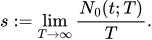
The conditions under which the limit in (S09_02_s_def) exists and converges to the same value independent of t are fixed as axiom [A-9.2-S1] (§9.2.5). Thus s is, as a definition [D], the “time density of attempt-event counts”; it is not justified by external texts.
9.2.3 [D] Survival weight and canonical event rate ν_can
9.2.3.1 Dual-constrained phases and half-wave rectification
For each attempt event e∈E₀(t;T), define two phase variables by

The production rules for θ(e) and φ(e) (from which log fields and by which computation) are locked in analysis_lock.
Define the half-wave rectification operator by
![\begin{equation} [x]_+ := \max(0,x). \end{equation}](/physics/eq/physics/phy-09-022.svg)
9.2.3.2 Definition of the survival weight w(e)
Define the survival weight of an attempt event e by
![\begin{equation} w(e) := [\cos\theta(e)]_{+}\,[\cos\varphi(e)]_{+}. \end{equation}](/physics/eq/physics/phy-09-023.svg)
Definition (S09_02_w_def) is the unique source of the survival convention; within the same version it must not be replaced by |·| or any other nonlinear function.
9.2.3.3 Definition of the canonical event count N_can
Define the canonical event count (rectified count) in the time window [t,t+T) by
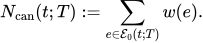
By definition, 0≤ N_can(t;T)≤ N₀(t;T).
9.2.3.4 Definition of the canonical event rate ν_can (long-time average)
Define the canonical event rate by the following long-time average.
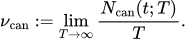
The conditions under which the limit in (S09_02_nucan_def) exists and converges independent of t are fixed as axiom [A-9.2-S1] (§9.2.5).
9.2.4 [D] Definition of δ and its locked value (lock location)
9.2.4.1 Definition of δ (mean survival coefficient over attempt events)
Define δ as the following mean survival coefficient.

For (S09_02_delta_def) to be meaningful, it must hold that N₀(t;T)→∞ for long times; this condition is included in axiom [A-9.2-S1].
9.2.4.2 Locking the value of δ (regimes where the universality axiom applies)
In regimes where the universality axiom [A-5.2-U] applies, the value of δ is locked as

Equation (S09_02_delta_value_lock) is locked in its unique source location in §5.2; it is not re-derived here. In this section, only referencing (S09_02_delta_value_lock) is permitted.
9.2.5 [A] Axioms: canonical stationarity and applicability of δ universality
[A-9.2-S1] Canonical stationarity axiom (existence and convergence of long-time averages)
Fix as an axiom that the following limits exist and converge to the same value independent of the start time t.

Axiom (S09_02_stationarity_axiom) means that the “canonical event rate”, the “attempt rate”, and the “survival coefficient” can be treated as constants within a regime. If this axiom fails, the premise of the theorem ν_can=sδ collapses.
[A-9.2-S2] δ-universality axiom (value fixation in applicable regimes)
Use δ=1/π² only in regimes where the following conditions are locked.
- phase uniformity: θ,φ each follow the uniform measure on the full cycle [0,2π);
- dual constraints: the survival weight is fixed to the product form (S09_02_w_def);
- product measure (separated measure): the joint measure of (θ,φ) factorizes as a product measure.
This axiom is a restatement, in this chapter, of the regime restriction of the universality axiom set [A-5.2-U] in §5.2; the value fixation is attributed to canon_lock.
9.2.6 [T] Canonical event-rate law ν_can=s·δ
In regimes where axiom [A-9.2-S1] holds, derive the following theorem from definitions (S09_02_s_def), (S09_02_nucan_def), and (S09_02_delta_def).
[T-9.2-1] Theorem (canonical event-rate law)
The following holds.

Proof
Using the definition of the canonical event count (S09_02_Ncan_def),
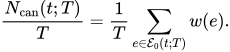
Multiply and divide the right-hand side by N₀(t;T) to obtain (for T such that N₀(t;T)>0)

Now take the limit T→∞. By axiom [A-9.2-S1],

so from (S09_02_step2) we obtain
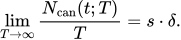
The left-hand side is ν_can by definition (S09_02_nucan_def), hence

Therefore (S09_02_theorem_goal) holds. square
[T-9.2-2] Special form in the universal regime
In regimes where axiom [A-9.2-S2] holds so that (S09_02_delta_value_lock) can be used, theorem (S09_02_theorem_goal) is fixed in the following special form.
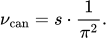
Equation (S09_02_nucan_special) is a special case of the theorem and is used only in regimes where value fixation of δ is permitted.
9.2.7 Standard conclusion format for connecting to PASS.rules
When using theorem (S09_02_theorem_goal) or (S09_02_nucan_special) as a conclusion sentence, the following items must be stated together (if omitted, the conclusion has no validity).
- identifiers of the referenced definitions of Trig₀ and w(e) (via the
analysis_lockreference); - the regime condition for δ value fixation (whether the regime is universal) and the Gate decision related to δ;
- sealed references (manifest/checksums/registry_snapshot) of the time window and log snapshots used to compute s,δ,ν_can.
These items are not “narrative style”; they are required fields that constitute the validity of the conclusion sentence, enforced by PASS.rules.
9.3 Electron canonical: νₑ,can=1, rₑ
9.3.1 [D] Defining the electron canonical event rate (fixing the unit)
Define and lock the electron canonical event rate ν_e,can by the following identity.

Equation (S09_03_nue_can_def) is the definition of the “electron canonical” and is not tuned within the same version. The unit of ν_e,can is fixed to the canonical event-rate unit used in this document (conversion to realized units is treated only in the unit-realization chapter).
9.3.2 [D] Electron attempt rate sₑ and survival coefficient δ
Specialize the general canonical-event-rate components defined in §9.2 to the electron case as follows.
9.3.2.1 [D] Electron attempt-event set and attempt rate
Denote the electron attempt-event (raw event) set by E_(0,e)(t;T), and define the raw count by

Define the electron attempt rate sₑ by the long-time average
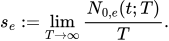
Existence and settlement of the limit are attributed to the stationarity axiom (the axiom items of §9.2) and are not restated here.
9.3.2.2 [D] Electron survival coefficient δ
Assume the survival weight w(e) is defined for electron attempt events e∈E_(0,e)(t;T), and define the electron survival coefficient δ by the average

The symbol δ is used by referring to the rectification-constant chapter (Chapter 5) and is not redefined within the same version.
9.3.3 [T] Applying the theorem: νₑ,can=sₑ·δ
Applying the canonical-event-rate theorem of §9.2 to the electron yields

Substitute (S09_03_nue_can_def) into (S09_03_nue_factor).
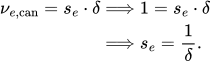
Therefore the electron attempt rate sₑ is fixed as the reciprocal of the survival coefficient δ. This relation holds even without assuming the universal value of δ (e.g., δ=1/π²).
9.3.4 [D] Defining the electron length rₑ (geometric implementation of the attempt rate)
This section locks the electron length rₑ by definition as a “geometric implementation of the electron attempt rate sₑ.”
9.3.4.1 [D] Anchor length and half-length
Assume the canonical-cell representative length D_anch is locked, and fix the half-length r₀ by the following derived definition.
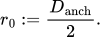
The geometric meaning of D_anch (edge length in the canonical cell) is locked in §3.3; this section only refers to it.
9.3.4.2 [D] Geometric definition of the attempt rate
Define the electron attempt rate sₑ by the following geometric ratio.
Definition (S09_03_se_geom) adopts the convention that the attempt rate is “how many times the half-length r₀ contains the electron radius rₑ,” and is not modified within the same version.
Equation (S09_03_se_geom) is admissible only when the meanings of the symbols (radius/half-length) are locked; any radius/diameter confusion or cell-geometry confusion is an immediate FAIL (see the convention in §2.4).
9.3.5 Step-by-step derivation of rₑ
Combine (S09_03_step2) and (S09_03_se_geom) to derive rₑ.
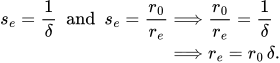
Substitute (S09_03_r0) into (S09_03_re_step2).

Therefore the final form of the electron radius is fixed as
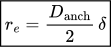
Equation (S09_03_re_final) is derived only by combining the electron canonical definition ν_e,can=1, the geometric attempt-rate definition (S09_03_se_geom), and the survival-coefficient definition (S09_03_delta_def).
9.3.6 Special form in the universal regime (value substitution)
If δ is locked to

in a regime where the universality axiom applies, then substituting (S09_03_delta_univ) into (S09_03_re_final) yields the special form

Special form (S09_03_re_univ) is used only in the universal regime; in regimes where universality triggers are broken, only the general form (S09_03_re_final) (regime-dependent δ) is allowed.
9.3.7 Derived quantity (diameter)
Define the electron diameter (length) by the derived definition

Therefore, from (S09_03_re_final),

and in the universal regime, from (S09_03_re_univ),

is fixed.
The symbol ℓₑ is subject to the diameter/radius disambiguation convention (§2.4); using ℓₑ as a radius is an immediate FAIL.
9.4 νₚ,can=3π⁴≈ 292.23 — length cross-check
Independent numerical reproduction of νₚ=3π⁴ and the integer combinatorics is recorded in §11.6.5 (deposited bundle); the same νₚ is the dynamical grind rate of §8.5. SSOT note. The canonical value of ν_p,can is fixed geometrically as ν_p,can=3π⁴≈ 292.227s⁻¹ by the n-fold rectification law [LOCK-NU-N] in §8.0.5. The length-anchored computation of this section, ν_p,can=fracD_anch2rₚδ≈ 292.245, is retained as a cross-check (it agrees with 3π⁴ to +61 ppm and equivalently predicts rₚ=D_anch/(6π⁶)=0.84125fm). Where the two differ, the geometric 3π⁴ is canonical and rₚ is the derived prediction. Cross-links for D: the quantum diameter D=ℓ_rot used here is defined in §3.4; its dynamical origin A=a/g^* is in §11.6.1; the structural identity D=2πλ/A (with the same A fitting both 633 and 532 nm) is recorded in the Reviewer Companion (§II provenance notes). The canonical numeric value is D_anch=2λ_(C,e)=4.8526 pm, locked in the preamble (master SSOT table).9.4.1 LOCK inputs and reference formula (starting point)
This section assumes that the following inputs are fixed (LOCK) by canon_lock.
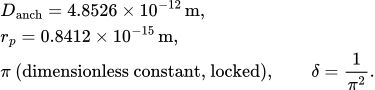
It also applies the canonical event-rate law (theorem) of §9.2 to the proton and uses

9.4.2 Definition: proton scale factor sₚ
Fix the canonical-cell half-length r₀ by the derived definition
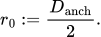
Define the proton scale factor sₚ as the following dimensionless ratio.
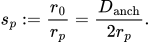
In definition (S09_04_sp_def), the geometric meanings of D_anch and rₚ (diameter/radius/cell geometry) must already be locked; any confusion (overloading) is an immediate FAIL.
Note: why sₚ is defined as a linear ratio (dimensionality of the event definition)
The sₚ in (S09_04_sp_def) is a scale factor used in the canonical event-rate law of §9.2; it is not “the number of volume slots” such as (r₀/rₚ)³. In this white paper, an event is not defined as “volume filling” but as turnover on a propagation/inflow backbone path. Effective reduction due to 3D geometry/angle cancellation/phase overlap is already absorbed into the rectification coefficient δ (§5.2 and §9.4.3.1). Therefore, interpreting sₚ again as a 3D volume ratio would double-count the same geometric factor.
9.4.3 Computation: δ, sₚ, νₚ,can
9.4.3.1 Computing the rectification coefficient δ
The rectification coefficient is locked from the unique source of §5.2 as

9.4.3.2 Computing the scale factor sₚ
Substitute (S09_04_Danch_lock) and (S09_04_rp_lock) into definition (S09_04_sp_def).

9.4.3.3 Computing the canonical event rate νₚ,can
Substitute (S09_04_sp_numeric) and (S09_04_delta_numeric) into (S09_04_nu_sp_delta).

Fix the effective digits (limited by input precision) as

Or, changing only the unit label,

may be recorded. Here “Hz=s⁻¹” reads the canonical second as equivalent to the SI second; the equivalence judgment is performed by the unit-realization (cross-validation) Gate.
9.4.4 Equivalent forms (a fully closed single expression)
Combining (S09_04_nu_sp_delta), (S09_04_sp_def), and (S09_04_delta_def) yields
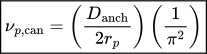
The numeric derivation in this section is completed by direct substitution into (S09_04_closed_form); no additional assumptions enter.
Equivalent form (reduction to the electron canonical)
In the universal regime, using the electron-radius definition rₑ=(D_anch/2)δ from §9.3, (S09_04_closed_form) can be written equivalently as

That is, “the form derived via the electron” and “the form derived via the anchor-to-proton ratio” are two notations of the same equation; no new assumptions are introduced here.
9.4.5 Sensitivity / error budget (LOCK linkage)
9.4.5.1 Differential sensitivity (directly from the definition)
From (S09_04_closed_form), ν_p,can is proportional to D_anch and inversely proportional to rₚ. Differentiating gives

The relative sensitivity is summarized as
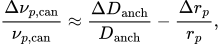
where the value of δ=1/π² is locked as a rectification constant (within the same version); therefore the only degrees of freedom in the error budget are the input precisions of D_anch and rₚ.
9.4.5.2 Example of input variation (importance of LOCK values)
If rₚ deviates from the LOCK value, ν_p,can changes immediately. For example, as a reference comparison,

would give
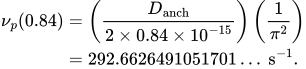
Therefore the difference is

with relative difference

Hence, locking rₚ to (S09_04_rp_lock) simultaneously fixes the corresponding ν_p,can to the single value (S09_04_nup_numeric).