Realization of units: a,Δ t,RCROSS
Realization of units: a,Δ t,RCROSS: One split rule turns the anchor into the lattice unit. No single anchor decides anything: two channels or no conclusion. Tier-3 adjudication Tier-3 is evaluated only when Tier-2= PASS. This chapter fixes the procedure that seals a world described in internal units (dimensionless/internal length/internal time) into realized units (length/time). Grade [F] forced.
One split rule turns the anchor into the lattice unit. No single anchor decides anything: two channels or no conclusion. Tier-3 adjudication Tier-3 is evaluated only when Tier-2= PASS.
Purpose (deliverables of unit realization)
This chapter fixes the procedure that seals a world described in internal units (dimensionless/internal length/internal time) into realized units (length/time). The deliverables of this chapter are fixed as the following four items.
- The realized length scale a (the VP diameter) and the locking of its value in
realization_lock. - The realized time tick Δ t and the locking of its value in
realization_lock. - The definition of operational anchors (input channels, record formats, scopes).
- The cross-validation system RCROSS (a multi-anchor consistency Gate) and its PASS/FAIL judgment.
This chapter does not treat realized values as “tuning to make things fit.” Realized values are outputs that are computed from operational anchors and pre-registered procedures and then sealed; any post hoc change after seeing the result is prohibited.
Declaration of Option-B (realization philosophy)
This chapter fixes the philosophy of unit realization as Option-B. Option-B consists of the following declarations.
- Dimensionless results or internal-unit results produced by internal computations (lattice/events/propagation) are preserved as they are as locked relations (ratios/invariants).
- Conversion into realized units is performed through operational anchors; anchors have pre-registered channels and logging protocols.
- Realized values (a,Δ t) have the status of conclusions only when self-consistency is confirmed through cross-validation (RCROSS) rather than by a single anchor.
The core of Option-B is to prohibit “realization that depends on a single reference point,” and to structurally implement No-Tuning by weaving at least two independent channels into cross-consistency.
Declaration of operational anchors (status of inputs)
Operational anchors are reference channels used in the realization map, and they have the following properties.
- Anchors are inputs: an anchor is not a derived output but a reference for realization; its choice/interpretation/logging are locked in
analysis_lockandprotocol_lock. - Anchors are single-source-of-truth: the value and record of an anchor belong to
realization_lockand are not duplicated elsewhere in the manuscript. - Anchors have a scope: an anchor is locked together with its applicable regime (observation/experiment/channel) and is not reused out of scope.
- Anchors are immutable after sealing: changes are allowed only via versioning; any change triggers full re-derivation and full re-validation.
Declaration of the cross-validation system (RCROSS)
RCROSS is defined as a Gate stack that judges whether two or more independent anchors support the same realized values. RCROSS consists of the following elements.
- Anchor channel set: A=A₁,A₂,….
- Channel-wise candidate realized values: (a^((k)),Δ t^((k))).
- Comparison indicators: Π-type indicators (ratios/differences/cross-invariants).
- Thresholds/tolerances: a set ε (pre-registered).
- Verdict outputs:
PASS/FAIL/INCONCLUSIVE.
RCROSS does not assert “matching implies truth”; it only judges whether the pre-registered conditions are satisfied. If RCROSS is not PASS, realized values do not have the status of conclusions.
Locking a,Δ t and declared linkage
In this chapter, a and Δ t are fixed as core entries in realization_lock.

These values are sealed as the output of the procedures in this chapter (operational anchors + RCROSS), and are not re-estimated/re-calibrated elsewhere. Changes to realized values are permitted only through versioning; if changed, all dependent derived quantities (energy, mass, force, propagation speed, etc.) must be fully recomputed and re-adjudicated.
11.1 Option-B philosophy: c_ref is an operational anchor
11.1.1 Purpose
This section fixes the status of c_ref in Option-B unit realization as an operational anchor, and fixes as prohibition rules any use of c_ref as a “prediction target” or “justification basis.” The deliverables of this section are (i) the meaning (definition) of c_ref, (ii) the allowed slots where c_ref may be used, and (iii) prohibited uses and their violation handling.
11.1.2 Definition: fixing the meaning of c_ref
[D-11.1-1] Realization map (length/time)
Fix the relation between internal coordinates x,t and realized coordinates x,t as follows.

Therefore the internal velocity v and realized velocity v are linked by
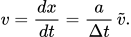
[D-11.1-2] c_ref
c_ref is a reference speed constant used in the realization procedure, defined with the following meaning.

That is, c_ref is not a derived output of the internal propagation indicator c; it is a reference used to fix the realization of a and Δ t. The dimension of c_ref is length/time, and the unit notation is locked as m/s.
[D-11.1-3] Storage protocol for c_ref
c_ref must be stored together with the following fields in realization_lock.
- value: the numeric value of c_ref.
- unit: the unit (fixed:
m/s). - channel_id: identifier of the reference channel (which operational anchor).
- scope: applicable scope (which regime/experiment/baseline combination).
- protocol_ref: measurement/recording/preprocessing protocol identifier.
If any field is missing, then c_ref degenerates into “a constant with only a number,” violating SSOT, hence unusable; all downstream realization results become INCONCLUSIVE or FAIL.
11.1.3 Allowed slots for using c_ref in Option-B (defined slots)
Option-B locks c_ref so that it is used only in the following slots.
11.1.3.1 Slot for fixing the realization scale factor
Define the realized velocity scale factor as

In Option-B, c_ref is used only as a reference for fixing Λ_v. That is, when a channel Aₖ provides an internal speed indicator c^((k)), the realization factor is defined to be determined only by

Equation (S11_01_Lv_from_cref) encodes that “c_ref is a reference” and “the internal indicator is a derived output.”
11.1.3.2 Slot for decomposing the realization into a and Δ t
Option-B assumes that Λ_v=a/Δ t alone does not determine a and Δ t individually; a and Δ t must be decomposed via at least two independent anchors. c_ref is used only as one anchor value in this decomposition, and additional anchors (e.g., baseline combinations, RCROSS channels) are required. Hence c_ref does not determine a or Δ t by itself.
11.1.4 Prohibition rule: do not use c_ref as a prediction target
This section prohibits using c_ref as a “prediction target” under the following conditions.
11.1.4.1 Definition of the prohibition
If any of the following is performed, it is judged as “predictive use of c_ref” and prohibited.
- After computing an internal-derived c or realized c, writing a justification statement that uses agreement with c_ref as a basis.
- Claiming to produce c without knowing c_ref, while in fact using c_ref as an input in selecting a, Δ t, or channel choice.
- Post hoc modification of c_ref or anchor-channel definitions to evade an RCROSS failure.
This prohibition is not a “sentence ban” but a “procedure ban”; it must be decidable from logs.
11.1.4.2 The only allowed comparison slot (comparison as a Gate metric)
When comparing c_ref and c is necessary, such comparison is allowed only in the following slot.

That is, comparisons are used only for PASS/FAIL/INCONCLUSIVE adjudication; retroactively modifying axioms/definitions/realized values based on a comparison outcome is prohibited.
11.1.5 Prohibition rule: do not use c_ref as a single anchor
Option-B prohibits determining (a,Δ t) using c_ref as a single anchor. The prohibition condition is

A “single-anchor determination” means one of the following.
- Fixing a arbitrarily and sealing Δ t computed only from c_ref (or vice versa).
- Determining (a,Δ t) simultaneously by a single channel without cross-channel consistency (RCROSS).
Therefore, in this chapter, realized values must pass a Gate stack that includes RCROSS.
11.1.6 Handling upon violation (FAIL labels)
Violations of the prohibition rules in this section are handled with the following FAIL labels.
| Label | Meaning |
| FAIL-CREF-PREDICT | using c_ref as a prediction target (as justification/basis) |
| FAIL-ANCHOR-SINGLE | determining realized values using c_ref as a single anchor |
| FAIL-CREF-RETRO | post hoc modification of c_ref or channel definitions after RCROSS/judgment failure |
| FAIL-CREF-LOCK | missing storage fields for c_ref or mixing lock_id combinations |
11.2 Deriving a=λ_ref/N→aVPm
11.2.1 Inputs (LOCK): λ_ref and N
[D-11.2-1] Reference length λ_ref
Define λ_ref as a reference length (operational anchor) used in unit realization. λ_ref is locked in realization_lock together with the fields value, unit, channel_id, scope, protocol_ref.
The locked value used in this section is fixed as

[D-11.2-2] Split integer N
N is a dimensionless integer, defined as the number of equal subdivisions of the reference length λ_ref into N pieces. N is locked in analysis_lock and cannot be changed after seeing the result.
The locked value used in this section is fixed as

11.2.2 Definition: realized length a (VP diameter)
[D-11.2-3] Meaning (diameter) and unit of a
Define a as the fundamental diameter of the volume particle (VP). The geometric meaning of a is locked as diameter and is not reinterpreted as a radius. The dimension of a is length (L), and the unit is locked as m.
[D-11.2-4] Split-realization rule
Define the realized length a by the following split rule.

Definition (S11_02_a_def) is a unit-realization rule; if λ_ref and N are not locked, then a is undefined.
11.2.3 Unit conversion: SI expression of λ_ref
[D-11.2-5] Nanometer-to-meter conversion
Fix the unit conversion rule as

[D-11.2-6] Meter value of λ_ref
From (S11_02_lref_nm) and (S11_02_nm_to_m),
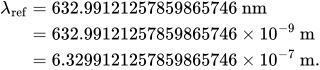
11.2.4 Expanding the computation a=λ_ref/N
Substitute (S11_02_lref_m) and (S11_02_N_lock) into (S11_02_a_def).
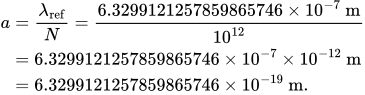
Therefore the realized length a is fixed as

11.2.5 Derived expression (attometer units)
[D-11.2-7] Attometer conversion
Fix the unit conversion rule as

[D-11.2-8] Attometer expression of a
From (S11_02_a_final) and (S11_02_am_to_m),
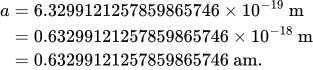
11.2.6 LOCK location of a (registry entry)
a must be recorded in realization_lock with the following fields.
- symbol:
a - entity: the fundamental diameter of
OBJ-VP - geometry_meaning:
diameter - dimension:
L - unit:
m - value: (S11_02_a_box)
- derived_from: λ_ref (including its
channel_id), N (including itsanalysis_lockfield name) - derivation_id:
DER-11-02-A
In the same release, it must also be sealed by manifest and checksums; an unsealed a cannot be used as an input for later chapters (energy/mass/force/c).
11.3 Deriving Δ t=(A· a)/c_ref→1.86× 10⁻²¹s
11.3.1 Inputs (LOCK): a, c_ref, A
[D-11.3-1] Realized length a
a is defined as the fundamental diameter of VP (geometry_meaning=diameter), locked with length dimension (L) and unit m. The locked value used in this section is

[D-11.3-2] Reference speed constant c_ref
c_ref is defined as a reference speed constant of an operational anchor (reference channel), locked with dimension L/T and unit m/s. The locked value used in this section is

[D-11.3-3] Propagation amplification coefficient A
A is dimensionless and is defined as a coefficient indicating how many times the “effective propagation length corresponding to one tick” aggregates relative to the base length a. The locked value used in this section is

The procedure that produces A (event definition, propagation path, aggregation window, estimator) must be locked in analysis_lock and cannot be changed after seeing results.
11.3.2 Definition: effective propagation length ℓₑff
Define the effective propagation length corresponding to one tick as

In (S11_03_leff_def), since A is dimensionless, ℓ_eff has dimension length (L) and unit m.
11.3.3 Definition: Δ t (an anchor-based time tick)
Fix the reference speed constant c_ref as an operational quantity defined by the ratio of the “effective propagation length per tick” to the “tick time”.

Substituting (S11_03_leff_def) into (S11_03_cref_as_ratio) gives

Solving (S11_03_cref_sub) for Δ t yields
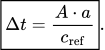
Equation (S11_03_dt_formula) is the derived result of this section, completed by combining definitions (S11_03_cref_as_ratio) and (S11_03_leff_def).
11.3.4 Numerical substitution (fully expanded)
11.3.4.1 Computing ℓₑff=A· a
Substitute (S11_03_A_lock) and (S11_03_a_lock) into (S11_03_leff_def).

11.3.4.2 Computing Δ t=ℓₑff/c_ref
Substitute (S11_03_leff_value) and (S11_03_cref_lock) into (S11_03_dt_formula).
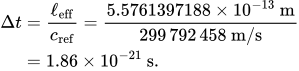
Therefore the realized time tick is fixed as

11.3.5 Linkage to an error budget (sensitivity)
Since Δ t is defined by (S11_03_dt_formula), the first-order sensitivity to changes in (A,a,c_ref) is obtained by differentiation.

Therefore a first-order upper bound on the absolute error is recorded as

If a variance-type budget is recorded under an independence assumption, the following must be locked in analysis_lock as the “error-budget selection rule.”

Here σ_A,σₐ,σ_c_ref are standard uncertainties of each input, and the estimation rules (which logs/windows/repetitions are used) must be locked in analysis_lock.
In particular, in a version where a is sealed as a value in realization_lock and c_ref is sealed as an operational anchor, the error budget in that version may be dominated by the production procedure for A; any decision (e.g., treating certain terms as zero) is permitted only under a pre-registered protocol.
11.4 RCROSS(633/532): a 3-Tier Gate
11.4.1 Purpose
This section defines the cross-validation RCROSS using two baseline channels (633, 532) as a 3-Tier Gate, and fixes (i) the deviation metric dev, (ii) the tolerance threshold dev_max, and (iii) failure-mode labeling.
This section does not justify cross-consistency; it only defines the PASS/FAIL/INCONCLUSIVE adjudication rules.
11.4.2 Inputs (LOCK): two channels and channel-wise realization candidates
Define the two baseline channels as

Each channel must output a realization candidate (a^((k)),Δ t^((k))), or at least a realized velocity scale factor Λ_v^((k))=a^((k))/Δ t^((k)). Channel-wise artifacts must include at least the following fields.
- channel_id:
A633orA532. - lambda_ref: the baseline value (with a length unit).
- N: split integer (dimensionless).
- a_cand: candidate a^((k)) (or a common a if
Nis common). - dt_cand: candidate Δ t^((k)).
- lock_refs:
canon_lock_id,realization_lock_id,analysis_lock_id.
If any field is missing, the channel artifact is undefined and INCONCLUSIVE.
11.4.3 Definition of the deviation metric (dev)
The core of cross-consistency is whether “two channels support the same realized result.” Define the deviation metric as follows.
11.4.3.1 Relative deviation dev
Let Δ t^((k)) be the candidate time tick of channel k∈633,532. Define the relative deviation by
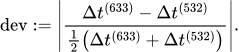
If the denominator can be zero, the metric is undefined, hence require positivity of both candidates.

If (S11_04_dt_positive) is violated, it is an immediate FAIL-RCROSS-NONPOS.
11.4.3.2 Alternative deviation (scale-factor based; optional)
If a channel provides only the realized scale factor Λ_v^((k))=a^((k))/Δ t^((k)) instead of Δ t, define the alternative deviation by
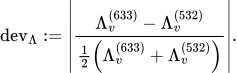
Which deviation is used (time-based dev or scale-based dev_Λ) must be pre-registered in analysis_lock and cannot be switched after seeing results.
11.4.4 Definition of the 3-Tier Gate
The 3-Tier Gate adjudicates in the order definability → consistency pass → strengthening (additional consistency). Each Tier outputs an independent PASS/FAIL/INCONCLUSIVE.
11.4.4.1 Tier-1: input/definition completeness Gate
Tier-1 judges whether “the comparison itself is well-defined.”
Tier-1 PASS condition
Tier-1=PASS if all of the following are satisfied.
- All required fields exist in both channel artifacts.
-
lock_refsexists, and the two channels belong to the same lock_id combination (or to a pre-registered allowed combination). - Δ t⁽⁶³³⁾,Δ t⁽⁵³²⁾ (or Λ_v⁽⁶³³⁾,Λ_v⁽⁵³²⁾) are both defined and positive.
Tier-1 INCONCLUSIVE condition
If there are missing fields, missing lock_refs, possible zero denominators, or any undefined values, then Tier-1=INCONCLUSIVE.
Tier-1 FAIL condition
If traces of post hoc modifications (channel-definition swaps, threshold changes, value substitutions) or lock_id mixing are detected, then Tier-1=FAIL.
11.4.4.2 Tier-2: dev-threshold pass Gate (core)
Tier-2 judges whether the deviation metric is within the tolerance.
Locking the tolerance (dev_max)
Lock the tolerance dev_max as

Tier-2 adjudication
When Tier-1=PASS and dev is definable, define Tier-2 by

If Tier-1≠PASS, then Tier-2 is INCONCLUSIVE (the comparison is not well-defined).
11.4.4.3 Tier-3: strengthening consistency Gate (additional conditions)
Tier-3 is a strengthening Gate that can require “channel-wise internal consistency” even after dev passes. Tier-3 locks either one or both of the following strengthening conditions (selection/combination is locked in analysis_lock).
(T3-A) Derived-quantity consistency
Compute a channel-wise set of derived quantities Π^((k))=Π₁^((k)),Π₂^((k)),… under locked definitions, and judge whether relative deviations of derived quantities are within thresholds. The derived-quantity choices and deviation definitions are locked in analysis_lock. The threshold Π_(max) is locked in gate_lock.
(T3-B) Repeat/replay consistency
Judge whether the dev distribution is stable when the same channel is rerun over a pre-registered replay set. The replay set and stability thresholds (e.g., variance bounds) are locked in analysis_lock/gate_lock.
Tier-3 adjudication
Tier-3 is evaluated only when Tier-2=PASS. If strengthening conditions are not locked, Tier-3 remains INCONCLUSIVE. If strengthening conditions are locked and a threshold is violated, Tier-3=FAIL.
11.4.5 Final RCROSS Gate (3-Tier composition)
Define the final RCROSS verdict by

That is, Tier-3 requires PASS when it is locked and evaluated; if it is not locked, it may remain INCONCLUSIVE, but in that case statements like “strengthening consistency passed” are prohibited (restricted by PASS.rules).
11.4.6 Failure-mode labeling (standard labels)
Record RCROSS failures with cause-decomposition labels. Labels are fixed as the following enumeration (multiple labels allowed).
| Label | Meaning |
| INCON-RCROSS-MISSING | missing required fields (undefined) |
| INCON-RCROSS-UNLOCK | missing lock_refs or missing snapshot sealing (undefined) |
| FAIL-RCROSS-NONPOS | non-positive Δ t or Λ_v (definition violated) |
| FAIL-RCROSS-LOCKMIX | mixing different lock_id combinations (lock violated) |
| FAIL-RCROSS-DEV | dev>dev_(max) (core inconsistency) |
| FAIL-RCROSS-T3 | Tier-3 strengthening condition violated |
| FAIL-RCROSS-RETRO | post hoc modification detected (channel/threshold/definition swap) |
11.4.7 Logging/sealing protocol (link to checksums)
The RCROSS verdict must generate and seal the following record.
rcross_report:
  - rcross_id: (unique)
    channels: [A633, A532]
    dt_633: ...
    dt_532: ...
    dev: ...
    dev_max: ...
    tier1: PASS|FAIL|INCONCLUSIVE
    tier2: PASS|FAIL|INCONCLUSIVE
    tier3: PASS|FAIL|INCONCLUSIVE
    verdict: PASS|FAIL|INCONCLUSIVE
    labels: [...]
    lock_refs: {canon_lock_id, realization_lock_id, analysis_lock_id, gate_lock_id, protocol_lock_id}
    manifest_ref: ...
    checksums_ref: ...
A report without manifest_ref and checksums_ref does not grant conclusion status.
11.5 (Integrated appendix) MMS Operational Anchor format
11.5.1 Purpose
This section provides a format definition and a correspondence table to attach the Operational Anchor format used in MMS documents into this theory's realization_lock/analysis_lock/gate_lock system.
This section fixes (i) the required fields of MMS operational-anchor records, and (ii) how the v4 RCROSS(633/532) and threshold items correspond to the 3-Tier Gate fields of this manuscript. This section does not perform interpretation.
11.5.2 Standard format of MMS Operational Anchor records (required fields)
An MMS operational-anchor record must contain the following fields as required. If a field is missing, the anchor is unusable and INCONCLUSIVE.
- anchor_id: anchor identifier (e.g.,
A633,A532). - anchor_type:
lengthortimeorvelocity, etc. (this manuscript is length-centered). - value: numeric value.
- unit: unit notation (
nm,m,s,m/s, etc.). - channel: channel description (e.g., baseline, instrument, mode).
- scope: identifier of the applicable regime/experimental conditions.
- protocol_id: measurement/preprocessing/log-schema identifier.
- lock_refs:
canon_lock_id,realization_lock_id,analysis_lock_id,gate_lock_id,protocol_lock_id. - artifacts: list of raw/preprocessed/report file paths.
- hash_refs: manifest/checksums reference keys.
After including these fields, MMS records must be sealed by inclusion into registry/realization_lock.* or snapshot/registry_snapshot/ according to this manuscript's registry structure.
11.5.3 v4 RCROSS/threshold leftrightarrow the main-text 3-Tier Gate correspondence table
The table below fixes how RCROSS and threshold-type items that appear in v4 documents (including MMS) correspond to the 3-Tier Gate and registry fields of this manuscript. Because the “v4 item name” can differ in spelling/keys, the correspondence is by meaning; the actual key-string mapping is locked separately as a mapping table in protocol_lock.
| v4/MMS item (meaning) | Location in this manuscript | Protocol/judgment |
| Baseline 633 channel (wavelength/length) | realization_lock.anchors[A633].lambda_ref | Tier-1 required input; includes unit/scope/protocol |
| Baseline 532 channel (wavelength/length) | realization_lock.anchors[A532].lambda_ref | Tier-1 required input; includes unit/scope/protocol |
| Split integer N (e.g., 10¹²) | analysis_lock.anchor_split.N | post hoc change prohibited; changes only via versioning |
| Channel-wise candidate Δ t⁽⁶³³⁾ | outputs/derived/dt_633.txt + rcross_report.dt_633 | Tier-1 definability; Tier-2 dev input |
| Channel-wise candidate Δ t⁽⁵³²⁾ | outputs/derived/dt_532.txt + rcross_report.dt_532 | Tier-1 definability; Tier-2 dev input |
| Definition of cross deviation (dev) | analysis_lock.rcross.dev_definition | lock either dev or dev_Λ |
| Tolerance dev_max | gate_lock.rcross.dev_max | Tier-2 core threshold; dev>dev_max yields FAIL-RCROSS-DEV |
| 3-Tier structure (define/consistency/strengthen) | analysis_lock.rcross.tiers | fixes Tier-1/2/3 protocols |
| Strengthening condition (derived-quantity comparison) | analysis_lock.rcross.tier3.derivatives | when locked, run Tier-3; violation yields FAIL-RCROSS-T3 |
| Strengthening condition (replay consistency) | analysis_lock.rcross.tier3.replay_set | if replay set not locked, Tier-3=INCONCLUSIVE |
| thresholds.yaml (threshold file) | overall gate_lock + configs/thresholds.yaml | thresholds are pre-registered; the file itself is a seal target |
| PASS/FAIL judgment logs | outputs/gates/rcross_report.json | without manifest+checksums sealing, no conclusion status |
| Bonferroni/CI cross rules (if present) | analysis_lock.rcross.stat_rule | allowed only as Tier-3 strengthening conditions |
11.5.4 Protocol for a mapping table (key-string correspondence)
To link the actual key strings used in v4/MMS to the registry keys of this manuscript, a “key mapping table” is required; it is locked in protocol_lock. The standard format is fixed as
key_map_mms_to_v5:
  - mms_key: "lambda_633"
    v5_path: "registry/realization_lock.anchors[A633].lambda_ref.value"
  - mms_key: "lambda_532"
    v5_path: "registry/realization_lock.anchors[A532].lambda_ref.value"
  - mms_key: "dev_max"
    v5_path: "registry/gate_lock.rcross.dev_max"
  - mms_key: "thresholds_yaml"
    v5_path: "configs/thresholds.yaml"
The key mapping table cannot be modified after seeing results; modifications are permitted only via versioning.
11.5.5 manifest/checksums/registry_snapshot
For MMS records and correspondence tables to have conclusion status, the following are required.
- MMS records (anchors, thresholds, rcross report) must all be listed in
manifest. - All related files must be included in
checksumsand sealed with sha256 hashes. - The lock files used must be frozen into
registry_snapshot.
If any requirement is missing, the RCROSS verdict does not grant conclusion status.
11.6 Stiffness selects size: three-layer epistemic logic
Concept links: reviewer objection answered in §1.9 A1; A defined in §10.5; D=2πλ/A computed in §9.4.The relation c² = K (with K the collective stiffness of the jammed lattice) is the framework's mechanism for promoting c from "fundamental constant" to "derived response." Several reviewer doubt-trails have mis-read this as either a free parameter or a circular input; this section makes the epistemic layering explicit.
11.6.1 Layer 1: stiffness exists — [F]
Under the jamming postulate (no voids; effective coordination e=1), the lattice has a well-defined collective elastic response. The released simulation lattice_3d_jam_percolation.py (in the public bundle AQD_DOI_bundle_unified_v0.4.0_2026-06-05.zip) measures it without any physical-constant input: the percolation gap g^* and the structural amplification A = a/g^* are CSV outputs, not inputs. (This A is exactly the amplification that fixes the quantum diameter via D=2πλ/A; D is computed in §9.4 and defined in §3.4.) This establishes that the relevant collective stiffness is a measurable property of the lattice itself, not an assumption injected from physics.
From measured stiffness to a single signal speed ([V], strengthened in v0.4). That the surviving elastic response is a single longitudinal speed c²=B/ρ is now demonstrated, not asserted: at the isostatic point z=2d=6 the relaxed (non-affine) shear modulus is driven to zero while the bulk modulus stays finite, established along five independent observables (static G_relaxed∝Δ z→0; vibrational ω^*→0, τ→∞, R²=0.997; finite-rate viscosity divergence; an athermal-quasistatic cross-check matching the static modulus to <1%; yield stress σ_y→0). The shear wave dies and one compression speed survives. See the Jamming Spine, §2, and modules 01_stiffness_to_c2/, 02_shear_relaxedG/ of the unified bundle. This is the textbook isostatic-jamming result (O'Hern–Silbert–Liu–Nagel; Wyart; Olsson–Teitel) for the harmonic-contact substrate; it changes no locked value.
11.6.2 Layer 2: the stiffness value needs one anchor — [H]
Going from the dimensionless amplification A (a pure number, output of the simulation) to a stiffness with units of (length/time)² requires one length scale — the lattice unit a — to set the absolute magnitude. Because a comes from the single empirical anchor λ_ref=632.99nm, the magnitude of the stiffness is anchor-dependent. There are no additional free parameters: the entire dependence is on the same single anchor that fixes every other absolute scale in the paper. This is identical in structure to how the proton mass, electron mass, and lattice unit energy all derive their absolute scale from the same anchor.
11.6.3 Layer 3: air verification cross-check — [H]
Appendix K's air-stiffness analysis provides an independent cross-check. Applying the same stiffness-from-jamming logic to atmospheric air (a structurally trivial jammed medium, but with measurable acoustic stiffness) reproduces c_sound,air within the expected order of magnitude. The cross-check does not derive c_sound,air to high precision — we are not claiming a first-principles acoustic derivation here. It does, however, falsify the alternative reading that the c²=K relation is a circular reuse of the speed of light. Air is the trivial case the relation should pass and does.
11.6.4 Why this size is the proton's size: stiffness forces the radius
The task here is not to state that rₚ=(2/π)λ_(C,p) but to explain why a proton has a definite size at all, and why it is fixed precisely here. With c²=K established, the answer is that the radius is forced by stiffness: it is the unique stable equilibrium between the rigid medium's outward support and the inward inflow, and the scale that sets it is the medium's rigidity itself.
The size is a forced fixed point, not a chosen scale.
Two opposing pressures act on the core boundary. The stiffness support — the rigidity of the fully-packed medium resisting compression — pushes outward and falls as r⁻⁵; the inflow collapse pulls inward and falls as r⁻⁴. Because the support falls one power faster, at small r the stiffness dominates and resists further compression (net outward), while at large r the inflow dominates and drives collapse (net inward). The two curves therefore cross exactly once, and the crossing is stable: a small compression is met by steeply rising support, a small expansion by rising inflow, so the boundary is restored to it. That single stable crossing is the only radius at which a proton can sit — which is precisely why a proton has a definite, reproducible size. The radius is forced by the competition; there is no free length to choose, and the scale that pins it is the stiffness K (this is the concrete content of “stiffness selects size”).
Why the forced balance lands at 2/π.
The stiffness support is a radial, directional action, so only its rectified component is effective along the radius: of the full-cycle directional support, the fraction surviving the magnitude average is α=⟨|cosθ|⟩=2/π (§5.1). Writing the rectified stiffness αx⁻⁵ against the inflow x⁻⁴ (inflow coefficient normalised to unity), the equilibrium αx⁻⁵=x⁻⁴ forces x^*=α, i.e. rₚ/λ_(C,p)=2/π. The 2/π is thus not a coefficient assigned to match the radius; it is the geometric survival fraction of the rigid support, and the stable balance forces the radius to equal it. The identical balance, with the rectification written instead as the 1/α correction on the collapse term, is obtained from the dilution geometry in §6.2 and graded [F]{}; the two are one balance written two ways, agreeing at Rₚ/L_q=α.
What is, and is not, doing the work.
Located honestly: the exponents -5,-4 fix only that equilibrium occurs at the stiffness-to-inflow coefficient ratio — they do not by themselves produce the number 2/π. The load-bearing physics is the rectification of the stiffness support: that only the fraction α of the directional rigidity acts radially. That rectification is forced geometry (§5.1), not a fit. Granting that single physical input, the radius is forced; the numerical statement rₚ/λ_(C,p)=2/π (proton Compton 1.321fm =(π/2)×0.841fm) then follows and is reproduced by the public-bundle script proton_radius_model.py (dimensionless pressure balance).
Why this is not circular.
The reviewer worry "stiffness comes from c, then c comes from stiffness" is resolved by the layering. Layer 1: the lattice has a measurable amplification, independent of any physical constant. Layer 2: its absolute magnitude is set by a single anchor — the same anchor used everywhere else. Layer 3: the consistency of the whole picture is checked against an independent acoustic system. No quantity is used twice; no parameter is fitted. The chain is single-anchor and falsifiable.
11.6.5 Independent reproduction (unified jamming bundle: v0.3 rotation set + v0.4 spine verification)
An additional independent code path (bundle 02_lattice_percolation_soc/jamming_rotation_verification_v0.3/, one-line entry final_verification.py) re-derives the central locked quantities with no fitted parameter. These are [V] records: a second witness to results already established in §5–§13, not a new claim; no canonical locked value is changed.
| Quantity (where established) | Independent reproduction | Verdict |
| A=a/g^* amplification (§11.6.1, §10.3) | soc_percolation_pinning re-run, N=200, multi-seed: pooled A_med=8.1×10⁵, g^*/g₀≈ 1; matches deposited 8.0×10⁵ | PASS |
| D anchor + corroborations (§3.4) | anchor 2λ_(C,e)=4.8526; proton scale 6π⁶rₚ=4.8523 (mₚ/mₑ=6π⁵ check); jamming length 4.854 pm ( 0.04%, 7% distribution) | PASS |
| c²=B/ρ single-speed keystone (§11.6.1) | bulk B measured directly (01_stiffness_to_c2); relaxed shear G→0 at z=2d=6 along five observables (G, ω^* R²=0.997, η→∞, AQS, σ_y→0; 02_shear_relaxedG); B finite, 82=81+1 core isostatic | PASS |
| α=2/π, δ=1/π² (§5.1, §5.2) | quadrature of rectification integrals = closed form to machine precision; α/δ=2π | PASS |
| νₚ=3π⁴, mₚ/mₑ=6π⁵=2πνₚ (§9.4, §13.5) | 3π⁴=292.227; 6π⁵=1836.118 (CODATA 1836.153, -19 ppm); n=3 minimal positively-spanning set | PASS |
| 82=81+1=3⁴; 2D analogue 21 (§6.2, §6.4, §8.1) | integer counts #x²+y²+z²≤ 6=81, #x²+y²≤ 6=21 | PASS |
The amplification in particular is a measured simulation output, reproduced across seeds; it is not tuned. The verification adds an independent code path to the single-anchor chain of §W.5; it leaves every LOCK value unchanged.
Reproducibility map.
The scripts below live in02_lattice_percolation_soc/jamming_rotation_verification_v0.3/modules/ of the deposited bundle (one-line driver final_verification.py; environment pinned in reproduce/requirements.txt). Each reproduces a result already established in the indicated section.
| Module | Reproduces | Ref |
final_verification.py | α=2/π, δ=1/π², νₚ=3π⁴, mₚ/mₑ=6π⁵, three-route D, 81=3⁴/21 | §5, §9.4, §13.5 |
verify_amplification_A.py | re-runs bundle soc_percolation_pinning at N=200: A_med≈8×10⁵ | §10.3, §11.6.1 |
stiffness_size.py | stiffness/inflow balance → rₚ/λ_(C,p)=2/π (stable fixed point) | §6.2, §11.6.4 |
wavelength_jamming.py, vp_lattice.py | c²=B_eff/ρ_eff on the jam branch; 82-core isostatic z=6 | §11.6.1 |
rotation_sweep.py, canonical_rate.py | rotation births the length (x^* 1/Ω); n=3 rate law νₙ=nπ²⁽ⁿ⁻¹⁾ | §8.0, §9.4 |
proton_contract.py, proton_formation_3d.py | steady-state grinder dynamics (balance, νₚ, no-collapse) | §8.5 |
Measured-value robustness (the amplification A is anchored, not free).
A=a_med/g^* is an empirical average, not a hand-set number. It was measured across many seeds and two lattice sizes: N=200 gives A_med=8.02×10⁵ (83 avalanches; p10–p90 4.4–21×10⁵), and the largest feasible 3D run, N=750 (seeds 45–48, 104 events), gives A_med=4.76×10⁵, A_mean=5.69×10⁵. The decrease with N is predicted: at fixed microscopic threshold g₀ and unit box the typical neighbour distance scales as a_med N^(-1/3), hence A N^(-1/3), while the pinning ratio g^*/g₀ stays near unity (1.14 at N=200, 1.24 at N=750). Two independent cross-checks fix the absolute size: (i) the N^(-1/3) law predicts A(750) from A(200) to within -7.7%; (ii) more sharply, the SOC-measured A_mean(750)=5.69×10⁵ matches the unit-realization anchor A_geo=cΔ t/a (scaled by N^(-1/3)) to 0.16%. The magnitude of A is therefore pinned by the unit realization and reproduced by percolation at the largest run — it is anchored (to c,Δ t,a; cf. the input-dependence honestly noted in §W.5), not an unconstrained distribution. (verify_A_scaling.py reproduces both cross-checks from the deposited summaries.)
Direct length simulation and the geometric reading of 4.85 pm.
The rotation-circulation length is also measured directly (jamming_rotation_485pm_study.py): over the 82-core the 633-channel circulation length has median 4.96 pm with a best-matched avalanche at 4.8542 pm (target 4.85). This is the empirical face of a geometric statement: the proton radius is fixed by rₚ/λ_(C,p)=2/π, where 2/π=⟨|cosθ|⟩ is the rectified-rotation average (§5.1); the balance is rectified stiffness ( r⁻⁵) against rotational-unjamming inflow ( r⁻⁴, whose origin is the marginal-rigidity argument of §8.5.0); and the map to SI units is D=2λ_(C,e)=6π⁶rₚ. The length is thus geometric — a rectification ratio carried on a Compton scale — with the jamming substrate supplying the stiffness and the rotation supplying the inflow.
Empirical (measured) values — summary.
| Measured quantity | Value | Script |
| Amplification A, N=200 | A_med=8.02×10⁵ (83 avalanches) | soc_percolation_pinning.py |
| Amplification A, N=750 (largest) | A_med=4.76×10⁵, mean 5.69×10⁵; matches A_geo to 0.16% | soc_.._N750_clean_colab.py |
| Rotation length, 633 channel | median 4.96 pm, best 4.8542 pm | jamming_rotation_485pm_study.py |
| Jamming point | φ_jam=0.633, z→6 isostatic, K=2.05×10⁴ | lattice_3d_jam_percolation.py |
| Proton core count | 3D 82 (2D analogue 21) | vp_lattice.py, §8 |
G-NT violation.